



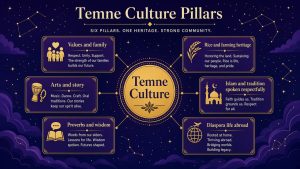
Supporting diagram — Course 1 educational graphic (Soul Journey of Life).
Lesson 5.1
Teaching-point outline
- Respect, hospitality, mutual obligation
- Intergenerational care
- Unity as practice, not slogan
Lesson body
Culture is not a costume box. It is the set of values that hold people together when money is short, when a child succeeds, when an elder dies, and when someone returns from overseas with a complicated heart. Among Temne communities—as in much of Africa—respect, hospitality, and mutual obligation are not slogans for posters; they are daily disciplines.
Respect shows in greetings, in how you enter a home, in how you speak about people who are not in the room. Hospitality shows in the plate offered to a visitor and in the time given to a stranger who arrives with a family name. Mutual obligation shows when relatives and neighbours organise around school fees, funerals, naming, and illness. None of these values means you must accept abuse or erase your boundaries; Module 4’s polite refusal belongs beside hospitality, not against it.
Intergenerational care keeps memory alive. Youth carry water, phones, and new skills; elders carry stories, land knowledge, and moral correction. A community that mocks its elders loses its mirror; a community that silences its youth loses its future. Soul Journey of Life teaches unity as practice: call someone, translate something, contribute transparently, correct a stereotype gently, learn a greeting properly.
Under night-sky violet branding, we say: many lives, one canopy. Values that hold Temne communities also speak to pan-African dignity—without pretending every African people is identical. Temne-specific practice is how the large sky becomes a home.
Reflection: name one value you already live, and one you will practise this month with a concrete act.