


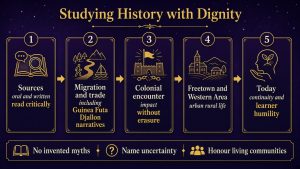
Supporting diagram — Course 1 educational graphic (Soul Journey of Life).
Lesson 3.1
Teaching-point outline
- Evidence, oral tradition, and humility
- Distinguishing well-attested patterns from speculation
- No invented origin myths
Lesson body
History can heal or it can harm. In Soul Journey of Life classrooms, history is a teacher: it strengthens identity when it is accurate, and it weakens community when it is invented for pride. This module offers an overview with careful framing—migration and trade narratives, colonial encounter, Freetown context, and the path from independence to today—without turning Temne past into a fantasy novel.
Three sources of knowledge sit at the table. Documentary and scholarly evidence (archives, careful histories, linguistics) help us see patterns that can be checked. Oral tradition—elders’ stories, family memory, community narratives—carries meaning, values, and local detail that books often miss. Humility is the third guest: it admits gaps, dates we do not know, and claims we cannot yet verify. Dignity grows when all three are honoured.
Learners must distinguish well-attested patterns from speculation. A well-attested pattern might be: Temne people are strongly associated with Sierra Leone’s Northern Province and Western Area; regional links toward Guinea appear in educational accounts of movement, trade, kinship, and faith. Speculation looks like: inventing a single founding hero, fabricating a precise migration year without sources, or inventing names of chiefs “to make the story complete.” This course forbids the latter.
No invented origin myths. Pride that rests on falsehood collapses when a child asks for proof. Pride that rests on truth, labour, language, and mutual care endures under the night-sky violet canopy. When you read blogs, videos, or chat rumours about Temne origins, ask: Who wrote this? What is the evidence? Does a living elder or serious source support it? If not, keep it out of your teaching voice.
Practice sentence: I will speak carefully about Temne history. Where I do not know, I will say I do not know—and I will keep learning.