


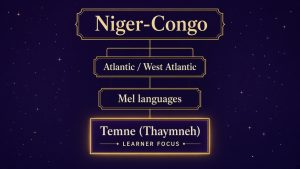
Supporting diagram — Course 1 educational graphic (Soul Journey of Life).
Lesson 2.3
Teaching-point outline
- Temne within Mel (West Atlantic) and broader Niger-Congo
- What “language family” means for learners
- Relatedness without overclaiming
Lesson body
Temne is discussed in this course as a Mel language (often grouped under West Atlantic labels in linguistic overviews) within the vast Niger-Congo family. You do not need a linguistics degree to use that framing. You need enough clarity to place Temne among Africa’s living languages—and enough humility to avoid overclaiming.
A language family is a scholarly way of saying that languages share deep historical relationships reconstructed by linguists—not that speakers automatically understand one another today. English and German are related; that does not make them interchangeable. Similarly, noting Mel / Niger-Congo relatedness helps learners see Temne as part of Africa’s linguistic architecture. It does not mean you can invent “sister phrases” from other languages and call them Temne. It does not mean every West African language is “basically the same.”
For beginners, the practical takeaway is threefold. First, Temne has its own sounds, orthography habits, and speech etiquette—you will practise those in Module 4 with instructor-verified phrases. Second, family labels fight the false idea that African languages are “dialects without structure.” Third, relatedness should inspire curiosity, not shortcuts: study Temne on Temne terms.
When online posts declare dramatic unique origins or deny any relationships, pause. Prefer careful educational summaries over viral certainty. Soul Journey of Life chooses accuracy over spectacle.
Next: complete the quiz that follows this lesson. Correct answers are scored in the quiz, not listed here.