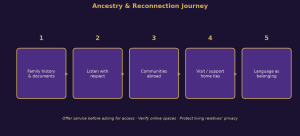
Supporting diagram — Course 1 educational graphic (Soul Journey of Life).
Lesson 6.1
Teaching-point outline
- What you already know
- Elders’ interviews (consent first)
- Documents, photos, oral stories
Lesson body
Reconnection begins with inventory, not with spectacle. Before you book flights or message distant DNA matches, write down what you already know: full names, nicknames, hometowns mentioned at funerals, languages spoken at home, faith communities, migration years, and the stories you are unsure about. Uncertainty deserves its own column. Soul Journey of Life prefers an honest incomplete map to a decorated false one.
Elders’ interviews are gold when done with consent first. Ask permission to talk and to take notes or record. Explain why you want the story. Offer to share the notes back. Accept “not today.” Prepare gentle questions: Where did our people live when you were young? What language did your parents love most? Who should I thank or greet if I visit? Avoid cross-examining trauma. Avoid arguing with memory using a website on your phone.
Documents, photos, and oral stories each have strengths. Passports, certificates, and letters can anchor dates. Photos open names. Oral stories carry meaning documents miss. Triangulate without declaring war on any single source. Store materials privately; digitise carefully; do not dump family archives into public groups without agreement.
Worksheet (copy into tutor lms downloadable or assignment)
| Field | What I know | Source | Still unsure | |——-|————-|——–|————–| | Family surnames / given names | | | | | Places in Sierra Leone named at home | | | | | Languages heard in childhood | | | | | Migration path (if any) | | | | | Elders to ask (with consent plan) | | | | | Documents / photos I can access | | | |
Fill this before Lesson 6.2. Bring humility as your main tool.