


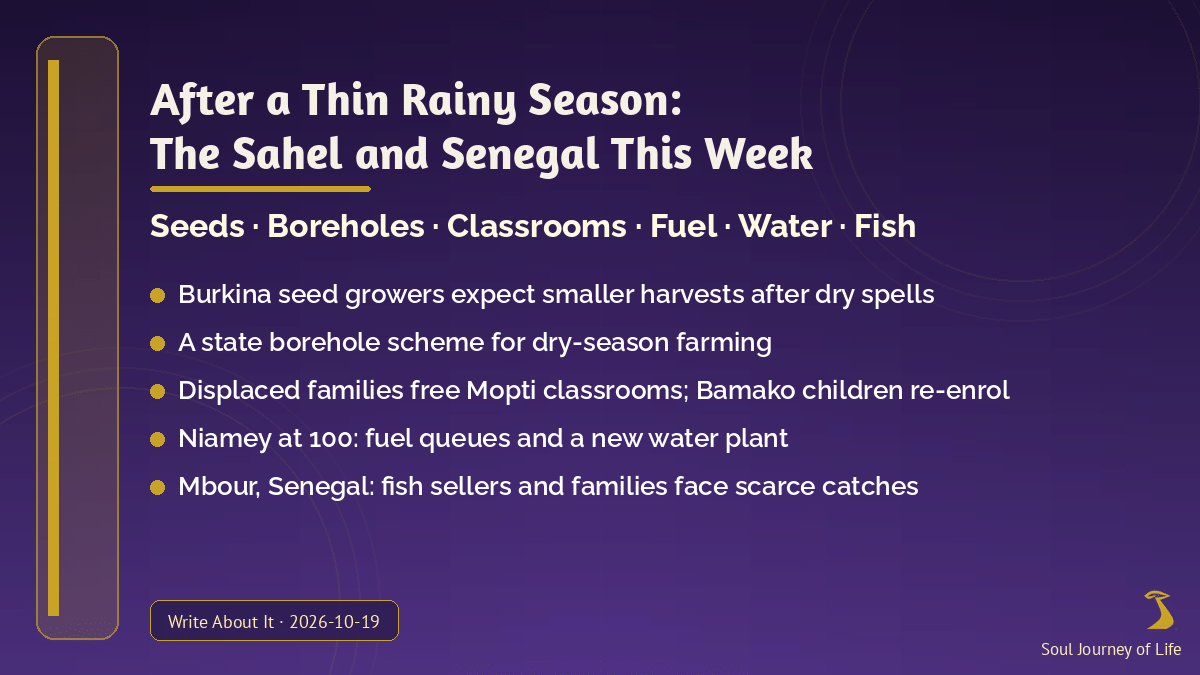

In the Sahel, October is when people find out what the rainy season really gave them. This year the rains came late and broke off in places, so the stories that matter most are about people making a short season stretch: farmers weighing smaller harvests, families settling children back into school far from home, and city dwellers queuing for fuel and waiting for water. Here is what local outlets reported over the past two weeks, with each claim left in the hands of the people who made it.
Burkina Faso: seed growers count the cost, and the state offers boreholes
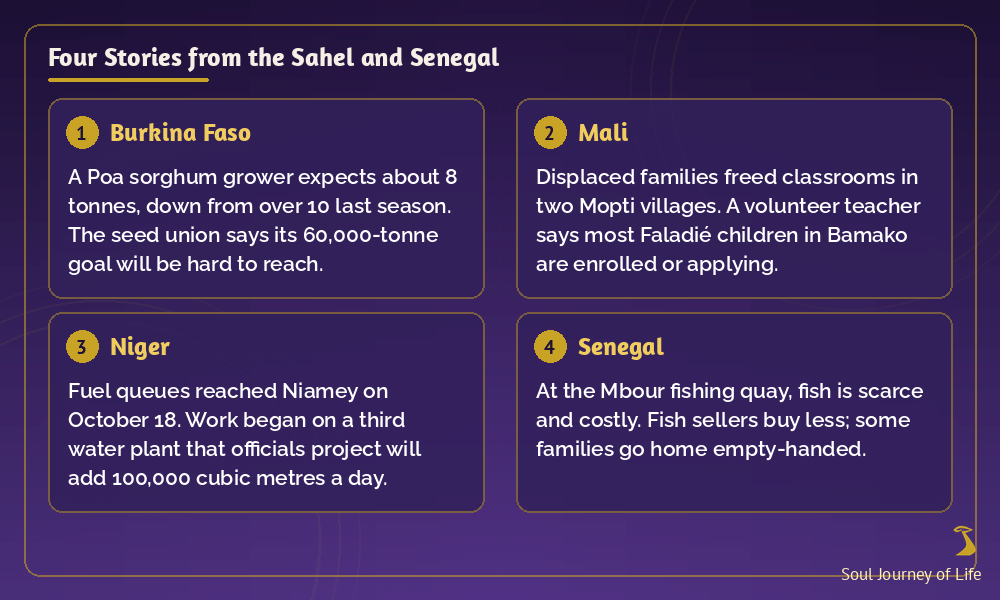
In the Nando region, the national union of seed-producing cooperatives (UNPS-B) toured farms to see how certified seed crops had weathered the dry spells, Faso7 reported on October 15. At Niakado, in the commune of Poa, Mathias Koala grows four hectares of sorghum. He harvested more than 10 tonnes from the same land last season and now expects about eight, because of weak rains. He asked for help finding buyers for his crop.
Nearby, at Mougounisi in Poa and at Salbisgo Dapoya in Ramongo, young farmers enrolled as agricultural Volunteers for the Defence of the Homeland (VDP) under a presidential food self-sufficiency initiative kept their cowpea, maize and okra plots going despite irregular rain; some participants had dropped out. The union’s president, Inoussa Ouédraogo, said that “on the whole, the seed sites are doing fairly well,” after a dry period of two to four weeks depending on the area. He admitted that the union’s goal of 60,000 tonnes of certified improved seed for the season will be hard to reach, and urged farmers to harvest quickly, limit post-harvest losses and plant again in the dry season. “Today, we must trust our research,” he said, pointing to Burkinabè seed varieties bred for shorter, less predictable seasons. Farther south, around Gaoua, Studio Yafa reported that a lack of rain in July and August had slowed the maize, and that while agricultural officials are hopeful now the rains have returned, some farmers still fear for their harvests.
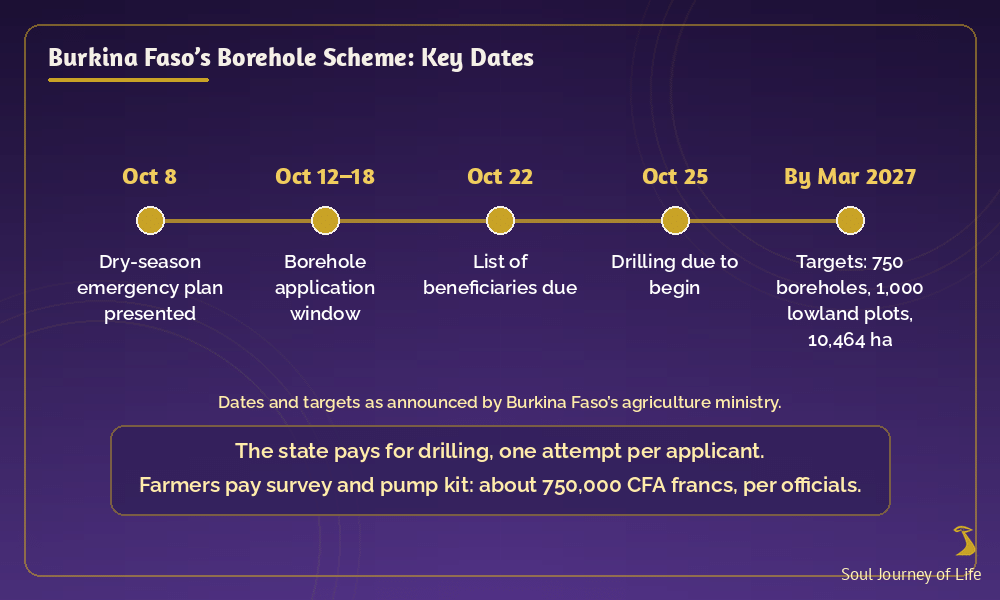
The government’s answer is water. On October 8, the agriculture ministry presented an emergency plan for the 2026–2027 dry season, estimated at nearly 255 billion CFA francs, the Burkina Information Agency (AIB) reported. By March 2027, the plan aims to drill 750 boreholes, equip 1,000 lowland plots and bring 10,464 hectares back into cultivation, with a longer-term goal of raising irrigated land from under 30,000 to 80,000 hectares by October 2027. These are government targets, not results.
Under the subsidised borehole scheme, the state pays for drilling, one attempt per applicant. Farmers must work at least two hectares, show secure land rights, and pay for the geophysical survey and the pump and solar equipment; officials put the farmer’s share at about 750,000 CFA francs, depending on the equipment chosen. Officials said smallholders, especially women with small plots, would get help applying at local agriculture offices. Applications closed on October 18. The ministry said the list of beneficiaries would be published on October 22 and that drilling would begin from October 25. Once the list is out, beneficiaries will have seven days to get their pump equipment and complete the survey; those who miss the deadline will be replaced by applicants from a waiting list, AIB reported.
Mali: classrooms freed, children re-enrolled, homes still uncertain
Families displaced by insecurity had been sheltering in classrooms at Djénédaga and Kouakrou, in the Mopti region. Before the school year began, they moved out so lessons could resume, Studio Tamani reported on October 13. In Djénédaga, the move was made possible by the village chief, Boyon Karabenta, and his councillors; some families found shelter in empty houses offered to them, while others are still in temporary lodging. Boubacar Thienta, a spokesman for the displaced families, said a site proposed for them at Médina Coura did not meet their needs. Most of the families are Bozo, a fishing people, and they want to live near the river that their work and way of life depend on.
In Bamako, families from the former displaced persons’ site at Faladié have scattered to outlying neighbourhoods such as Sirakoro and Mountougoula. Amadou Tamboura, a volunteer teacher, told Studio Tamani that the great majority of the children have been enrolled or have applications under way, but housing, transport and daily costs still keep some from attending regularly.
The scale behind these stories is large. According to official figures that Mali’s delegation presented to the executive committee of the UN refugee agency in Geneva, as reported by Bamako Matin, Mali counted 414,524 internally displaced people and was hosting 322,584 refugees and asylum seekers as of September 30, while 343,091 Malians were living as refugees abroad.
Communities are also being asked what local money should build. In Gao, on October 13, the urban commune and the rural commune of Gounzoureye presented projects they want paid for from mining funds, Studio Tamani reported. Gounzoureye asked for school latrines and the rehabilitation of the primary school at Goungoumali.
Niger: Niamey at 100, in the fuel queue and waiting for water
Niamey is marking 100 years as a capital, counted from a colonial decree of December 26, 1926, according to the city government, and a scientific conference on the city’s history, memory and future ran from October 13 to 15. Its recommendations, as reported by the Niger Press Agency (ANP), ranged from protecting historic sites during road and housing works to growing food in and around the city, speeding up a digital library and improving transport links between neighbourhoods.
The city’s residents spent the weekend in a more practical struggle. On Sunday, October 18, long queues formed at Niamey’s filling stations, and one motorist told RFI that some stations had begun limiting sales to 10 litres per person. “Filling up has become a battle,” he said. That is his account; no official rationing order has been announced. Le360 Afrique, citing AFP, also reported long queues at Niamey’s stations that Sunday, with one resident saying she waited from 9 p.m. to 3 a.m. to be served. Shortages had already hit Zinder and Maradi for weeks; in Maradi, residents told AFP that sales were capped at two litres for motorcycles and ten for cars, according to AfricActu. The Ministry of Commerce had published a list of stations that still had petrol, and those stations were quickly overrun.
Why does an oil-producing country run short? The former head of the national petroleum company, Sonidep, said Niger’s only working refinery, at Zinder, supplies about 1.6 million litres a day against national demand of about 3 million, RFI reported. Cheaper fuel smuggled from Nigeria once filled part of the gap but has become too expensive since Nigeria ended its fuel subsidies. On October 8, General Abdourahamane Tiani named Oumar Fatimata Marafa Salifou, a principal customs inspector, to lead Sonidep. General Tiani has rejected any rise in pump prices so as not to “worsen the cost of living,” RFI reported; after earlier cuts, the government says pump prices stand at 499 CFA francs a litre for petrol and 618 for diesel, and it has set up a technical committee. It also blames informal circuits and fraud for feeding the shortages, according to a Council of Ministers statement carried by ANP. That is the government’s account; no findings have been published.
Water is the other long wait. On October 6, Prime Minister Ali Mahaman Lamine Zeine launched work on a third drinking-water treatment plant for the capital at Karey Gorou, about ten kilometres from Niamey on the right bank of the river. According to ANP, the plant is designed to add 100,000 cubic metres a day, the works are planned to take 30 months at a cost of about 166 billion CFA francs, and the project includes 45,000 subsidised household connections meant to serve some 450,000 people. These are official projections; the World Bank is among the backers.
Elsewhere in Africa: Mbour waits for fish
On Senegal’s coast, the Mbour fishing quay is one of the country’s largest landing points, yet fish has become scarce and expensive, the Senegalese Press Agency (APS) reported on October 13. Fish seller Fatou Seck said she can now afford only small amounts, and only the smallest fish. Sokhna Diarra Lô, shopping for her family, went home empty-handed: “There is a terrible shortage of fish,” she said. She thinks heavy rain and bad weather have kept boats ashore. Fishers Babacar Ndiaye and Amadou Guèye blamed foreign industrial vessels, which they say overfish and use nets that kill young fish. That is the fishers’ view; APS did not report specific cases. In a recent interview with APS, fisheries engineer Ibrahima Lô said industrial fishing has a “globally negative” impact on coastal communities, and that industrial vessels moving into zones close to the coast are making species such as sardinella, horse mackerel and mackerel scarce.
What we can carry forward
- Trust the seed and the research. Shorter-cycle varieties bred at home are a farmer’s first defence against a short season.
- Put the water where the farmer is. A borehole is only as useful as the smallholder who can afford the pump.
- Keep the classroom open. A village chief who finds families another roof keeps a whole school going.
- Tell people the truth about scarcity. Whether it is fuel in Niamey or fish in Mbour, clear information helps people plan.
Soul Journey of Life — Write About It
All quotes are translated from French.
Sources
- Faso7: https://faso7.com/2026/10/15/campagne-agricole-dans-le-nando-les-producteurs-semenciers-restent-resilients-face-au-defi-de-la-faible-pluviometrie/
- Studio Yafa: https://www.studioyafa.bf/42331-gaoua-le-retour-des-pluies-redonne-espoir-aux-producteurs-apres-la-secheress
- Burkina Information Agency (AIB): https://www.aib.media/?p=169801
- Burkina Information Agency (AIB): https://www.aib.media/?p=169819
- Government of Burkina Faso via APO Group: https://www.africa-newsroom.com/press/burkina-faso–campagne-seche-20262027–le-gouvernement-mise-sur-lirrigation-pour-accroitre-la-production-agricole?lang=fr
- Studio Tamani: https://www.studiotamani.org/209029-personnes-deplacees-les-enfants-reprennent-lecole-les-familles-cherchent-encore-un-toit
- Bamako Matin: https://bamakomatin.com/geneve-le-mali-fait-le-point-sur-les-personnes-deplacees-et-refugiees/
- Studio Tamani: https://www.studiotamani.org/209056-gao-les-communes-devoilent-leurs-projets-sur-les-fonds-miniers
- RFI: https://www.rfi.fr/fr/afrique/20261019-niamey-la-capitale-du-niger-est-%C3%A0-son-tour-touch%C3%A9e-par-les-p%C3%A9nuries-d-essence
- Le360 Afrique: https://afrique.le360.ma/economie/niger-la-penurie-dessence-setend-a-la-capitale-niamey_4CDWDWIREZA7DCIOLHHM2KTJS4/
- Niger Press Agency (ANP): https://anp.ne/niger-le-gouvernement-annonce-des-mesures-pour-securiser-lapprovisionnement-en-produits-petroliers-et-prevenir-les-difficultes-alimentaires/
- AfricActu: https://www.africactu.com/economie/penurie-de-carburant-au-niger-la-sonidep-change-de-direction/
- Niger Press Agency (ANP): https://anp.ne/lancement-a-karey-gorou-des-travaux-de-construction-dune-3eme-usine-de-traitement-deau-potable-pour-desservir-la-ville-de-niamey/
- Journal du Niger: https://www.journalduniger.com/niamey-eau-potable-troisieme-usine-karey-gorou/
- Niger Press Agency (ANP): https://anp.ne/fin-des-travaux-du-colloque-scientifique-international-sur-le-centenaire-de-la-capitale-niamey-plusieurs-recommandations-formulees/
- City of Niamey: https://www.villedeniamey.ne/centenaire
- Senegalese Press Agency (APS): https://aps.sn/mbour-la-rarete-du-poisson-contrarie-pecheurs-mareyeurs-et-consommateurs/













You must be logged in to post a comment.