


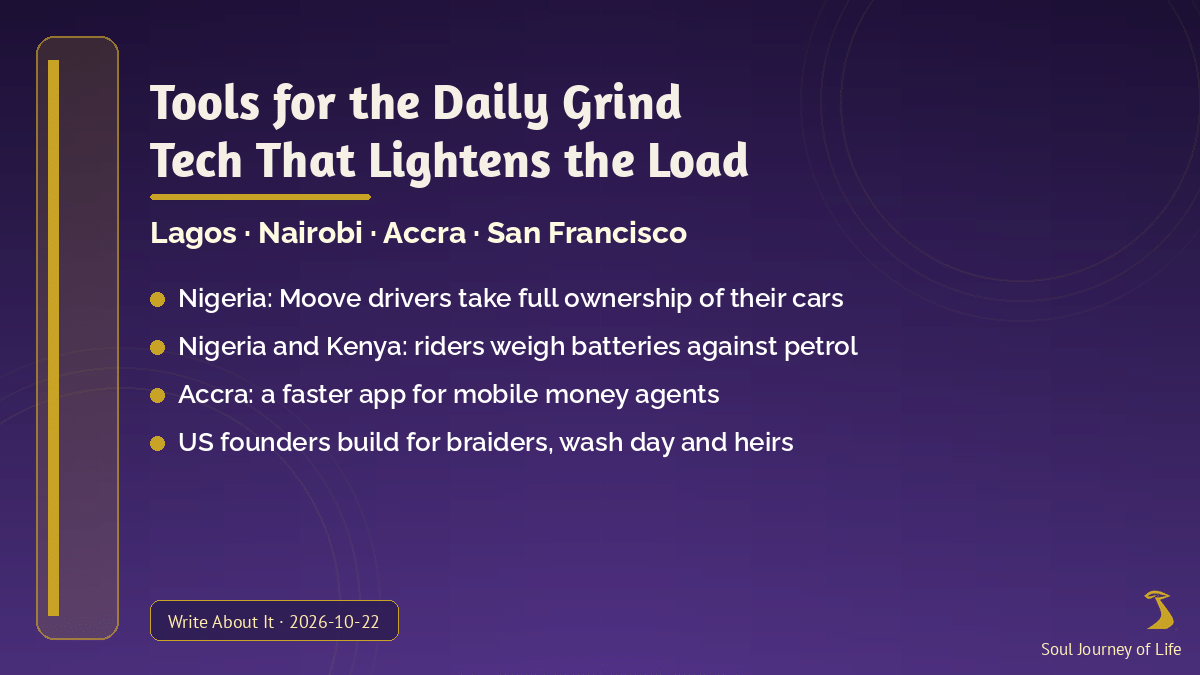

Tech news often follows the money: who raised what, and at what valuation. This week we follow the people doing the daily work. In Nigeria, drivers who spent years paying off their cars are being handed the keys for good. In Nigeria and Kenya, motorcycle riders are doing the sums on batteries against petrol. In Accra, a local software team says it can shorten the queue at the mobile money kiosk. And in the United States, founders building for braiders, wash day and grieving families, including Black women who say the industry overlooked them, took their tools to one of the country’s biggest startup stages. Different streets, one question: does this tool make a working person’s day lighter?
What is happening on the ground
Lagos and beyond: drivers take full ownership of their cars (Oct 8)
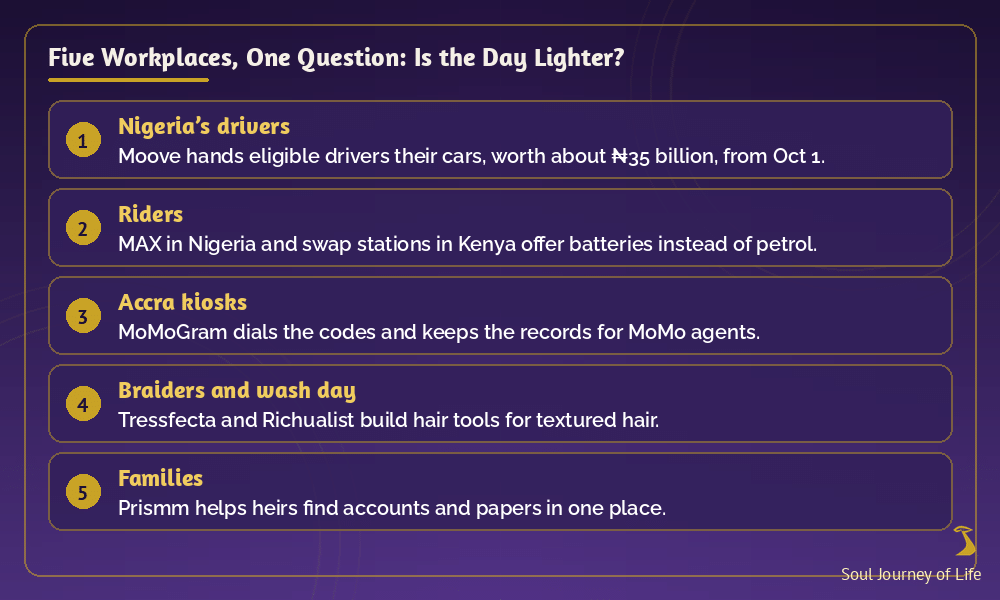
On 8 October, Moove, the vehicle financing company founded in Lagos in 2020 by Ladi Delano and Jide Odunsi, announced it was ending its Nigerian operations after six years. Moove rented and financed cars for ride-hailing drivers under a “drive-to-own” plan. According to the company, drivers currently operating eligible vehicles will take full ownership, with no further payment for the vehicles themselves from 1 October 2026. Moove puts the value of those cars at about ₦35 billion. It also said its Nigerian staff would each receive a car.
The exit came about a month after Uber, Moove’s main ride-hailing partner, shut down in Nigeria on 2 September. Delano told BusinessDay, as reported by Punch, that Uber’s departure “materially changed the operating environment,” and that Moove could not sustain its Nigerian model. The company says more than 9,000 customers used its drive-to-own and rental products in Nigeria and earned about ₦57 billion in revenue with Moove-financed cars. Those figures come from the company.
Drivers have their own view of those years. The Amalgamated Union of App-Based Transporters of Nigeria called the handover “an unprecedented act of corporate empathy” and told members: “You have officially moved from being lessees to being car owners.” Drivers quoted by Technext were relieved but cautious. The outlet reports that weekly payments rose sharply during the four-year contracts, a long-running complaint among drivers. “Every Moove driver is a hero,” one said. Another warned colleagues to read the terms carefully, saying some drivers who had recently paid large sums were still waiting for their cars. Business Post reports that payments owed from before 1 October must still be settled and that drivers must complete the transfer paperwork. Moove says it will contact affected drivers directly.
Lagos, Ibadan and Nairobi: batteries against petrol (Oct 4 to 15)
In Nigeria, petrol sold for about ₦1,350 to ₦1,409 a litre in Lagos and Abuja this month, and industry estimates cited by BusinessPress put fuel at 40 to 60 percent of a commercial rider’s daily earnings. That is the problem MAX says it is solving. The Lagos company, founded in 2015 by Adetayo Bamiduro and Chinedu Azodoh, lets riders it calls “Champions” pay to use an electric motorcycle and a swappable battery instead of buying either outright. Washington-based climate lender Nithio has now extended MAX’s latest funding round to US$29 million. Neither company disclosed the size of Nithio’s share.
MAX says it serves more than 60,000 riders in 20 cities across Nigeria, Ghana and Cameroon, and runs an assembly plant in Ibadan with a stated capacity of 3,600 vehicles a month. It says its electric bikes and solar-powered swap stations cut a rider’s energy and maintenance costs by more than 40 percent compared with petrol. These are company figures, and MAX has not published audited accounts.
In Kenya, riders described the same choice to Citizen Digital in early October. Morrice Kasamu, who rode a petrol motorcycle from 2015 before switching in 2024, said: “I did calculations on swap and fuel; I thought maybe swap would be cheaper.” A rider in Nairobi’s Kilimani area said he used to spend Ksh 1,000 on fuel and was “left with nothing” by evening. Now, he said, a Ksh 250 battery charge can earn him about Ksh 1,000. His complaint is coverage: swap stations stop around Thika, Machakos and Ngong, so he cancels trips as far as Naivasha. Cyrus Kuria in Ngong said lower running costs let him accept longer trips and win more customers. Not everyone is switching. James Melusori Lukumai said he will buy another petrol bike, and a young rider near Yaya Centre named Job said mechanics and spare parts for petrol bikes are easy to find anywhere. The Electric Mobility Association of Kenya counts about 64,840 electric motorbikes registered from 2023 to mid-2026. Petrol bikes still dominate Kenya’s roads.
Accra: a faster day at the MoMo kiosk (Oct 11)
Anyone who has waited at a mobile money stand knows the scene: a queue, a long dial code entered again and again, and a worn notebook where the agent writes down every transaction. Octagram Tech, a Ghanaian software company based in Madina, Accra, has released MoMoGram, an Android app for MoMo agents on MTN MoMo, Telecel Cash and AirtelTigo Money. The agent enters the amount and the customer’s number and confirms with their own PIN. The app dials the code, picks the right network’s SIM, and saves the record.
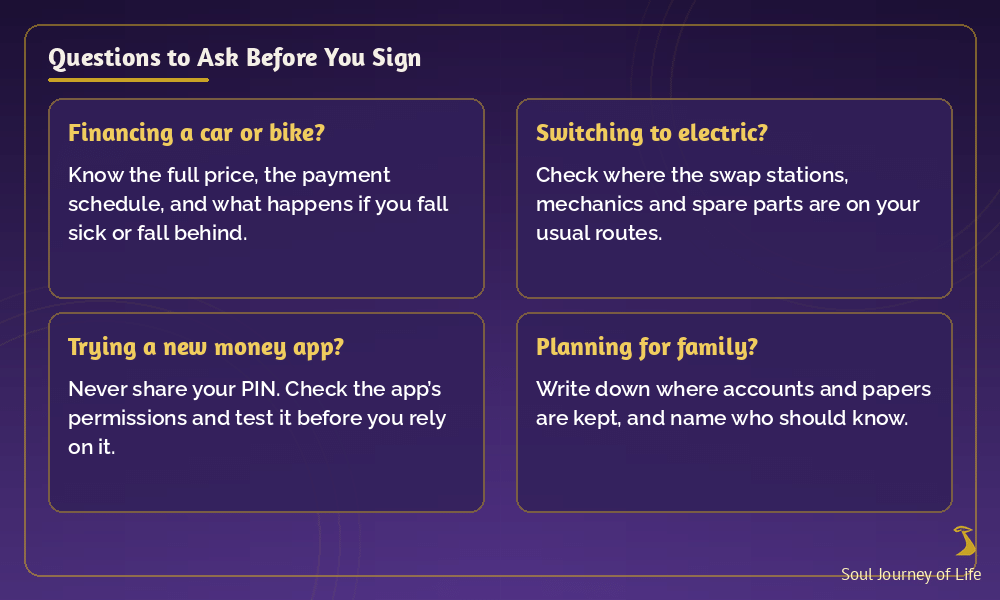
According to the company, MoMoGram lets agents work “up to 20 times faster,” warns them when a number has been reported by other agents for fraud, keeps track of float, cash and commission, and works offline because those dial codes do not need mobile data. Octagram says the app never asks for or stores the agent’s PIN. It is free for 30 days and then costs GHS 7 a month. These are the company’s own claims, reported in a launch article. Agents should test the app themselves and check its permissions before they rely on it.
San Francisco: tools for braiders and wash day (Oct 11 to 16)
At TechCrunch Disrupt in San Francisco this month, two women founders brought textured hair to the stage as part of the Startup Battlefield 200. Aisata Diallo, 24, says she has braided all her life and ran a braiding business while studying at Northeastern University in Boston. She stopped because of the physical toll, she told TechCrunch: a single style can take eight hours, and many braiders suffer cramping and carpal tunnel syndrome. Her company, Tressfecta, is building Plait Pilot, a device that separates braiding hair from the pack into the sizes a stylist sets and hands the pieces back while she works. The tool is still a prototype, and Diallo is bootstrapping with grants and accelerator support while she prepares to raise money.
Dawn Myers, founder of Richualist and, by her own account, one of the first 100 Black women to raise more than US$1 million in venture funding, built Mint, a tool that detangles, conditions and styles textured hair in one stroke using refillable product pods. She says it brings styling time down to about seven to 10 minutes. Myers told TechCrunch she sold her home and cashed out her retirement savings to fund early development, and closed a funding round while being treated for stage three colorectal cancer. A Shark Tank deal with Mark Cuban and Emma Grede followed, then a listing on Ulta’s website. “There are no people who look like me in those R&D suites,” she said of early meetings with the beauty industry. “We really do need bespoke technology.”
On the Disrupt stage: keeping a family’s money in the family (Oct 14)
Prismm, founded in 2020 by sisters Martha Sylla Underwood and Shella Sylla, pitched as one of the Top 20 finalists in Disrupt’s Startup Battlefield on 14 October. TechCrunch reports that the idea began in 2017, when their father was hospitalised in Miami and no one in the family knew where the important papers were. Prismm’s software lets bank and credit union customers name the family members who can see their accounts and documents, so that when the account holder dies, heirs can find everything in one place and start eligible transfers without a paper chase.
“Black families lose more than money when an account holder dies without the institution knowing the heirs,” Underwood said in a statement from the company. “They lose the relationship, the history, and sometimes the house.” The company says it is live and has several credit unions lined up to join. Prismm did not reach the five-company final. The overall winner was Intero Biosystems.
Lessons we can carry
- Read the contract before you sign for the car. Moove’s handover is good news for many drivers, but the years before it show why every driver should know the full price, the payment schedule and what happens if they fall sick or fall behind.
- Count the whole cost, not just the fuel. Kenyan riders show that batteries can save money, but only where swap stations, mechanics and parts are close by. Ask before you switch.
- Small tools for big queues matter. A faster kiosk app or a hair-separating machine will not make headlines like a billion-dollar deal, but it can give back hours to the people who serve us every day.
- Plan the handover. Prismm’s founders learned the hard way. Write down where your accounts and papers are, and name who should know.
Encouragement
This week, ask a driver, a rider, a braider or a mobile money agent what would make their working day easier, and listen. Then sit down with one elder in your family and write down where the important papers are kept. Technology is at its best when it lightens the load of the people who carry us.
Watch: how smoothly Moove’s vehicle transfers go for Nigerian drivers; whether new swap stations reach Kenyan towns beyond Nairobi’s edge; whether MAX publishes audited results; and whether Tressfecta’s Plait Pilot makes it from prototype into salons.
Sources
- Punch on Moove’s exit and vehicle transfer
- The Guardian Nigeria on Moove’s exit
- Technext on the drivers’ union statement
- Technext on drivers’ reactions
- Business Post on the transfer terms
- BBC on Uber leaving Nigeria and Uganda
- BusinessPress on MAX and Nithio
- TechBuild Africa on MAX’s funding and rider costs
- Citizen Digital on Kenya’s electric boda bodas
- GhanaNews24 on MoMoGram
- TechCrunch on Tressfecta
- TechCrunch on Richualist and Dawn Myers
- TechCrunch on Prismm
Soul Journey of Life — Write About It. Conscious. Constructive. United.
Recommend0 recommendationsPublished in Write About It












You must be logged in to post a comment.