




Jamilah Conteh Speaks — Wednesday, October 21, 2026. From Freetown, Sierra Leone: Ebola reaches West Africa again with a confirmed case in Abuja, and Sierra Leone keeps its screening up; Burkina Faso protects its strategic state companies and mills its own rice; Ghana sets 2030 for keeping raw ores at home; Dave the Potter’s jar comes to Hampton; and two Write About It posts on music without borders and a thin rainy season — ten minutes of SJOL News.
Today’s rundown
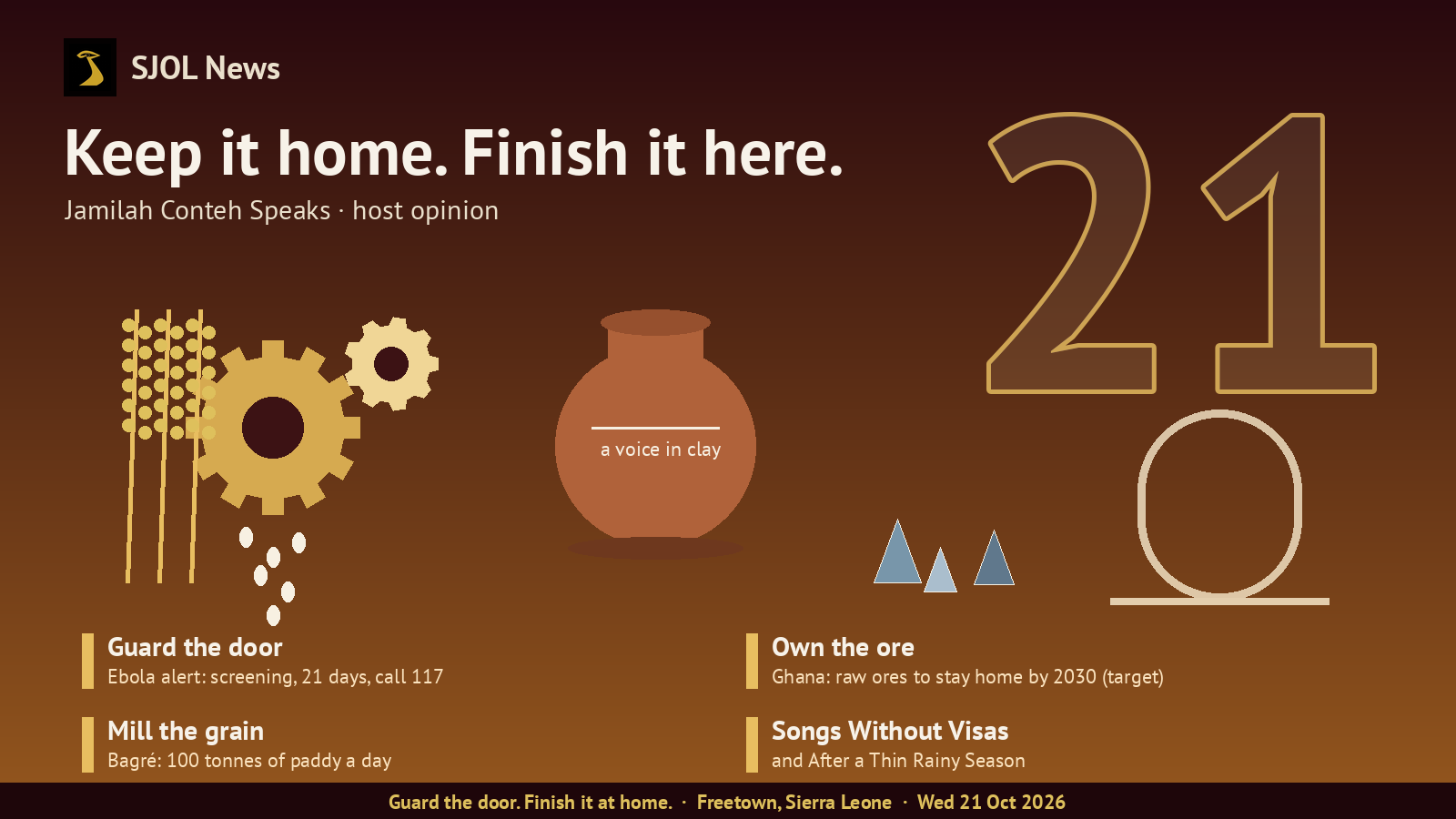
0:00 — News lead: Ebola at West Africa’s door. Per a statement from Nigeria’s Federal Ministry of Health and Social Welfare (20 October), Nigeria confirmed one case of Ebola disease in the Federal Capital Territory: a woman who recently arrived on an international flight from Uganda, now in isolation, with 44 close contacts identified so far. Per the Associated Press, as carried by NPR, Africa CDC Director General Jean Kaseya said “we are facing an extremely serious threat” and that this Bundibugyo outbreak “has already become the most geographically extensive in history.” Home desk: Per Sierraloaded (19 October), even before the Abuja case, Sierra Leone’s National Public Health Agency strengthened screening at Freetown International Airport and official land borders; travellers from affected areas should monitor their health for 21 days, and anyone who falls sick after travel or contact should call 117. AES progress: Per APA News (20 October), Burkina Faso’s Legislative Assembly on Monday 19 October passed a law banning the full or partial privatization of strategic state-owned enterprises, with 70 votes in favour and one abstention; the list of protected companies will be set by decree. Ghana desk: Per Citi Newsroom (19 October), President John Mahama told the Mining in Motion Conference that “by 2030, raw mineral ores should no longer leave our shores,” naming bauxite, manganese, iron and lithium. Per MyJoyOnline (29 September), citing JoyNews Research, the 2030 deadline is not yet written into law, and Ghana has no law yet requiring minerals to be processed in the country.
1:30 — Platform support. Sourced news costs time and care: donate, subscribe, and invite one person who still believes we can build at home, at Soul Journey of Life.
2:00 — Channel sparks (attributed, fair use — watch the originals).
- Make Afrika Great — “[TRAORE STUNS COWARDS] Burkina Faso Unveils 100 Tonns/day Rice Factory Without” (title as published; “stuns cowards” is the channel’s framing). On the record, per Sidwaya and APA News, Prime Minister Rimtalba Jean Emmanuel Ouédraogo inaugurated the public rice mill at Bagré on Tuesday 20 October, with a capacity of 100 tonnes of paddy rice a day; it is managed by the state company Faso Agropôles and was funded entirely from the state’s own resources. Per Burkina24, he invited Burkinabè to keep producing and consuming Burkinabè (translated).
- Zack Mwekassa — “GHANA REJECTS $109M US MONEY TO PROTECT ITS PEOPLE’S HEALTH DATA”. The rejection is real but not new: per Graphic Online (12 October), Cabinet rejected the proposed $109 million health compact in April; at a town hall in Goaso, President Mahama said Washington is now seeking amendments and the possible removal of some clauses, and that Ghana will stand firm on its sovereign rights.
- The Kings Monologue — “Egyptology… pretending Kush doesn’t exist for 30 mins” (the critique is his). For context, per Wikipedia’s entry on the Kingdom of Kush, Kush was centred in what is now northern Sudan and southern Egypt; the Kushite king Piye invaded Lower Egypt and established the Twenty-fifth Dynasty, and Kushite monarchs ruled Egypt for over a century.
4:00 — Culture, tech & spirit. Per Hampton University’s announcement (20 October), the Hampton University Museum is receiving the loan of a stoneware vessel by David Drake, known as “Dave the Potter,” from his descendants. Born into slavery in Edgefield, South Carolina, he made an estimated 40,000 jars and defied anti-literacy laws to inscribe his name and poems on them. The artist Theaster Gates transferred the jar to Drake’s heirs in May 2026; it is being unveiled at a private Homecoming reception on 21 October and stays on view through May 2027. His fourth great-grandson Yaba Baker, a Hampton alumnus, said his alma mater is the first HBCU to show a Drake jar, adding, “Our ancestor left something for his family to find – a voice, a connection, a way to know him.” Per Kachwanya (19 October), Nairobi-based Neural Labs Africa won US$5,000 in equity-free funding at the inaugural Meta AI Academy Kenya Pitchathon for NeuralSight, an AI-powered tele-radiology platform that links facilities with remote specialists; per the company its models can run locally where connectivity is weak, and no clinical validation results have been published yet. Per APA News (21 October), The Gambia retained the Jollof rice crown at the West Africa Food Festival (WAFFEST) in Banjul, beating Ghana, Nigeria, Sierra Leone and Liberia among others. Opinion: Salone, we cook again next year.
5:30 — Your ad goes here! This spot is open for businesses and causes that serve our people with dignity: your shop, farm, clinic or school, placed small and clean in front of African and Diaspora families. Advertise with us — see how to place your ad on The Light Dome.
6:00 — Write About It + SJOL take. Fresh this morning: Songs Without Visas (the Ivorian singer Meiway in Kinshasa: “We cross borders with our songs without visas,” per the Congolese Press Agency as cited, translated — the post labels his wish for visa-free travel a hope, not a policy; Miriam Makeba as the sole performer at the founding conference of the Organisation of African Unity in 1963, per curator Nancy Dantas as cited; and the ACCES music conference in Johannesburg, 28–31 October). Also fresh: After a Thin Rainy Season (a Burkinabè sorghum grower who harvested more than 10 tonnes last season on four hectares now expects about eight, per Faso7 as cited; a dry-season plan of nearly 255 billion CFA francs aiming at 750 boreholes by March 2027, per the Burkina Information Agency as cited, which the post labels targets, not results; displaced families in Mali’s Mopti region freeing classrooms so lessons could resume, per Studio Tamani as cited; and long fuel queues in Niamey on 18 October, per RFI and AFP as cited). Jamilah’s take (opinion): a mill needs paddy, and paddy needs water — sovereignty is a chain, and every link is a farmer.
8:00 — Closing opinion. From Freetown: we have met this enemy before — per the WHO, as cited by the AP, the 2014–2016 West African outbreak killed 11,000 people. No panic, no rumours: wash your hands, respect the screening, call 117 if you fall sick after travel, and treat the sick and the traveller with dignity. Ghana, by its president’s word, wants its ore processed at home and its health data protected; Burkina Faso keeps its strategic companies and mills its own rice. A promise is not a law, and a target is not a harvest — watch the follow-through. Black America: Dave the Potter wrote his name in clay, and his family is bringing his work home; bring your money, skills and stories home too, here and on the continent. Young people: learn a trade that finishes things. Guard the door. Finish it at home. (Opinion.)
Support the platform. Keep sourced, Pan-African news free — donate, subscribe, and invite a friend: souljourneyoflife.org
Your ad goes here! Advertise with us. Reach African and Diaspora families with a small, clean placement on Soul Journey of Life. See ad placement details on The Light Dome →
Jamilah Conteh Speaks is SJOL News’ daily noon brief from Freetown, Sierra Leone. Every quote and factual claim is attributed on air; opinion segments are labeled. Full source list available on request.
Recommend0 recommendationsPublished in Perspective, Write About It











You must be logged in to post a comment.