



A robot can dance at a party, greet visitors, or stack parts in a factory. The harder question comes after the applause: who programs it, who repairs it, who sets the rules, and who benefits? In recent weeks, students in Kenya showed they are learning to program and even build humanoid robots. African governments and partners kept pushing for AI that speaks African languages. At embassy receptions in Angola and Congo, Chinese robots provided the entertainment, and analysts asked what Africa gains beyond the show. And in South Korea and at Tuskegee University in Alabama, people are working on the rules and safeguards for machines that share space with us. The thread running through it all: a machine is only as good as the people who keep it.
What is happening on the ground
Nairobi: learning the machine up close (Sept 30 to Oct 5)
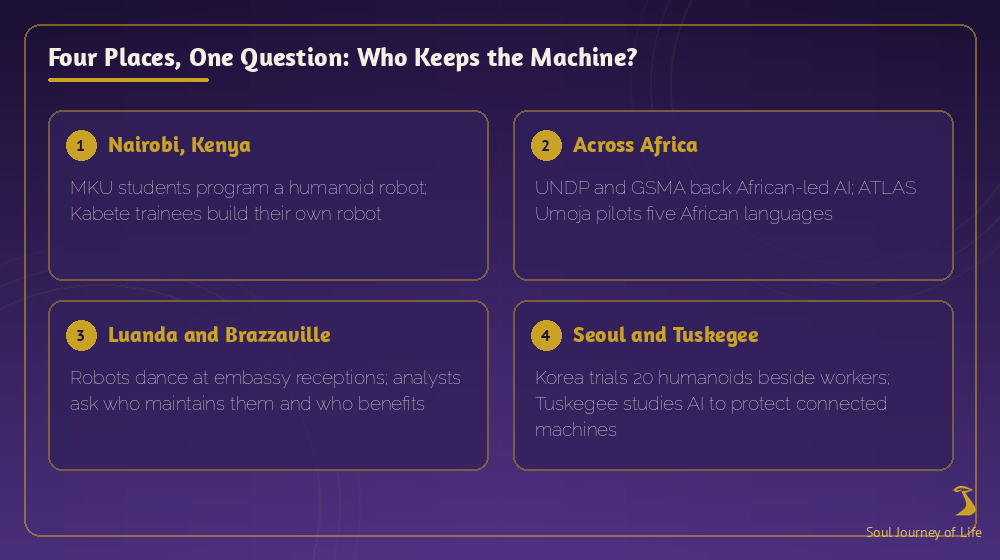
At the Nairobi International Trade Fair, the Agricultural Society of Kenya’s show at Jamhuri Park, two Kenyan institutions brought their robots to the public. The Daily Nation reported on 5 October that, according to Elena Mwai, Coordinator of AI, Digital Transformation and Emerging Technologies at Mount Kenya University (MKU), students are getting hands-on practice with a Walker S2 humanoid robot that cost the university about Sh20 million. That cost is her figure, and the Nation is the only source for it. MKU also names the robot as a Walker S2, though The Star’s coverage of the lab’s launch in November 2025 called it a Walker E. Per UBTECH’s product page, Walker S2 is one of the Chinese robot maker’s models. Students program it to respond to speech, move, and pick up objects. Per MKU, the robot is part of its Robotics, AI and Immersive Technologies Lab, opened late last year, and the university now offers a Bachelor of Science in Artificial Intelligence and Data Science.
Mwai also gave a warning that every African builder should hear. “If you want AI to give you the right answers for Kenya, you need Kenyan data,” she said. Systems trained on other countries’ soils, weather, and farming can give advice that does not fit a Kenyan farm. She told researchers to double-check AI answers too, because it “can give you papers that do not exist.”
At Kabete National Polytechnic, according to the Daily Nation, lecturer David Ochieng showed the Kabete Poly-TVTBOT, a general-purpose robot that the polytechnic built itself. Trainees in its Industrial Automation and Robotics course, which began about three years ago, help assemble and program it from servo motors, circuit boards, cameras, and microphones. Ochieng said it could greet visitors, share information with students, or help with career guidance. “We are trying to show our trainees that this is something we can build locally,” he said. He was honest about jobs as well. Work that once took 10 secretaries might need only one or two people to supervise the system, he said, but “AI is not here to replace human beings. It is here to support people,” he added.
Across Africa: AI that speaks our languages (Oct 2)
On 2 October, the United Nations Development Programme (UNDP) and the GSMA, the global association of mobile operators, announced a partnership to scale African-led AI, including AI in African languages. Working through UNDP’s timbuktoo initiative, they plan to improve access to computing power for priority AI pilots, connect African talent with real-world projects through university innovation hubs and AI labs, and help locally built tools reach the people who need them.
Per the GSMA, the partnership builds on ATLAS Umoja AI, launched in Abuja in July 2026 with the digital ministries of Benin, Kenya, Namibia, Nigeria, and Togo, along with African partners such as Awarri, Zindi, and Pawa AI. ITWeb Africa reports that its first pilot models cover Amharic, Malagasy, isiZulu, Pulaar, and Kiswahili. “Africa’s AI future must be shaped by its own talent and reflect the languages and needs of its communities,” said Angela Wamola, GSMA’s Head of Africa, per the joint press release. UNDP’s Officer-in-Charge and Regional Director for Africa, Aissata De, said the continent “has the talent and creativity to shape the future of artificial intelligence.” These are announcements for now. The real test is whether a grandmother in Antananarivo or a farmer in Senegal’s Fouta Toro can soon ask a question in their own language and get a useful answer.
Luanda and Brazzaville: robots as diplomacy (Oct 1 to 10)
At receptions for China’s National Day on 1 October, robots took the stage. Per Forum Macao, citing the Chinese embassy in Luanda, its event for about 400 guests included a robot dance demonstration, followed by a local orchestra playing Chinese and Angolan pieces. In Brazzaville, per the SCMP, nearly 400 guests, including Congolese officials, watched a robot dog performance. The South China Morning Post asked on 10 October whether these shows will turn into business deals in Africa. Per the SCMP, Ambassador Zhang Bin called the industry “a small snapshot of the Chinese economy’s move towards innovation and higher-quality development.”
According to a Korean-language summary of that report by Global Economic, analysts see the robots as marketing China as a technology partner, not as products for sale that night. They also pointed to real limits: labour in many African countries is cheap, robots are expensive up front, and there are few trained engineers to install and maintain them. Georgetown University’s Bulelani Jili is reported as saying that the key question for Africa is not how impressive the robots are, but who maintains these systems locally and who actually benefits. Unless investment in African research and engineers comes with them, he warned, the displays may stay one-off shows.
Seoul and Tuskegee: rules and safeguards for machines beside people (Oct 9 to 13)
On 13 October, South Korea’s trade and industry ministry approved a regulatory trial for robot maker Robros to put 20 two-legged humanoid robots to work at four companies, Yonhap and the Seoul Economic Daily reported. The robots will clean semiconductor parts at Nepes, place car body parts at Sungwoo Hitech, stack scaffolding brackets at the HD Hyundai Samho shipyard, and handle cold-chain packaging at Delivery Lab. Per Yonhap, Korea’s safety rules were written for robots fixed in place behind safety fences. This trial lets humanoids move in spaces shared with or next to workers, but only after a labour ministry risk assessment and safety measures are in place. It is a test to gather data for new safety standards, not permission for general commercial use. Robotics professor Han Jae-kwon of Hanyang University told the Seoul Economic Daily, in its English edition, that what matters is expanding the tests and gathering data on how skilled workers move. In other words, the robots are learning from people’s skill. Yonhap adds that the ministry is drafting a standard to stop “AI washing,” where products with little or no real AI are advertised as AI.
In Alabama, according to its news release, Tuskegee University announced on 9 October a three-year, US$449,999 grant from the National Science Foundation to study how AI can protect cloud-connected “cyber-physical” systems from attack. Computer science chair Dr. Fan Wu said these systems show up every day “in smart homes, robotics used in surgery and in manufacturing, and the energy grids that power our communities.” Connecting machines to networks and the cloud creates new risks. The project, led by Dr. Mohammad Rahman, will look at how AI can head off and stop attacks before they interrupt services or endanger the public. Per the university, the grant will open more research opportunities for students, and it launched a doctoral program in Information Systems and Computer Security last spring.
Lessons we can carry
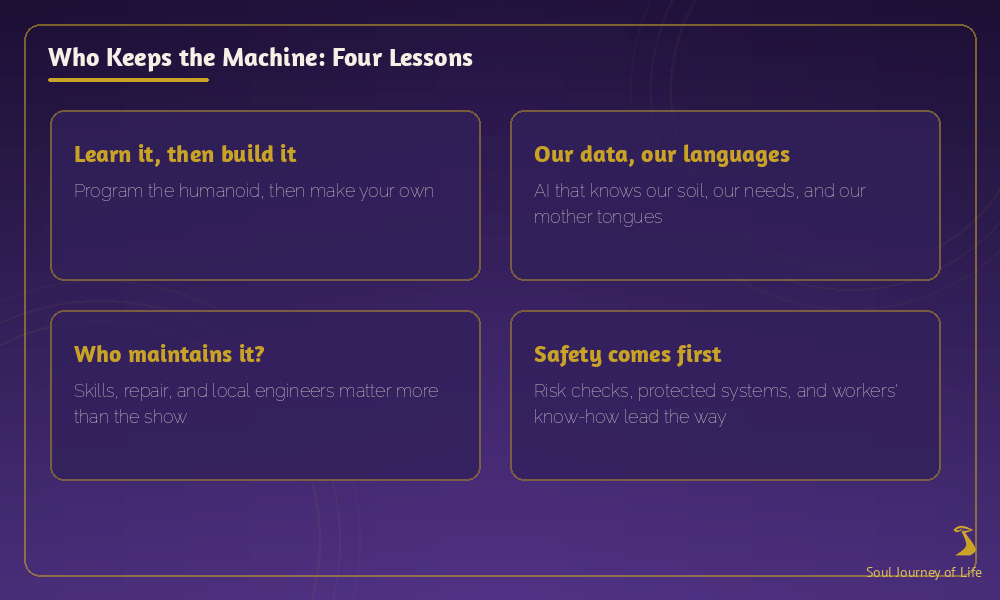
- Learn it, then build it. MKU students program a humanoid. Kabete trainees build their own. The goal is not only to use imported machines but to understand and make them.
- Our data, our languages. AI gives the right answers for Kenya only with Kenyan data, and it serves more Africans when it speaks the languages they use every day, from Kiswahili and isiZulu to Pulaar, Amharic, and Malagasy.
- Ask who maintains it and who benefits. A dancing robot is a show. Skills, repair work, and local engineers are the real deal.
- Rules and safety come first. Korea tests humanoids only with a risk assessment, and Tuskegee trains people to defend connected machines. Workers’ safety and know-how should lead, not follow.
Encouragement
This week, encourage a young person to visit a polytechnic or university lab, record a story or a proverb in your mother tongue, and when someone shows you a new robot, ask the kind questions: who built it, who fixes it, and who does it serve? If your workplace brings in new machines, ask about safety checks and training. Technology becomes a blessing when our people hold the keys.
Watch: results from Korea’s Robros factory trial and the new safety standards it informs; the first ATLAS Umoja and UNDP-GSMA pilots in African languages; whether China’s robot showcases bring training and engineering jobs to Africa; and the first student research from Tuskegee’s new project.
Sources
- Daily Nation on Mount Kenya University and Kabete National Polytechnic
- The Star on the launch of MKU’s robotics and AI lab (November 2025)
- Mount Kenya University on its robotics and AI lab
- UNDP on its partnership with the GSMA
- ITWeb Africa on the UNDP and GSMA partnership and ATLAS Umoja
- GSMA on the launch of ATLAS Umoja AI in Abuja
- South China Morning Post on China’s dancing robots in Africa
- Global Economic summary of the SCMP report (Korean)
- Forum Macao on the Chinese embassy reception in Angola
- Seoul Economic Daily on Korea’s humanoid factory trial
- Yonhap on the Robros trial and the AI washing standard (Korean)
- Tuskegee University on its NSF grant
Soul Journey of Life — Write About It. Conscious. Constructive. United.
Recommend0 recommendationsPublished in Write About It











You must be logged in to post a comment.