



On Monday, 12 October, the United States marks Columbus Day, and many states and communities now mark Indigenous Peoples Day on the same date. It is a fitting moment to remember a Black thinker who challenged the old story that history in the Americas began when European ships arrived. Fifty years ago, in 1976, Ivan Van Sertima published They Came Before Columbus: The African Presence in Ancient America. In this edition of our reminders and teachings from Black thinkers, we honor the man, share what he gave us and speak honestly about the debate his boldest claims started.
A Son of Guyana Who Spoke to the World
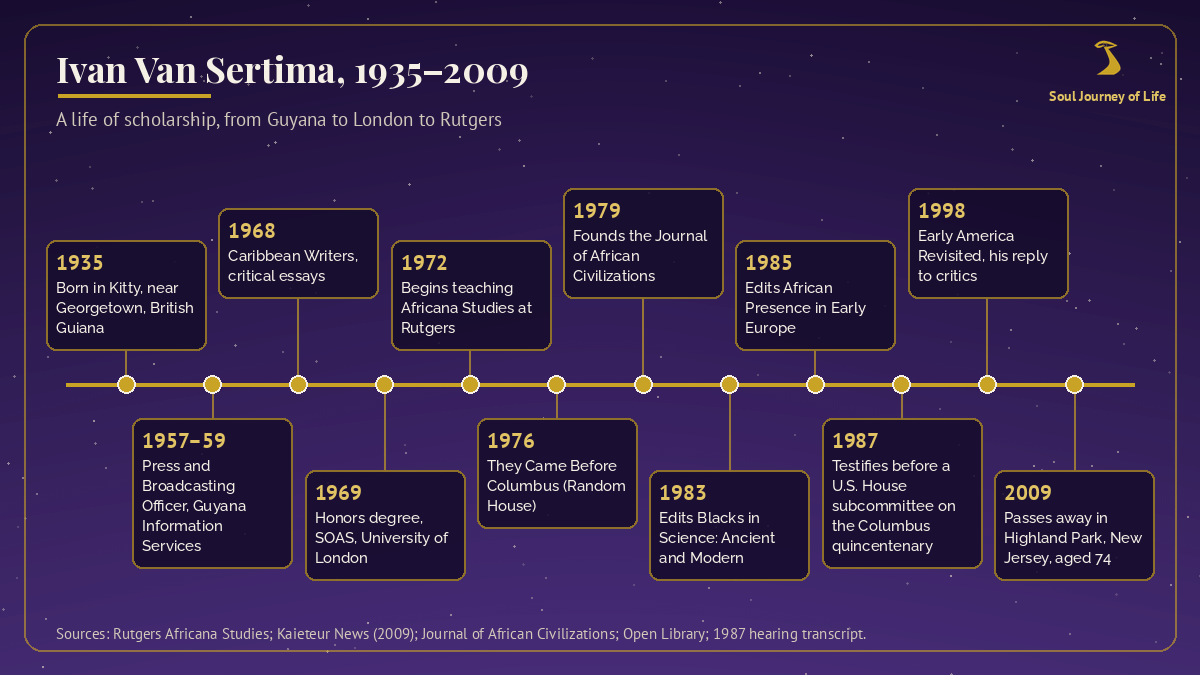
Ivan Van Sertima was born on 26 January 1935 in Kitty, near Georgetown, in what was then the colony of British Guiana. After serving as a Press and Broadcasting Officer in the Guyana Information Services from 1957 to 1959, he went to London, broadcasting weekly to Africa and the Caribbean through the 1960s. He studied African languages and literature at the School of Oriental and African Studies, University of London, and graduated with honors in 1969. Fieldwork in Tanzania produced his dictionary of Swahili legal terms, and Caribbean Writers (1968) gathered his critical essays.
In 1970 he came to Rutgers University in New Jersey for graduate study, and from 1972 he taught Africana Studies there for more than 30 years. He passed away at his home in Highland Park, New Jersey, on 25 May 2009, aged 74.
A Life’s Work: Recovering the African Story
When he died, his colleagues in Rutgers Africana Studies wrote that he had dedicated his professional life to telling “the true story of the African, to recover the essence of his early civilizations so that the tragedy of slavery, colonization, of myths about his fundamental inferiority may be destroyed forever.”
They Came Before Columbus, published by Random House, became a bestseller and was still in print decades later. It argued that Africans had crossed the Atlantic long before 1492 and had influenced the peoples of ancient Mexico, starting with the Olmec. In 1981 it received the Clarence L. Holte Prize, given for work on the cultural heritage of Africa and the African diaspora.
In 1979 he founded the Journal of African Civilizations and served as its editor. Its themed volumes, which the journal says influenced multicultural curriculum in the United States, include Blacks in Science: Ancient and Modern (1983), African Presence in Early Europe (1985), Black Women in Antiquity, Egypt Revisited, Golden Age of the Moor and Great African Thinkers, on Cheikh Anta Diop.
Blacks in Science shows his gift at its best. Beside chapters on Great Zimbabwe, the Yoruba number system and the inventor Lewis Latimer, it carried “Steel-Making in Ancient Africa,” on the Haya people of Tanzania, a story with strong evidence behind it: in 1978 the journal Science published research by Peter Schmidt and Donald Avery showing that the Haya and their forebears, 1,500 to 2,000 years ago, practiced an advanced iron smelting technology based on preheating principles and produced carbon steel.
The Mali Voyage: An Account Worth Knowing
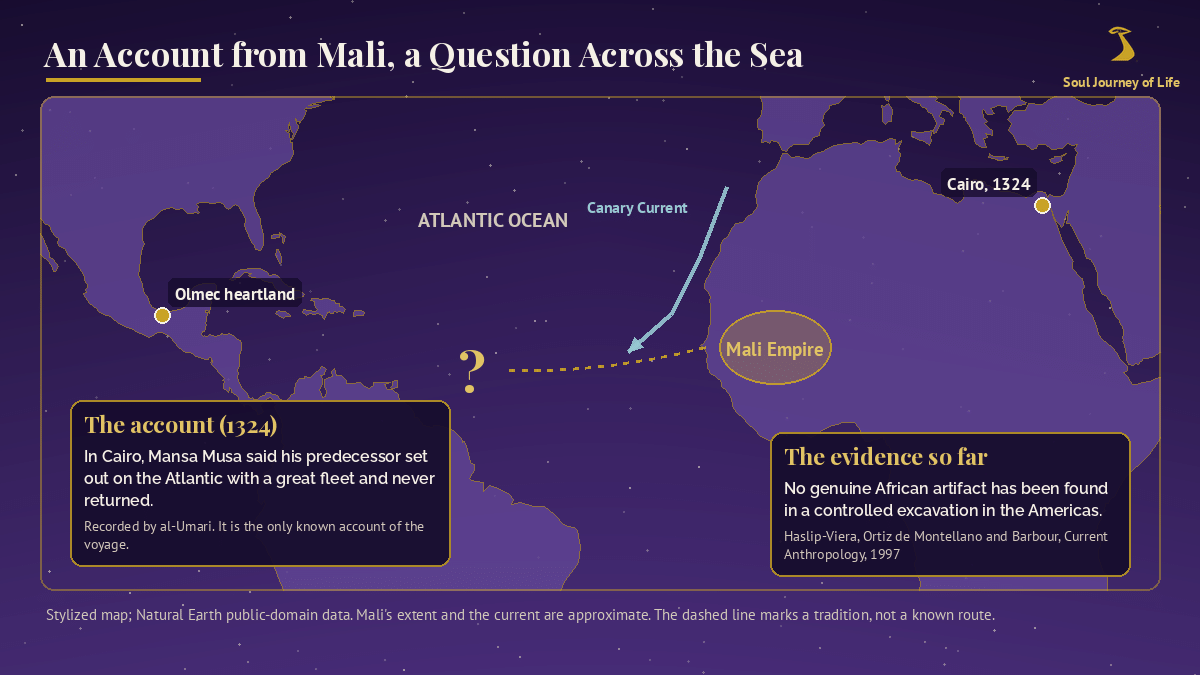
One story Van Sertima drew on comes from the Mali Empire. In 1324, while in Cairo on his pilgrimage to Mecca, Mansa Musa told the emir Ibn Amir Hajib how he became king. His predecessor, Musa said, “did not believe that it was impossible to discover the furthest limit of the Atlantic Ocean.” He sent out 200 ships of men and as many again with supplies, and only one ship came back. Then he set out himself with 2,000 ships and was never seen again. The emir later passed the story to the scholar al-Umari, who wrote it down.
It is a powerful account of African curiosity and courage, and the only known account of the voyage. The ruler is often called Abu Bakr II, but al-Umari gives no name, and that name traces back to a 19th-century mistranslation; Ibn Khaldun names Musa’s predecessor as Muhammad ibn Qu. Van Sertima believed the fleet reached the Americas. No evidence has shown where it went, so we hold the story as a tradition: precious, but unproven.
Honest About the Debate
Respect for a teacher includes hearing his critics. In 1997 the journal Current Anthropology published a detailed review by Gabriel Haslip-Viera, Bernard Ortiz de Montellano and Warren Barbour titled “Robbing Native American Cultures: Van Sertima’s Afrocentricity and the Olmecs.” They concluded that his proposal was “devoid of any foundation.” They wrote that “no genuine African artifact has ever been found in a controlled archaeological excavation in the New World,” that the Olmec colossal heads were carved hundreds of years before the visitors he proposed, and that the theory “diminishes the real accomplishments of Native American cultures.” His Olmec claims are not generally accepted by archaeologists and anthropologists, and the great stone heads of Veracruz and Tabasco are thought to portray Olmec rulers. Van Sertima answered his critics in Early America Revisited (1998).
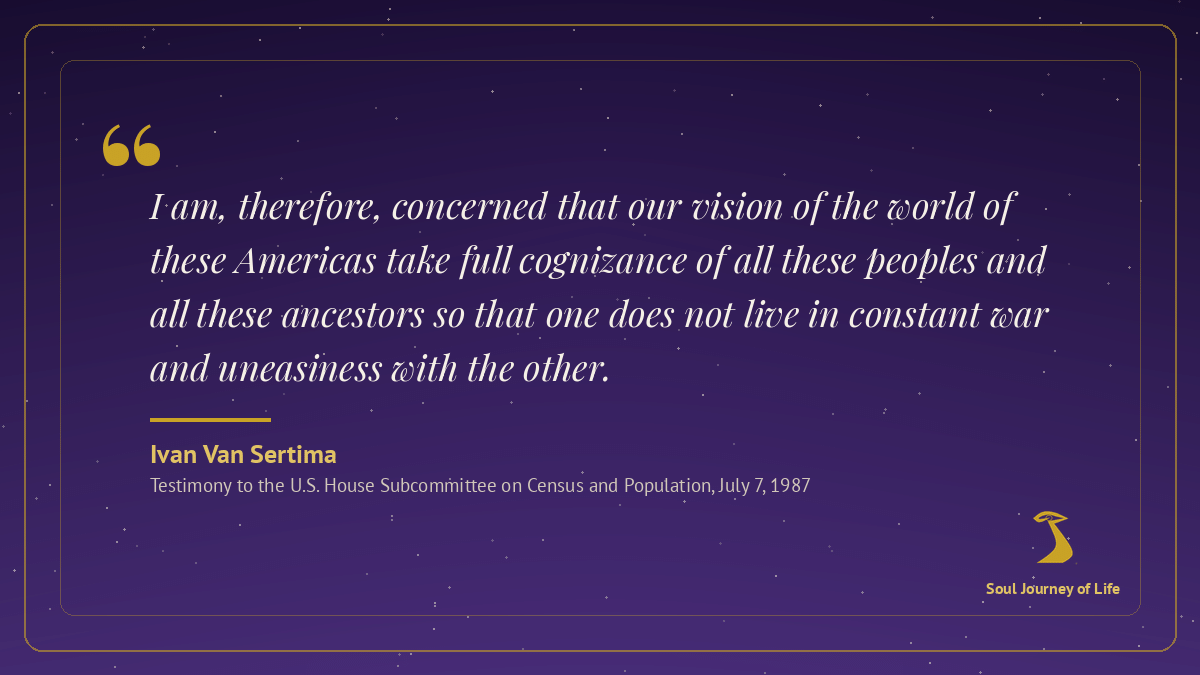
Van Sertima himself pointed toward a way to hold all of this together. Testifying before a U.S. House subcommittee on 7 July 1987, he described himself as “largely African” but also Native American, with Macusi ancestry. He said that calling Columbus’s journeys “voyages of discovery” insulted the Native American side of him.
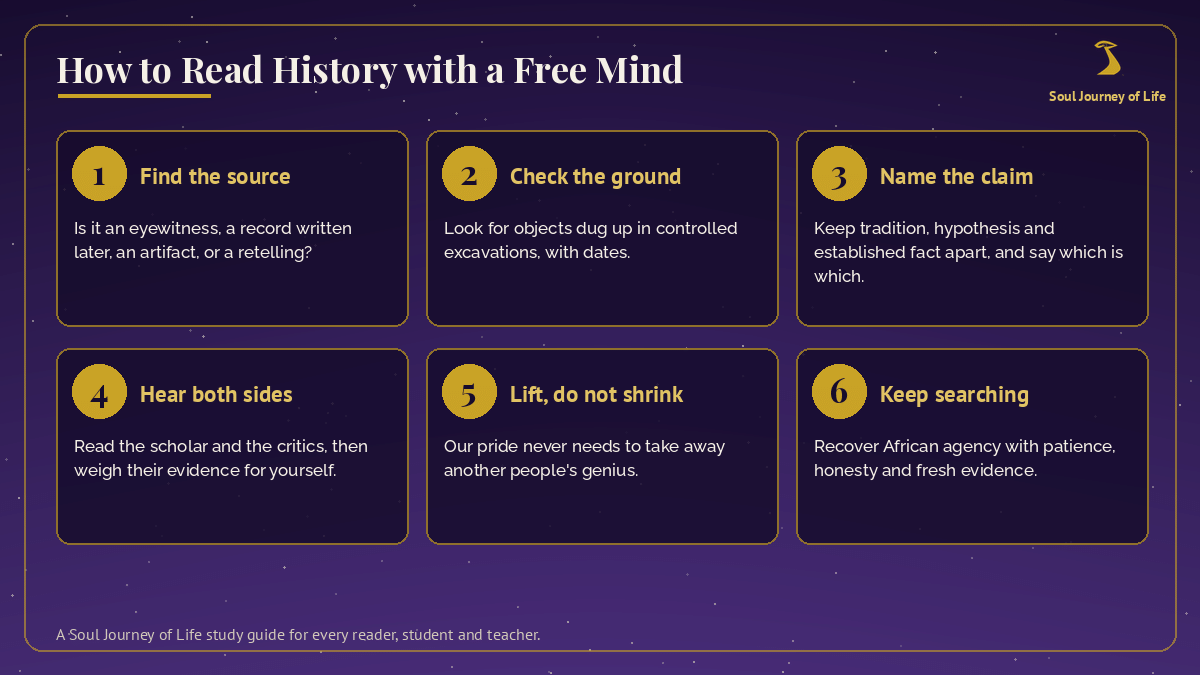
How to Read History with a Free Mind
Lessons to carry from his work and the arguments around it:
- Find the source. Is it an eyewitness, a later record, an artifact or a retelling?
- Check the ground. Objects from careful, dated excavations carry great weight.
- Name the claim. Keep tradition, hypothesis and established fact apart, and say which is which.
- Hear both sides. Read the scholar and his critics, then weigh the evidence.
- Lift, do not shrink. African pride never needs to take away another people’s genius. The Olmec and Maya built wonders of their own.
- Keep searching. His deepest call stands: recover African agency, and do it with patience, honesty and fresh evidence.
Watch: Ivan Van Sertima – They came before Columbus
A Teaching That Lives On
Fifty years on, Ivan Van Sertima still reminds us that our ancestors were thinkers, builders, sailors and scientists, and that we need no one’s permission to look for them. His critics remind us that truth is honored best with evidence. This Monday, honor the first peoples of these lands and the African story, and read every history, even the ones we love, with an open heart and a careful mind. Tell us in the comments which Black thinker first taught you to question the story you were given.
Sources
- Rutgers University, Department of Africana Studies: In Memoriam, Dr. Ivan Van Sertima (1935–2009)
- Kaieteur News: Guyanese Dr. Ivan Van Sertima passes at 74 (29 May 2009)
- Journal of African Civilizations: Dr. Ivan Van Sertima
- Haslip-Viera, Ortiz de Montellano and Barbour, “Robbing Native American Cultures: Van Sertima’s Afrocentricity and the Olmecs,” Current Anthropology 38(3), 1997
- Schmidt and Avery, “Complex Iron Smelting and Prehistoric Culture in Tanzania,” Science 201, 1978
- Statement of Ivan Van Sertima, House hearing on the Christopher Columbus Quincentenary Jubilee Act, 7 July 1987 (as republished in The Journal of Pan African Studies, 2012)
- Big Think: Mansa Musa and the mythical African king who sailed to America
- Wikipedia: Atlantic voyage of the predecessor of Mansa Musa (with al-Umari’s account)
- Wikipedia: Olmec colossal heads
- Open Library: They Came Before Columbus (Random House, 1976)
- Pew Research Center: Columbus Day, Indigenous Peoples Day or just a regular Monday? (2025)
- YouTube: Ivan Van Sertima – They came before Columbus











You must be logged in to post a comment.