



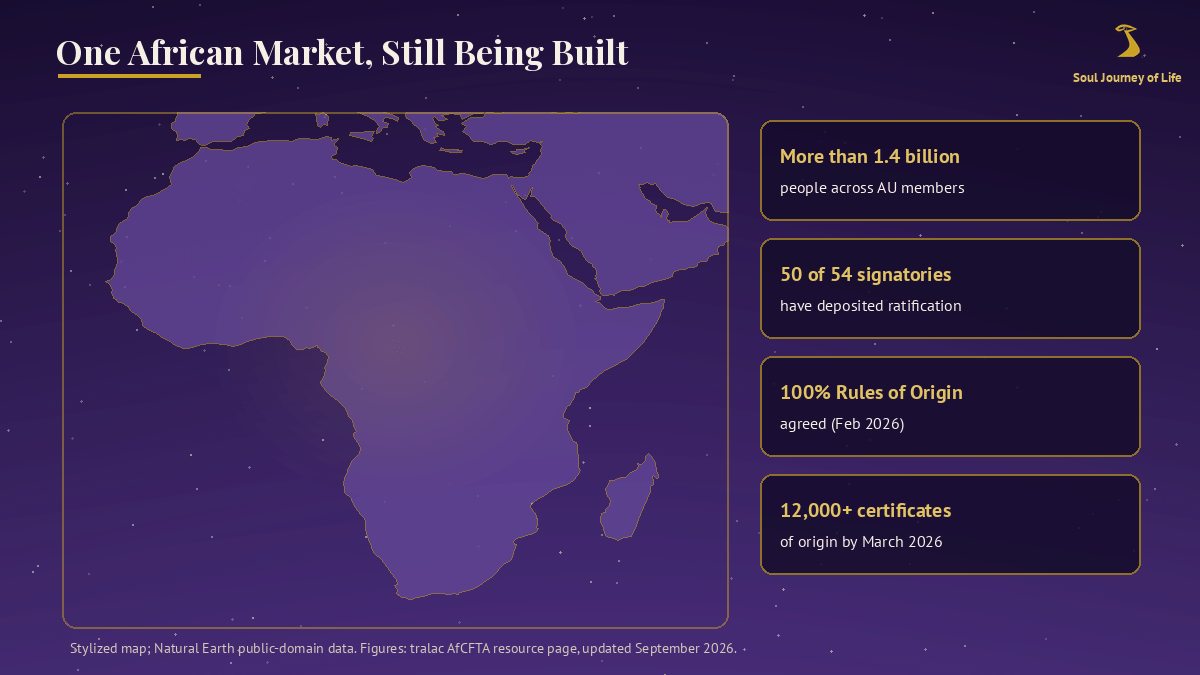
For years, Africa’s continental free trade story lived in negotiation halls. In 2026, the harder work is in warehouses, ports, certificates of origin and the corridors that either carry cargo or send it on a long detour. The African Continental Free Trade Area (AfCFTA), a flagship of the African Union’s Agenda 2063, aims to bind a market of more than 1.4 billion people into one trading space. The question of this season is no longer only whether leaders can sign. It is whether goods can move.
A Market Large Enough to Matter
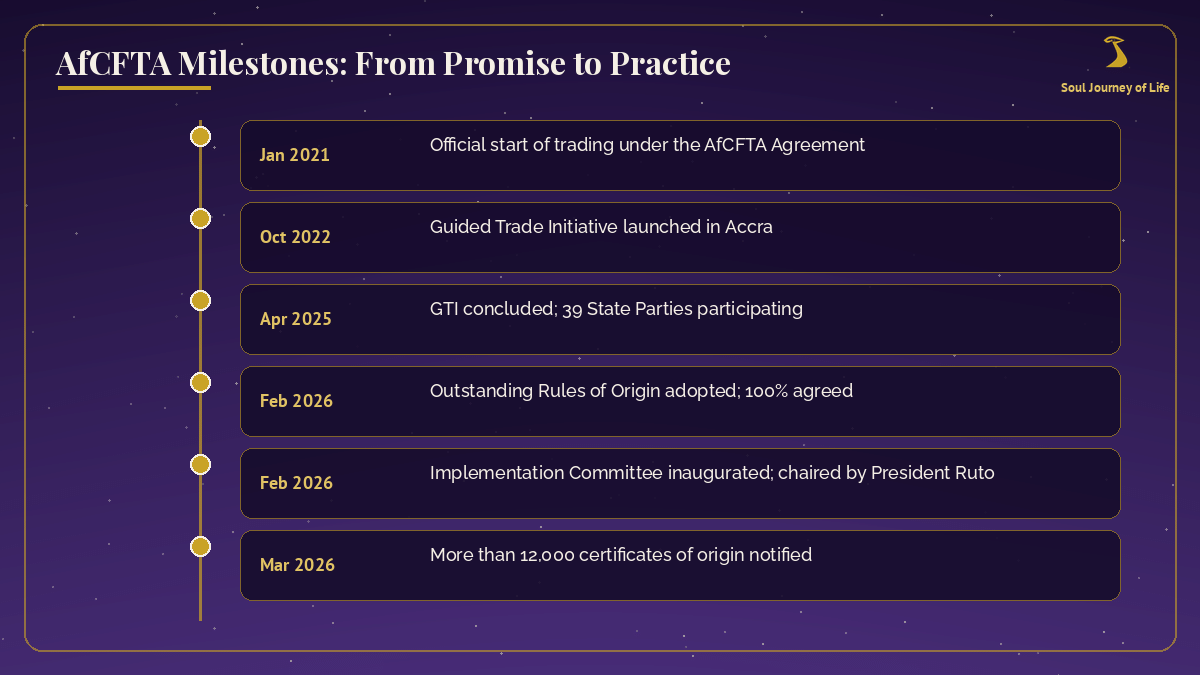
As at end-September 2026, according to tralac’s AfCFTA resource page, 50 of the 54 signatories have deposited their instruments of ratification with the African Union Commission Chairperson. Benin, Libya, South Sudan and Sudan are yet to approve ratification. Eritrea has not signed the consolidated text. Trading under the Agreement was set to begin officially on 1 January 2021. The Guided Trade Initiative (GTI) launched in Accra on 7 October 2022 to help early movers trade under AfCFTA rules; it concluded in April 2025 with 39 State Parties participating by its close.
Paper progress is real. Forty-eight tariff offers have been verified by the AfCFTA Secretariat. As of March 2026, South Africa’s Department of Trade, Industry and Competition (DTIC), in a newsletter hosted via tralac, reported that 25 countries had started preferential trade on 90 percent coverage of tariff books. In February 2026, the African Union Assembly adopted the outstanding Rules of Origin on Automotive and Clothing and Textiles, which means 100 percent of Rules of Origin are now agreed. As of March 2026, more than 12,000 certificates of origin had been issued and notified to the Secretariat. Those certificates are not ceremony. They are the paperwork that lets a shipment claim the preferential tariff.
From Negotiation to Implementation
On 14–15 February 2026 in Accra, on the sidelines of the 39th Ordinary Session of the AU Assembly, the AU Heads of State and Government Committee on Implementation of the AfCFTA was inaugurated. It is chaired by Kenya’s President William Ruto. tralac describes the Committee as a high-level platform meant to accelerate the shift from negotiations to full implementation, monitor progress and keep political support behind measurable trade and industrial outcomes.
That language matters. A free trade area lives or dies in customs posts, standards labs, payment rails and truck parks. Completing Rules of Origin for every sector, verifying tariff offers and issuing certificates of origin are the unglamorous steps that turn a dream of unity into a commercial fact a small exporter can use.
The Connectivity Gap Behind the Deal
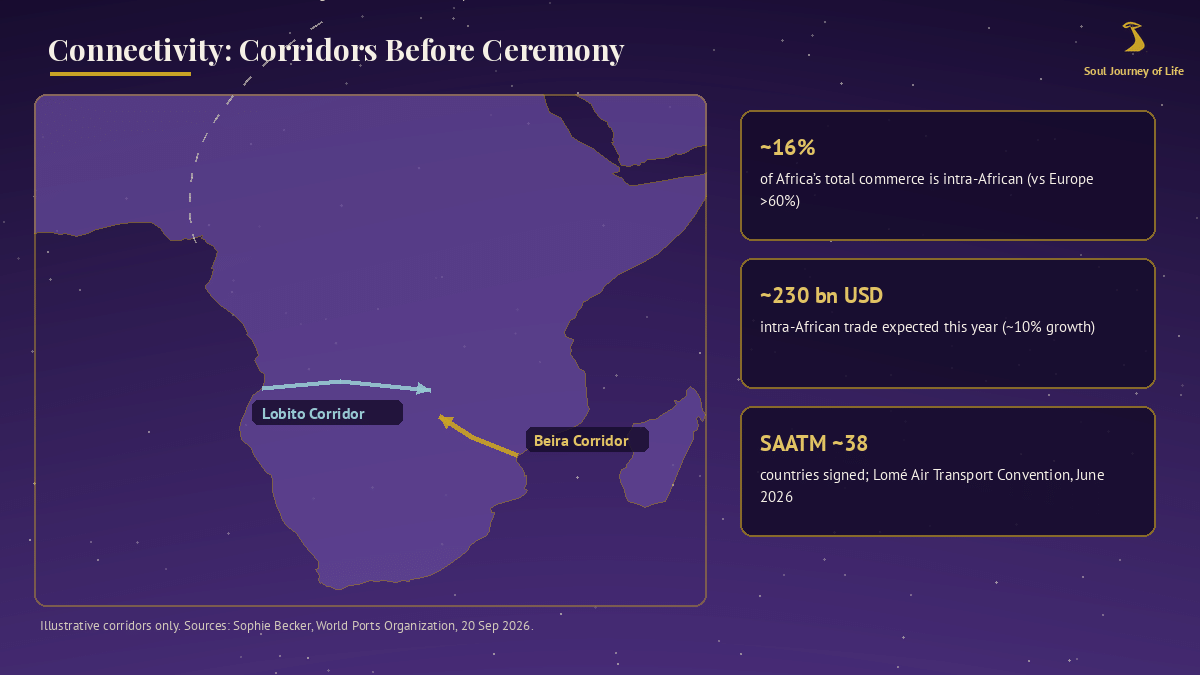
Rules alone do not move crates. Writing for the World Ports Organization on 20 September 2026, Sophie Becker reported that intra-African trade is expected to grow by around 10 percent this year, reaching close to 230 billion U.S. dollars, yet still accounts for roughly 16 percent of Africa’s total commerce. In Europe, trade among neighbouring countries makes up more than 60 percent of the total. Cargo bound for a nearby African country, she notes, often has to route through Europe or the Middle East first, adding time and cost.
There are bright spots. Becker points to improved structure on the Beira Corridor serving landlocked markets such as Zimbabwe, Zambia and Malawi, and to the Lobito Corridor reshaping logistics for Southern Africa’s mining sector between the Democratic Republic of the Congo, Zambia and the Atlantic. In the air, around 38 African countries have signed up in principle to the Single African Air Transport Market (SAATM). In June 2026 in Lomé, Togo, ministers and industry leaders gathered for the first African Air Transport Convention and adopted a declaration and action plan to accelerate SAATM and regional cargo corridors.
Decisions, Not Dusty Declarations
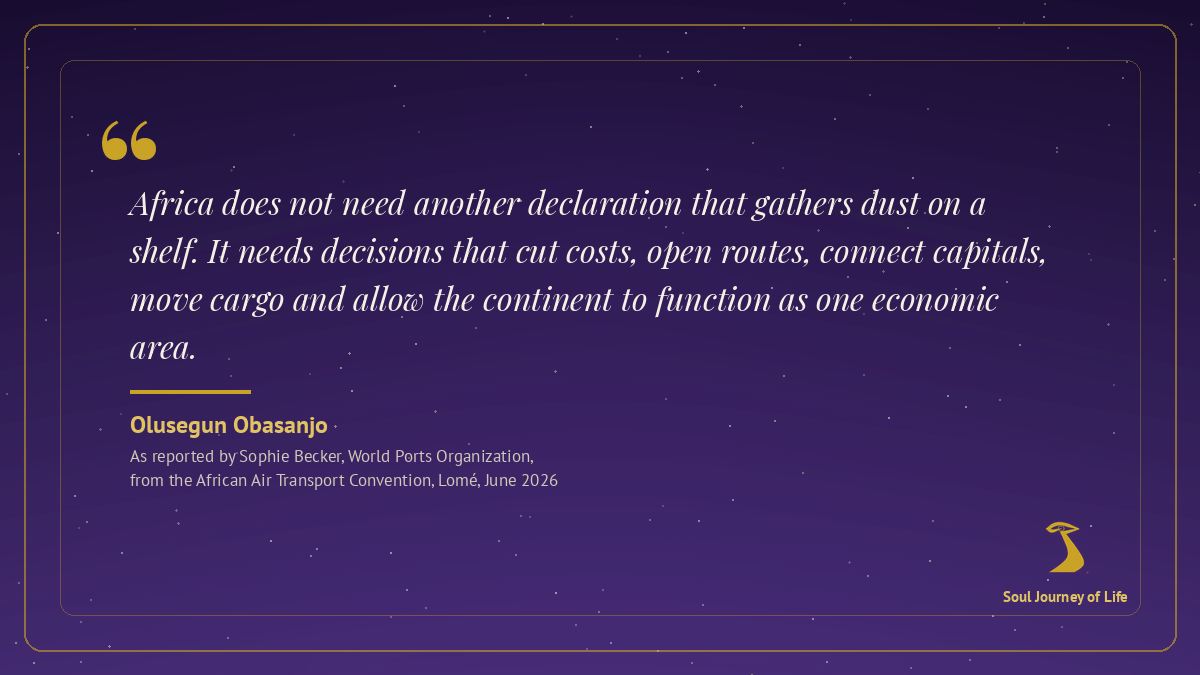
At that Lomé gathering, former Nigerian president Olusegun Obasanjo put the challenge bluntly. As reported by Sophie Becker for the World Ports Organization, he said Africa does not need another declaration that gathers dust on a shelf. It needs decisions that cut costs, open routes, connect capitals, move cargo and allow the continent to function as one economic area.
Separately, Ambush Business Nigeria and other outlets reported in June 2026 that AfCFTA Secretary-General Wamkele Mene said the continental trade bloc was on course to achieve an annual intra-African trade volume of 250 billion U.S. dollars in 2026, up from 220 billion recorded in 2025. That is a target and a statement from the Secretariat’s leadership, not a completed year-end result. World Ports’ mid-September reporting of trade “close to” 230 billion expected this year sits in the same conversation: momentum is real, and the gap to a fully connected market remains wide.
Looking further ahead, tralac cites UNECA’s Economic Report on Africa 2025 projection that a successful AfCFTA has the potential to increase intra-African trade by 45 percent in 2045 and raise Africa’s GDP by 1.2 percent. Those are potentials, not present facts. They arrive only if the hard season of building continues.
Watch: The African Continental Free Trade Area #AfCFTA (English version)
What This Season Asks Of Us
African unity has always needed both vision and freight. Completing Rules of Origin, standing up an Implementation Committee, issuing certificates and opening corridors will not make headlines like a summit photo, but they are how one market becomes real for a trader in Accra, a manufacturer in Nairobi or a farmer whose crop must clear a border before it spoils. The ceremony already happened. The cargo is the test.
Tell us in the comments: what corridor, port or border crossing near you still blocks African goods from reaching African buyers?
Sources
- tralac: African Continental Free Trade Area (AfCFTA) resources (updated September 2026)
- South Africa DTIC: Newsletter on the AfCFTA, March 2026 (via thedtic.gov.za; also listed on tralac)
- Sophie Becker, World Ports Organization: Can Africa trade within itself? The connectivity challenge behind AfCFTA (20 September 2026)
- Ambush Business Nigeria: AfCFTA targets $250bn intra-African trade volume in 2026 (reporting Wamkele Mene, June 2026)
- African Union / AU Commission: The African Continental Free Trade Area #AfCFTA (English version)













You must be logged in to post a comment.