


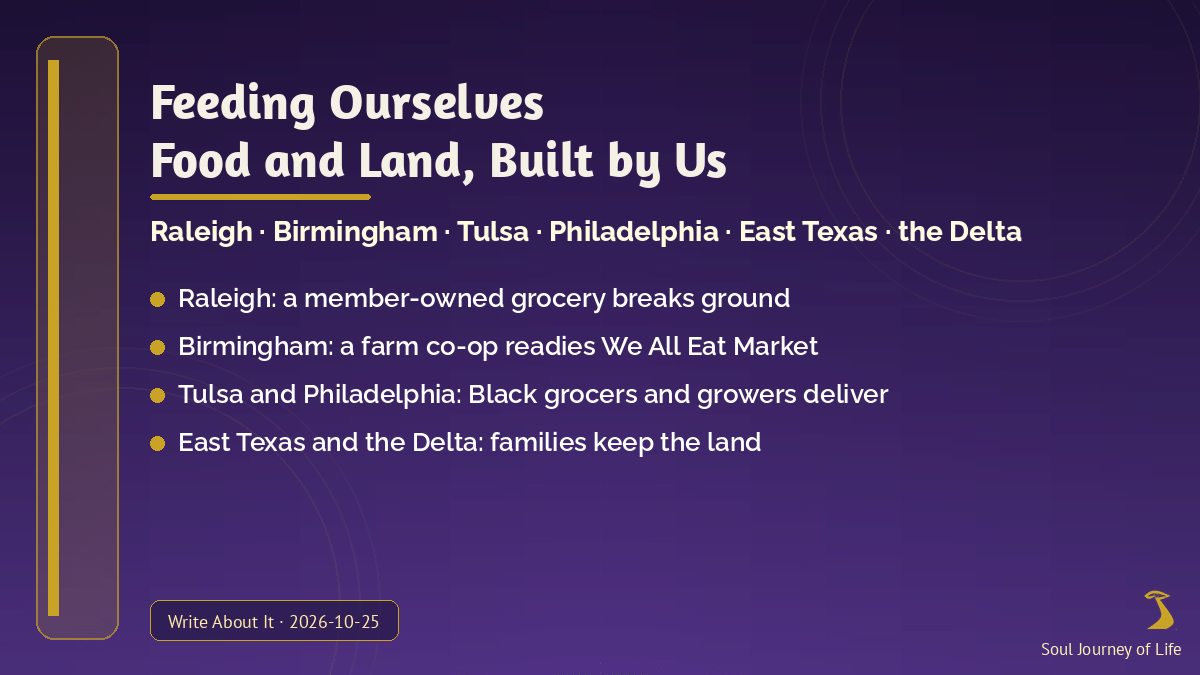

A people who can feed themselves can stand together. For generations, Black neighborhoods across the United States have been told to wait: for a chain store to come back, for a bank to say yes, for someone else to decide that their corner of the city was worth serving. This week’s news is about people who stopped waiting. In Raleigh, Birmingham, Tulsa and Philadelphia, Black-led cooperatives, farmers and business owners are putting fresh food on their own shelves. In East Texas and the Mississippi Delta, families are fighting to keep the land that feeds them.
Building our own stores
Raleigh, North Carolina: Fertile Ground breaks ground
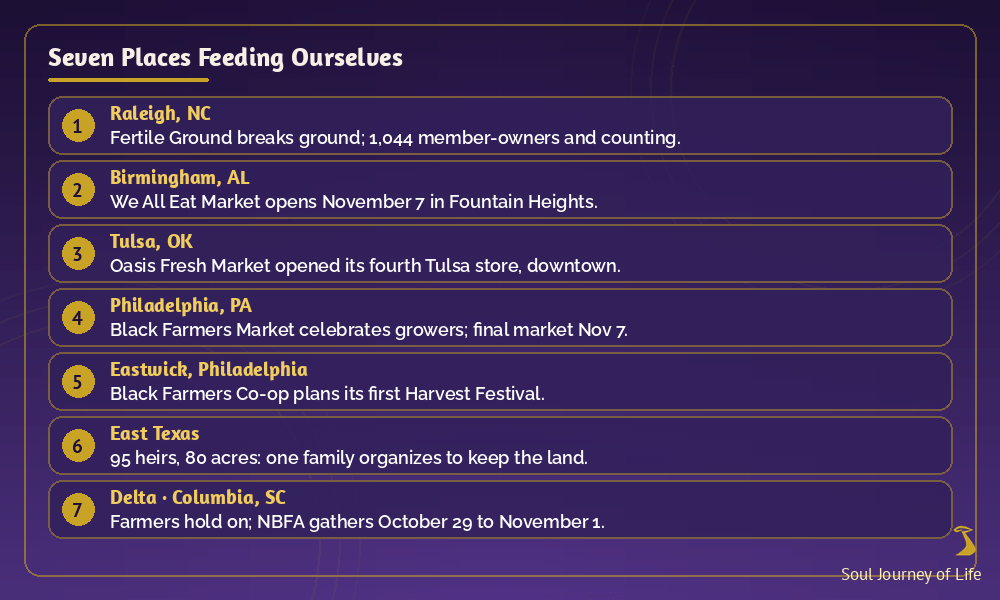
On Saturday, October 24, the Fertile Ground Food Cooperative broke ground on Garner Road in Southeast Raleigh for a member-owned grocery store and community gathering space, ABC11 reported. The effort began more than a decade ago as an idea among neighbors who wanted healthier food close to home. The cooperative held its annual member meeting the same morning, just before the public ceremony.
Architect Andre Johnson, who told the station he grew up about a mile from the site, said the building is meant to be more than a store. “The building is designed to both be a grocery store, but also a community center,” he said. “It’s almost like a center hub of activity. So, what this means is being able to demonstrate to the next generation what the possibilities are.” According to ABC11, students from kindergarten through 12th grade were invited to dream up ideas for the cooperative in a community challenge.
The cooperative says on its website that it has 1,044 member-owners and wants to reach 2,000 before the store opens, and that it has raised $4.5 million toward an $11 million goal. Until the doors open, its Black Farmers’ Market meets on the second and fourth Sundays of the month at Montague Plaza on Rock Quarry Road, from 1 to 4 p.m., including today, October 25.
Birmingham, Alabama: “On our own terms with our own people”
In Birmingham’s Fountain Heights neighborhood, the Fountain Heights Farms Cooperative, a Black-owned urban farm cooperative, is getting ready to open We All Eat Market on Saturday, November 7, Bham Now reported on October 23. The outlet calls it the neighborhood’s first new grocery store in 70 years.
Founded in 2016 by M. Dominique Villanueva and Christopher Gooden, the cooperative describes its mission as “nourish[ing] community connections through food, health and healing.” It has grown from a single backyard farm to 16 neighborhood farm plots, with a goal of 119 plots by 2030, according to Bham Now. The market will sit on the ground floor of the cooperative’s Heart of the Farm Market and Community Kitchen at 1201 16th Street North, where local food entrepreneurs can get affordable access to commercial kitchen space. We All Eat started as a delivery service for fresh local produce. The City of Birmingham is supporting the market through a $150,000 agreement approved unanimously by the City Council.
“Access to fresh, healthy food shouldn’t depend on your ZIP code,” said Mayor Randall Woodfin. Villanueva put it in plain words: “We’re not just opening a store. We’re bringing back something this neighborhood lost generations ago, and we’re doing it on our own terms with our own people.”
Tulsa, Oklahoma: the store they said would fail
In north Tulsa, people told Aaron “A.J.” Johnson that his grocery would never work. “So many people said it will never happen,” he recalled, his voice cracking, at the grand opening of the newest Oasis Fresh Market, the Tulsa Regional Chamber reported on October 1. “We heard that time and time and time again. And we still made a decision to keep going. We still made a decision to put people first.”
The Black-owned grocery opened its first store in 2021 on North Peoria Avenue to serve a neighborhood without fresh food. Its new store, on the ground floor of the ARCO building at 119 East 6th Street, is its fourth in Tulsa and, according to the Chamber, the first full-service grocery store downtown in more than a decade. Through its nonprofit arm, The Oasis Projects, it also connects neighbors with housing help, financial education, job training and health resources. Tulsa Mayor Monroe Nichols said the city did not have to become the owner: “We had a great entrepreneur, a great team of folks who came together, banded together and made it happen.”
Growing our own food
Philadelphia, Pennsylvania: the last markets of the season
In West Philadelphia, Get Fresh Daily’s Black Farmers Market at Freedom Greens + Gardens, 5200 Pine Street, set aside its second-to-last market of the season, on Saturday, October 24, to celebrate Black farmers, according to its event listing. Shoppers could buy fall produce from growers they know by name, and community herbalist Tajah of The Lavender Room Apothecary & Library led a workshop on making fire cider, a traditional herbal tonic, while participants traded memories of kitchen medicine. The final market of the year will be on Saturday, November 7. In the organizers’ words, it is “More than a market. It’s a movement.”
The same Saturday, in Southwest Philadelphia, the Black Farmers Co-op of Philadelphia planned its first annual Harvest Festival in Eastwick, with vendors, music, children’s activities and healthy food. The cooperative, which teaches children and adults to grow their own food, including through hydroponics, said the festival aimed “to bridge the Eastwick Community to establish unity and awareness of its history.”
Keeping the land
East Texas: 95 heirs, one family, 80 acres
After slavery ended, Robert Tatum bought 300 acres in East Texas and fed his family and neighbors from it. When he died, his land was never formally divided, as was common for Black families who had little access to lawyers. Today his remaining 80 acres near Center belong to 95 heirs, the Houston Chronicle reported on October 9. Land held this way can be lost when one heir forces a sale, or when no one pays the taxes.
His granddaughter Jacque Tatum, a retired nurse who grew up in Houston’s Fifth Ward, decided not to let that happen. She traced the family tree, called and visited relatives as far away as Oklahoma, and over almost two years persuaded 77 of the 95 heirs to give her the power to make decisions for the land. The family now meets monthly online and gathers every year for a reunion on the land; this year about 60 relatives came. With help from the new East Texas Heirs’ Property Initiative, a network of lawyers and advocates that launched this summer with support from South Carolina’s Center for Heirs’ Property, the family plans to have a forester survey the timber so the land can earn its keep. “That’s how it ends up on the courthouse steps,” she said of land no one steps up for. And to a doubtful relative: “It won’t happen if you don’t try.”
Mississippi Delta: finding the joy in the struggle
In the Delta, where Black farmers once ran nearly 62,000 farms, fewer than 1,000 Black-operated farms remain, according to 2022 Census of Agriculture figures cited by The Globe and Mail on October 23. The paper notes that many of the 1950 farms were sharecroppers’ plots on land the farmers did not own. During the civil rights movement, Black landowners sheltered activists and put up their land as bail. Fourth-generation Mississippi farmer Robert Miller knows the odds and keeps going. “I think our superpower is our struggle,” he told the paper. “You get used to finding the small wins to celebrate. You get used to finding the joy in everything.”
Columbia, South Carolina: farmers gather (October 29 to November 1)
This week, the National Black Farmers Association will hold its 36th annual conference in Columbia, from Thursday, October 29, to Sunday, November 1. Association president Dr. John W. Boyd Jr. is scheduled to open each day, and according to the published agenda, sessions will cover starting a farm, farm taxes, access to capital, and land retention and stopping farm foreclosures, with an awards banquet on Saturday evening.
Lessons we can carry
- Own the shelf. Raleigh’s 1,044 member-owners and Birmingham’s cooperative show that a grocery store can belong to the neighborhood it serves.
- Start small and keep growing. Fountain Heights went from one backyard farm to 16 plots before it opened a market.
- Put people first, even when doubted. Oasis was told it would fail. It now has four stores in Tulsa.
- Know your farmer by name. Buying from Black growers keeps money, skills and soil in our communities.
- Settle the land while the elders are here. A will, a family meeting and one patient cousin can keep a homeplace from the courthouse steps.
Encouragement
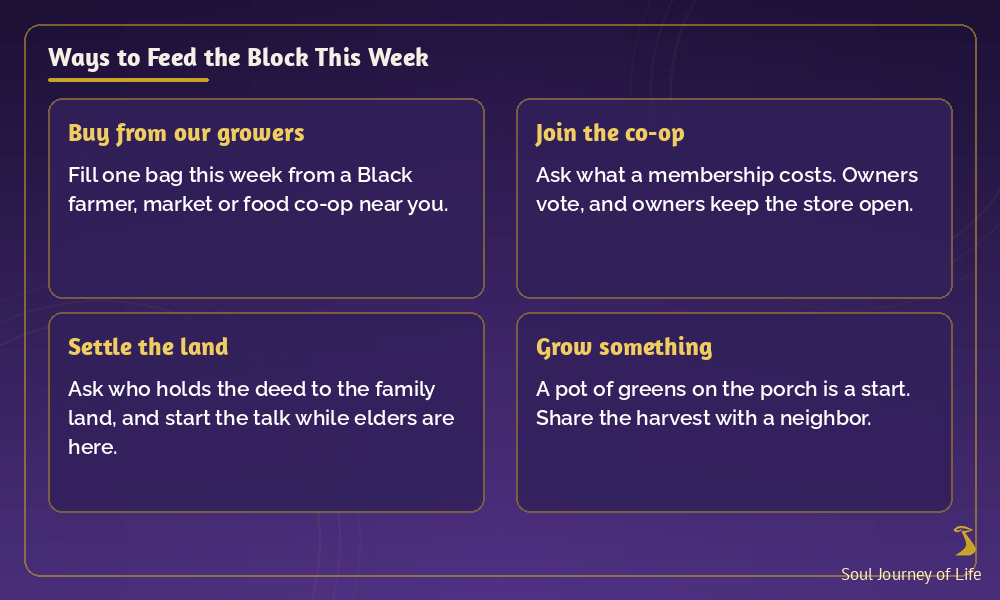
This week, buy one bag of groceries from a Black farmer, a Black-owned market or a food cooperative near you. If your town has a co-op forming, ask what a membership costs and what it would take to join. And if your family has land “down home,” ask who holds the deed, and start the conversation now. Every store we own and every acre we keep is a table our children will eat from. Let us set it together.
Watch: the opening of We All Eat Market in Birmingham on November 7; how fast Fertile Ground reaches its 2,000-member and $11 million goals; and what the National Black Farmers Association announces on land retention in Columbia.
Sources
- ABC11 on Fertile Ground’s groundbreaking
- Fertile Ground Food Cooperative: membership and fundraising
- Fertile Ground Food Cooperative: events and Black Farmers’ Market
- Bham Now on We All Eat Market in Fountain Heights
- Tulsa Regional Chamber on Oasis Fresh Market downtown
- Grid Magazine listing for the Black Farmers Market workshops
- Black Farmers Co-op of Philadelphia on its Harvest Festival
- Houston Chronicle, via Yahoo News, on the Tatum family and East Texas heirs’ property
- The Globe and Mail on Black farmers in the Mississippi Delta
- National Black Farmers Association conference agenda

Write About It is brought to you by Soul Journey of Life. Conscious. Constructive. United.










You must be logged in to post a comment.