


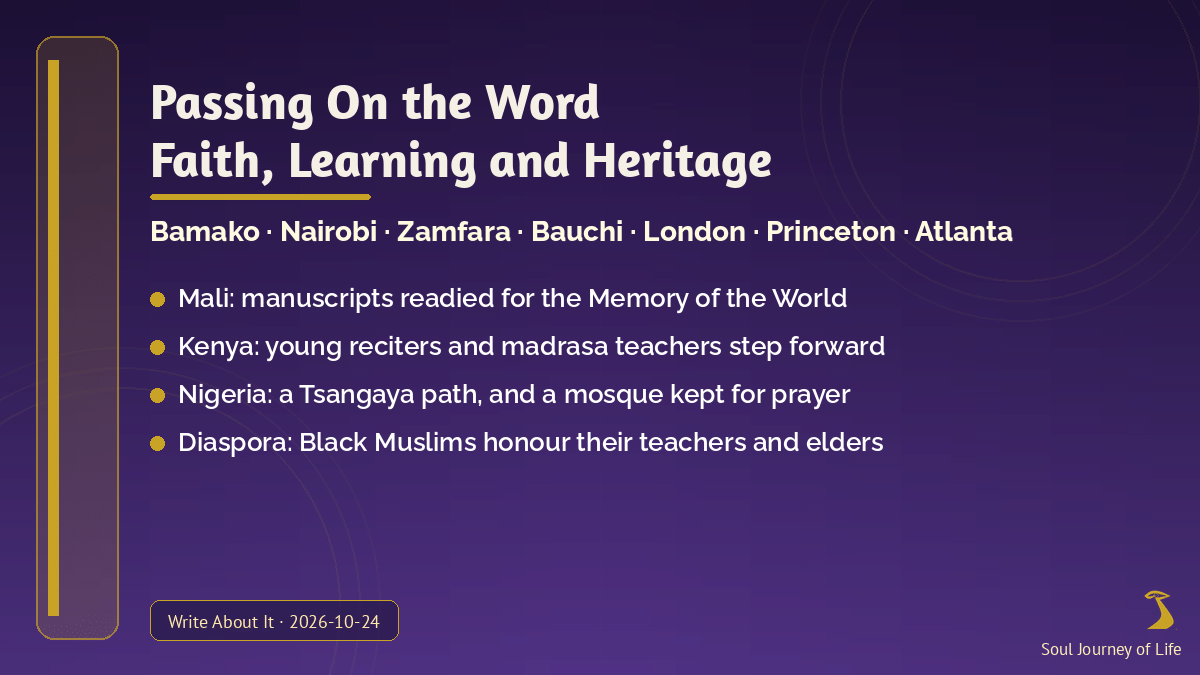

A faith lives as long as someone is willing to teach it. Before there were printing presses in West Africa, scholars copied books by hand and families guarded them for centuries. Before there were classrooms, children sat with a teacher and a wooden slate and learned the Qur’an line by line. This week’s news from Africa and the diaspora is about the people who pass the word on: the custodians of Mali’s manuscripts, Kenya’s young Qur’an memorisers and their madrasa teachers, a mosque committee in Bauchi that kept its house of prayer for worship, Black British Muslims who honoured their own, and Black American Muslims who still remember the woman who built their first schools.
Keeping the books
Bamako, Mali: preparing the manuscripts for the world’s memory
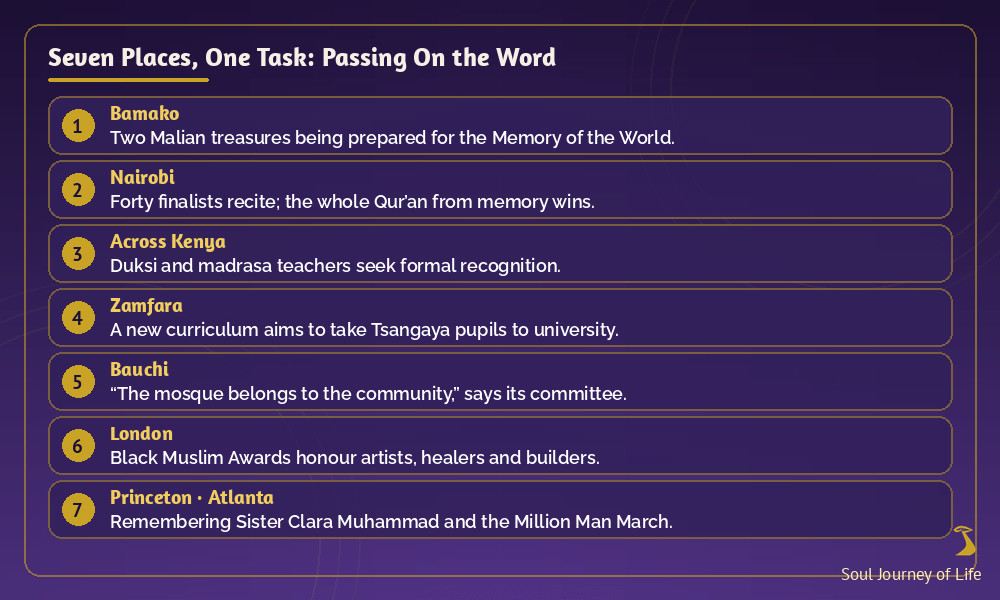
Mali’s ancient manuscripts, from Timbuktu and other centres of learning in the Sahel, are one of the great written records of African history. On 22 October, UNESCO reported on a new phase of work led by Mali’s National Directorate of Libraries and Documentation (DNBD) to protect them and make them easier to reach. Members of Mali’s national Memory of the World committee were trained on how UNESCO’s international register works and how to write strong applications for it. The directorate then worked with Mali’s heritage institutions and outside experts to identify two items of Malian documentary heritage to put forward in the 2026 to 2027 cycle. UNESCO did not name them. The project runs from 2025 to 2027 and is funded by Japan through UNESCO.
The people involved are not only librarians. The committee includes Anna Sambala Diallo, a poet from the Federation of Artists of Mali, and Mohamed Ben Cherif Diabaté, a member from the network of traditional communicators. Dr. Amadou Bekaye Sidibé, director of the National Library and president of the committee, said Mali should not wait until the last minute. “We have a real wealth of documents, many of them very relevant for a possible listing,” he said, in our translation from French. “It is essential to start identifying them now.”
This builds on work closer to the families who hold the books. In June and July, UNESCO and the Malian organisation SAVAMA-DCI began training more than 70 people, including members of manuscript-owning families, students and researchers, to find, identify and catalogue manuscripts held in homes and private libraries.
Teaching the children
Nairobi, Kenya: the whole Qur’an, from memory (Oct 11 to 12)
Forty contestants reached the finals of Kenya’s second National Qur’an Competition in Nairobi. They had come through preliminary rounds in seven counties, from Garissa and Mombasa to Wajir and Mandera, in which 280 people took part, Sahifa Media reports. They competed in four categories, from five sections of the Qur’an up to all thirty.
Hamza Mohamed Madobe from Nairobi won the top category, reciting the entire Qur’an from memory with correct tajweed, the rules of recitation. He received about Sh860,000. Ahmed Mohammed Hille, also from Nairobi, came second, and Abubakar Abaw Salim came third. Category winners included Sayid Ahmad Salim Sharif from Mombasa and two contestants from Garissa, Abdurahman Yusuf Abdille and Abdullahi Farah Sirat.
The competition was organised by the Supreme Council of Kenya Muslims (SUPKEM) and the Jamia Mosque Committee Nairobi with Saudi Arabia’s Ministry of Islamic Affairs, which put up the prize money. SUPKEM chairman Hassan Ole Naado said the competition “provides a valuable platform for nurturing our young people’s connection with the Qur’an.” Saudi Ambassador Al-Nofaia promised that next year’s competition will also include female competitors, calling women “the first Madrassa.”
Across Kenya: recognising the madrasa teacher
Behind every child who memorises the Qur’an is a teacher. In June, President William Ruto directed the Ministry of Education to work out how to bring duksi (traditional Qur’an schools) and madrasa education into Kenya’s national system. Since then, Muslim educators have held meetings around the country to prepare. At a meeting in Mombasa organised by the Islamic Curriculum Development Centre, Sheikh Abu Qatada urged Muslims to agree on a common approach, Sahifa Media reported on 5 October. A key question is whether duksi and madrasa teachers can have their experience recognised. Many have years of teaching but no training recognised by the Teachers Service Commission. More than 300 of them have already been trained so that their prior learning can be recognised, according to the report.
Zamfara, Nigeria: a path from the Tsangaya to university
Northern Nigeria is having a similar conversation about its Tsangaya Qur’an schools. On a radio programme on Gamji FM in Gusau, Dr. Aminu Umar Gummi, executive secretary of the Zamfara State Arabic and Islamic Education Board, said the board has written a new curriculum for Tsangaya schools so their pupils can sit national school examinations such as WAEC and NECO and go on to university, The Nation reported on 1 October. The curriculum has been sent to Governor Dauda Lawal for approval. Dr. Gummi called Tsangaya education “a springboard for academic excellence and good morals.”
Guarding the house of prayer
Bauchi, Nigeria: “The mosque belongs to the community”
In the Madina quarters of Bauchi, a mosque committee has removed its imam, Dahiru Abubakar, after he repeatedly used his talks after prayers to urge worshippers to re-elect President Bola Ahmed Tinubu in 2027, Daily Trust reported on 22 October. The final straw came after the dawn prayer on Sunday, 18 October.
The imam told the paper he was only telling people to fear God and stop blaming the president for insecurity and hardship. Committee chairman Imam Abubakar Jibrin said the problem was larger: the imam gathered people in and around the mosque to talk politics and ignored repeated warnings. He had also pushed to rename the mosque, Masjid Abdullahi Bin Zubbair, after the president. “All the committee members said ‘no’ because the mosque belongs to the community,” Jibrin said. He added that the committee does not oppose any candidate. Political campaigning, he said, belongs in party offices, “and not in the mosque.” The committee prays that God will give Nigeria the best leader, whoever that may be. With campaigns for 2027 starting, it is a lesson for congregations of every faith.
Honouring our own
London: the Black Muslim Awards
In Stratford, east London, the African and African Caribbean Muslim Association (AACMA) held this year’s Black Muslim Awards, The Voice reported on 22 October. The top honour, the Malik El Shabazz Award, named for Malcolm X, went to Romain Muhammad, a leadership coach. “To be recognised and honoured with an award that carries the name of a giant like that is no small thing to me,” he said.
Many of the winners carry African traditions forward. The Performing Artist Award went to Canab Cuud, a Somali artist who performs buraanbur, a poetic tradition of the Horn of Africa. Kinsi Abdulleh, founder of Numbi Arts, received the Lifetime Achievement Award for decades of using the arts to build community. Taqia Adelabu, a mother of five who took up running in 2023, won the Sports Advocate Award, and Dr. Ayo Khalil Moiett, a doctor in the National Health Service, received the Peace Advocate Award. Professor Mashood Baderin gave the keynote on representation and belonging.
Princeton and Atlanta: remembering the teacher who started it all (Oct 28)
In the 1930s, under Jim Crow, Sister Clara Muhammad (1899 to 1972) founded the first private Muslim school system in the United States. In 1975 her son, Imam W. Deen Mohammed, renamed his community’s national network of schools in her honour. Some of those schools are still open. In the short documentary Clara’s Fruit, her great-grandson leads one of them in Atlanta, according to the film’s distributor, Reel South.
On Wednesday, 28 October, Princeton University’s Muslim Life Program will hold its 17th Annual Reflections on the Legacy of Imam W. D. Mohammed under the title “Clara’s Fruit and the Roots of Islamic Education.” The evening will include a screening of the film, a talk by filmmaker Aïdah Aliyah Rasheed and a panel discussion.
Atlanta: clergy and the Nation of Islam remember the Million Man March (Oct 8 to 11)
Atlanta also hosted this year’s commemoration of the Million Man March and the Holy Day of Atonement, from 9 to 11 October. Before the main programme, the Concerned Black Clergy of Metropolitan Atlanta welcomed the Nation of Islam’s Student Minister Ishmael Muhammad to the Vicars Community Center for a conversation on unity and faith, The Final Call, the Nation of Islam’s newspaper, reported. “This is not a meet and greet. This is a family get together,” said the group’s president, Rev. Shanan Jones, who remembered how the 1995 call “beckoned us to atone.” Rev. Timothy McDonald recalled that Atlanta’s organising committee kept meeting for years after the march. “I have never had a spiritual experience, personally, more powerful than the Million Man March,” he said. Christian pastors and Muslims in the same room, remembering the same day: that is unity practised, not just preached.
Beyond the mosque
Addis Ababa and Bishoftu, Ethiopia: Irreechaa, a thanksgiving (Oct 3 and 4)
Spiritual heritage in Africa is wider than any one faith. On 3 October, tens of thousands of people gathered at Hora Finfinnee in Addis Ababa for Irreechaa, the Oromo thanksgiving held at the end of the rainy season, with the celebration at Hora Arsadi in Bishoftu set for the next day, the Ethiopian News Agency reported. Dressed in traditional clothes, and joined by Aba Gadas and Hadha Sinqes, traditional Oromo leaders, people gave thanks to Waaqa, the Creator in Oromo tradition, for peace, harvests, family and livestock. Like a Qur’an school or a manuscript library, Irreechaa survives because each generation teaches the next.
Lessons we can carry
- Treat knowledge as an inheritance. Mali’s manuscripts survived because families protected them. Our own family papers, photos and recordings deserve the same care.
- Honour the teacher. The madrasa and Tsangaya teacher shaped generations, often without formal recognition. Recognising their work honours everyone they taught.
- Open the door to our daughters. A promise to include women in next year’s competition is a start. Every child deserves the chance to carry the word.
- Keep the house of prayer for prayer. Bauchi’s mosque committee showed that a community can welcome every voter and still refuse to let its pulpit become a campaign stage.
- Celebrate our own while they can hear it. London’s awards and Princeton’s reflections honour people for work done in plain sight.
Encouragement
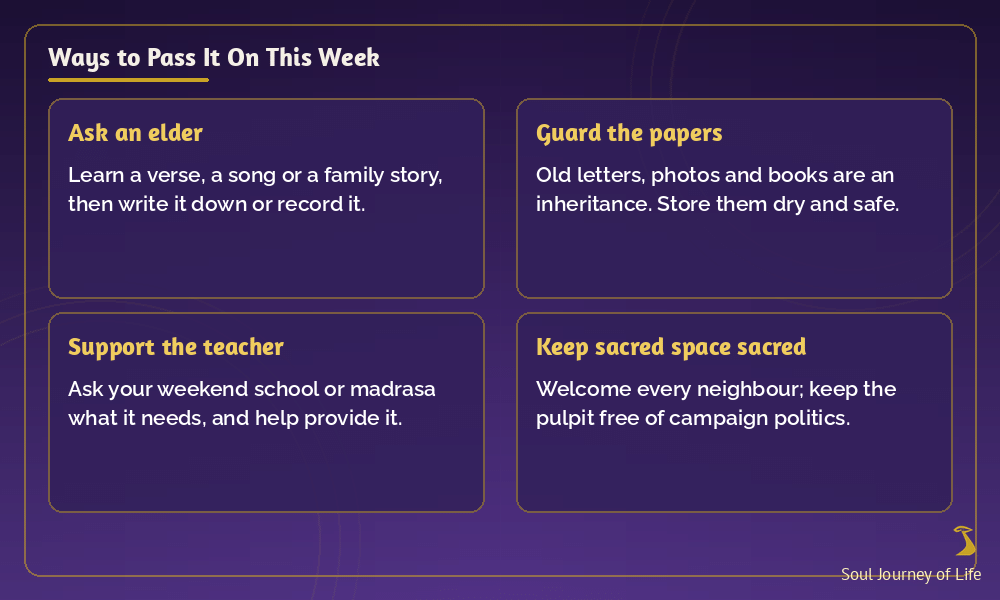
This week, sit with an elder and ask them to teach you something: a verse, a song, a recipe, a story about where your family came from. Write it down or record it. If your mosque, church or community centre runs a weekend school, ask the teachers what they need, and give it. The word reaches the next generation only if someone carries it. Let it be us.
Watch: which two Malian treasures go forward to the Memory of the World register; how Kenya’s duksi and madrasa integration recognises teachers; whether Zamfara’s Tsangaya curriculum is approved; and whether women recite in Kenya’s national Qur’an finals next year.
Sources
- UNESCO on Mali’s Memory of the World preparations (French)
- UNESCO on manuscript training with SAVAMA-DCI (French)
- Sahifa Media on Kenya’s National Qur’an Competition
- The Eastleigh Voice on the competition’s preliminary rounds
- Sahifa Media on duksi and madrasa integration
- The Nation on Zamfara’s Tsangaya curriculum
- Daily Trust on the Bauchi mosque committee
- The Voice on the Black Muslim Awards 2026
- Princeton Muslim Life Program on the Imam W. D. Mohammed reflections
- Reel South on Clara’s Fruit
- The Final Call on Atlanta’s clergy and the Million Man March anniversary
- Ethiopian News Agency on Irreechaa

Write About It is brought to you by Soul Journey of Life. Conscious. Constructive. United.











You must be logged in to post a comment.