




Young builder —
There is an old Akan story from Ghana that elders still tell children, and it crossed the ocean with our ancestors, where Anansi lived on as “Aunt Nancy” in Black American and Caribbean storytelling. It is the story of the day the spider tried to keep all the wisdom in the world for himself.
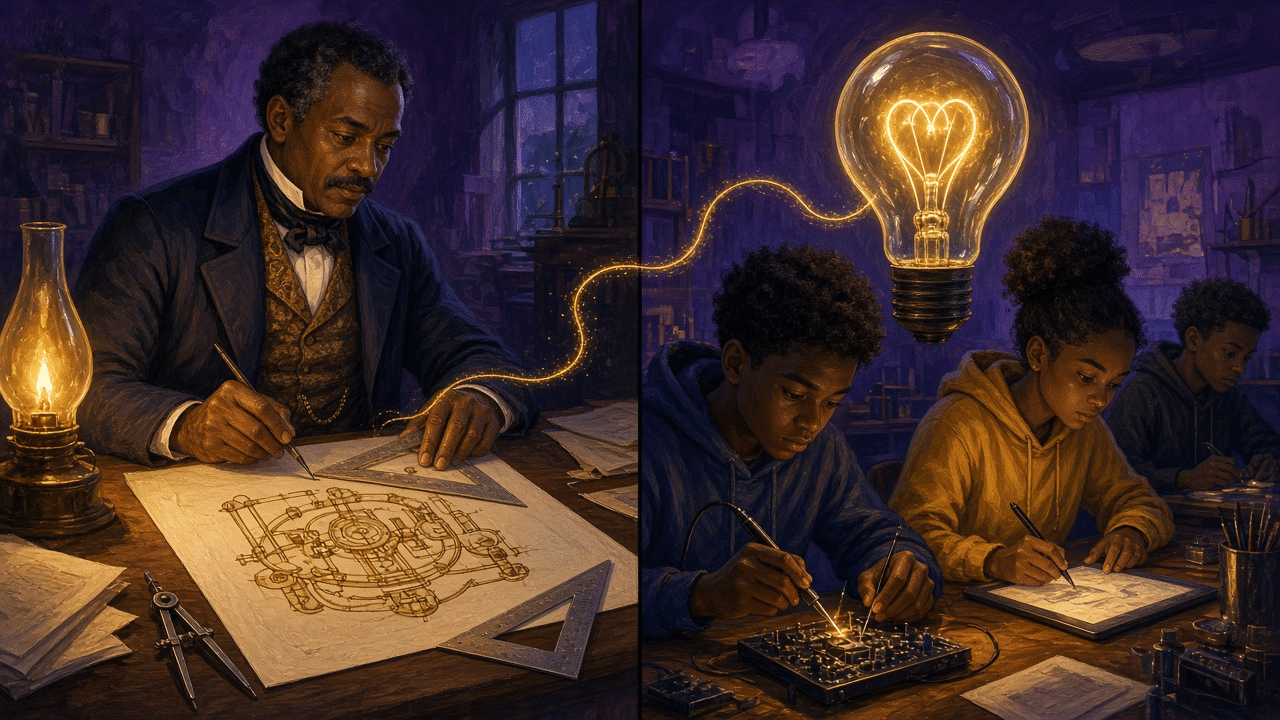
Pair it with a real life from the United States: Lewis Howard Latimer, the son of people who escaped slavery, who taught himself to draw by watching others, and whose careful hands helped light the modern world.
Two stories, one lesson: nobody owns all the wisdom, so learn from everyone, and never stop learning.
Pocket fable: Anansi and the Pot of Wisdom
Kwaku Anansi wanted to be the wisest one of all. So he went from village to village and gathered every bit of wisdom he could find, and he sealed it inside a clay pot.
“If I hide this pot at the top of the tallest tree,” he said, “nobody else will ever be wise. Everyone will have to come to me.”
He tied the pot to his front and began to climb. But the pot was big and round, and it bumped against the trunk. He slipped. He tried again, and slipped again.
Down below, his young son Ntikuma had been watching. “Father,” he called, “why don’t you tie the pot to your back? Then you could hold the tree.”
Anansi stopped. All the wisdom in the world was pressed against his chest, and a child had just given him the answer.
In his frustration the pot slipped from his grip and shattered. The rain came and washed the wisdom into the streams and rivers, and from there it spread across the whole earth.
That is why, the elders say, a little wisdom lives in everyone. Even the smallest voice in the room may be holding the answer you need.
The real-life echo: Lewis Howard Latimer (1848–1928)
Lewis Latimer was born in Chelsea, Massachusetts. As a teenager he joined the U.S. Navy during the Civil War. Afterward he found work as an office boy at Crosby and Gould, a Boston patent law firm.
He was not hired to draw. But he watched the draftsmen closely, studied books on mechanical drawing, and practiced with T-squares, triangles, and compasses until his drawings were precise and beautiful. When he finally asked for a chance, the firm saw his skill and promoted him to draftsman, and he later became chief draftsman.
In 1876 he worked late into the night with Alexander Graham Bell to prepare the drawings for Bell’s telephone patent application. Later, working for Hiram Maxim’s United States Electric Lighting Company, he patented a “Process of Manufacturing Carbons” (U.S. Patent 252,386, granted 17 January 1882), which protected fragile filaments during manufacturing and helped make carbon filaments longer lasting and more affordable. He helped set up early electric lighting plants in New York, Montreal, and London, wrote the book Incandescent Electric Lighting, and joined Thomas Edison’s company.
He was also a poet and taught English and drafting to immigrants. He wrote about electric light: “Like the light of the sun, it beautifies all things on which it shines, and is no less welcome in the palace than in the humblest home.”
Anansi tried to lock wisdom in a pot. Latimer did the opposite: he collected wisdom from everywhere he could, then gave his light to everyone.
Intellectual encouragement
Wisdom was never meant to sit in one pot, one school, one country, or one person. You can learn from a grandmother’s proverb, a younger cousin’s question, a library book, a patent drawing, or a free online course. Latimer had no fancy degree in drafting. He had attention, patience, and the courage to ask for a chance once he was ready.
So stay humble enough to learn from anyone, and bold enough to show what you can do. Pride says, “I already know.” Wisdom says, “Teach me, and let me try.” The moment you think you hold all the wisdom, you start slipping down the tree.
Tech motivation checklist (this week)
- Learn by watching (30 minutes): Watch someone skilled build something, such as a coder streaming, a designer sketching, or a mechanic fixing an engine. Write down three moves they make that you could copy.
- Draw before you build: Before your next project (an app, a robot, a website, a poster), sketch it on paper first, like a patent drawing. Label every part.
- Ask the “small voice”: Ask a younger student or a beginner how they would solve your problem. Fresh eyes often see the “tie it to your back” answer.
- Read one patent: Search a real invention on Google Patents (try Latimer’s U.S. Patent 252,386) and look at the drawings. Notice how clearly each part is explained.
- Ask for your chance: When you have practiced enough, ask a teacher, club, or mentor to let you show your skill, just as Latimer did.
Sources & further reading
- “Anansi,” overview of Akan folklore, including the pot of wisdom tale and Anansi’s New World names such as Aunt Nancy: Anansi on Wikipedia
- R. S. Rattray, Akan-Ashanti Folk-Tales (Oxford: Clarendon Press, 1930), a classic collection of Anansi stories in English and Twi.
- Felix Boateng, “African Traditional Education: A Method of Disseminating Cultural Values,” Journal of Black Studies 13, no. 3 (1983): 321–336.
- Thomas A. Edison Papers, Rutgers University: Lewis Latimer introduction
- Smithsonian Lemelson Center: Innovative Lives: Lewis Latimer, Renaissance Man
- U.S. Patent 252,386, “Process of Manufacturing Carbons,” L. H. Latimer, 1882: Patent on Google Patents
Wisdom Is Everywhere is brought to you by Soul Journey of Life.













You must be logged in to post a comment.