


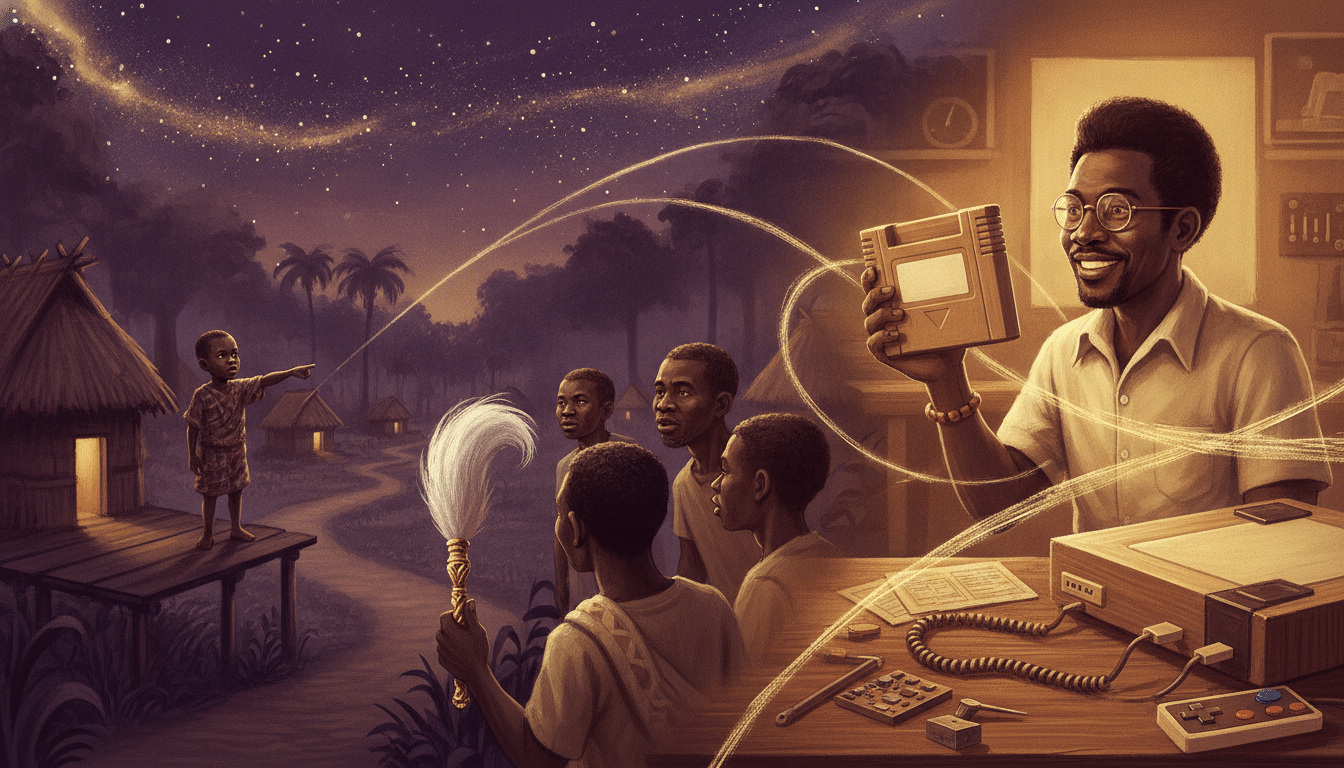

Who built the things you use every day? Not the brand name. The person. Somebody figured out the phone in your pocket, the game you play after school, the map that gets you home. In our view, a lot of those builders looked like you, and a lot of them almost got forgotten.
There is a Liberian folktale about that, usually credited to the Jabo people. It is called The Cow-Tail Switch, and it ends with a saying worth carrying your whole life: “a man is not really dead until he is forgotten.”
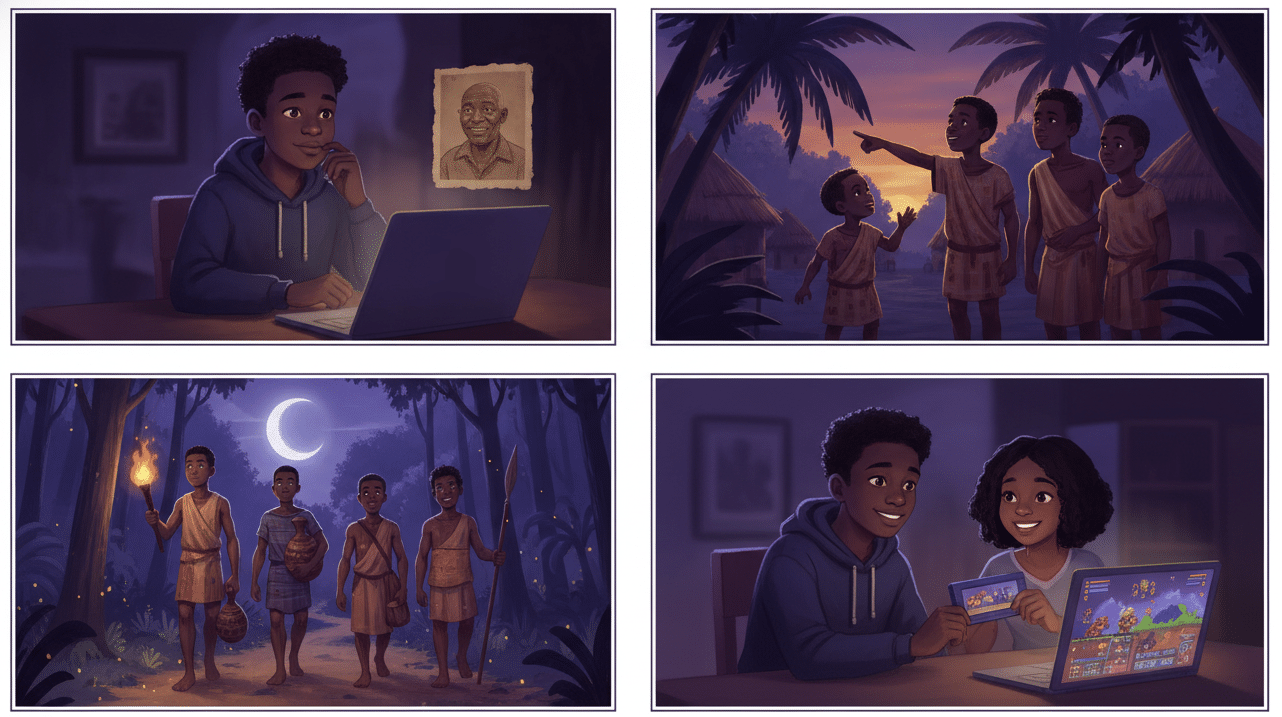
Comic panels
Panel 1: The question
Visual: A Black teen sits at a desk at night, laptop open, looking at an old photo of an elder pinned to the wall.
Teen: “Grandpa always said somebody like us helped invent video games. Nobody at school has ever heard of him.”
Panel 2: Where is my father?
Visual: A rainforest village in Liberia at dusk. A small boy points toward the forest while his older brothers turn to look.
Narration: “Long ago, a hunter named Ogaloussa went into the forest and never came back. Time passed, and his family stopped speaking of him. Then his youngest son, Puli, born after he was gone, spoke his very first words: ‘Where is my father?’”
Panel 3: Every gift counts
Visual: The brothers walk a moonlit forest trail, each carrying something different: a torch, a gourd, a woven bag, a spear.
Narration: “The question woke the brothers up. They went into the forest to look for him, and each time they lost the trail, a different brother found it again. When they found their father’s bones, they used their special gifts to put them together and bring back his flesh, his blood, his breath, his movement, and his voice. Each gift mattered. None of them could have done it alone.”
Panel 4: The cow-tail switch
Visual: Back in the village, Ogaloussa holds up a beautiful cow-tail switch, a symbol of authority, and places it in Puli’s small hands.
Ogaloussa: “To this son I will give the cow-tail switch, for I owe most to him.”
A man is not really dead until he is forgotten.
Panel 5: Back to the laptop
Visual: The teen and a friend, smiling, hold a retro game cartridge next to a laptop running a colorful pixel game they built themselves.
Teen: “His name was Jerry Lawson. Now we know it. And now we’re building too.”
The real-life echo: Jerry Lawson
Before the Channel F, most home video game systems had their games built into the hardware. If you wanted a new game, you often needed a new machine.
Gerald “Jerry” Lawson (1940–2011), a largely self-taught Black engineer, helped change that. As director of engineering and marketing for the new video game division of Fairchild Semiconductor, he led the team that brought out the Fairchild Channel F in 1976. Guinness World Records lists it as the first video game console with slot-in game cartridges, and cartridges stayed the standard for console games for about the next 20 years. Lawson’s team refined cartridge technology from another company, Alpex, so that games on removable chips could be swapped safely and repeatedly.
Lawson also said he was the only Black person at the meetings of the famous Homebrew Computer Club in Silicon Valley. Even so, in the author’s view, for decades most gamers had never heard his name. In March 2011, about a month before he died, the International Game Developers Association honored him as an industry pioneer, recognition the author feels was long overdue.
Like Puli, someone had to ask, “Who built this?” Every time we say Jerry Lawson’s name, we keep the builder alive.
Intellectual encouragement
- Asking is a gift. Puli could not track, heal, or carry. He could ask, and his question started everything.
- Every skill on the team matters. The trail-finder, the bone-setter, the one who gave breath: like the parts of a console, each piece made the whole work.
- Remember your builders. Learn the names of the inventors, elders, and teachers who came before you, and say them out loud.
- You can be remembered too. The things you build, write, and teach are how your name keeps living.
Tech motivation checklist
- Ask “who built this?” Pick one device you use every day and research the people behind it this week.
- Make a tiny game. Use a free beginner tool like Scratch or a simple game tutorial and build one level.
- Think in modules. In the author’s view, Lawson’s big idea was separating the game from the machine. Break your next project into small swappable parts.
- Find your team. Every brother had a different gift. Pair up with a friend whose skills are different from yours.
- Keep a builders’ journal. Write down one Black or African inventor, engineer, or scientist each week, and what they made.
Sources & further reading
- Harold Courlander and George Herzog, The Cow-Tail Switch, and Other West African Stories (Henry Holt, 1947), a Newbery Honor book. Book overview on Wikipedia
- West Afrikan Oral Literature, The Cow-Tail Switch (text of the Courlander and Herzog version)
- Liz Warren, The Cow-Tail Switch as Story Learning Device
- The New York Times, Gerald A. Lawson, a Pioneer in Video Games, Dies at 70 (2011)
- Guinness World Records, First videogame console with slot-in game cartridges
- Game Developer, Obituary: Fairchild Channel F Creator Jerry Lawson (2011)
- Vintage Computing and Gaming, Interview with Jerry Lawson (2009)
- Engadget, Game console pioneer Jerry Lawson dies at 70 (2011)
Folktale retold in our own words; versions vary by teller.

brought to you by Soul Journey of Life
Recommend0 recommendationsPublished in Write About It











You must be logged in to post a comment.