


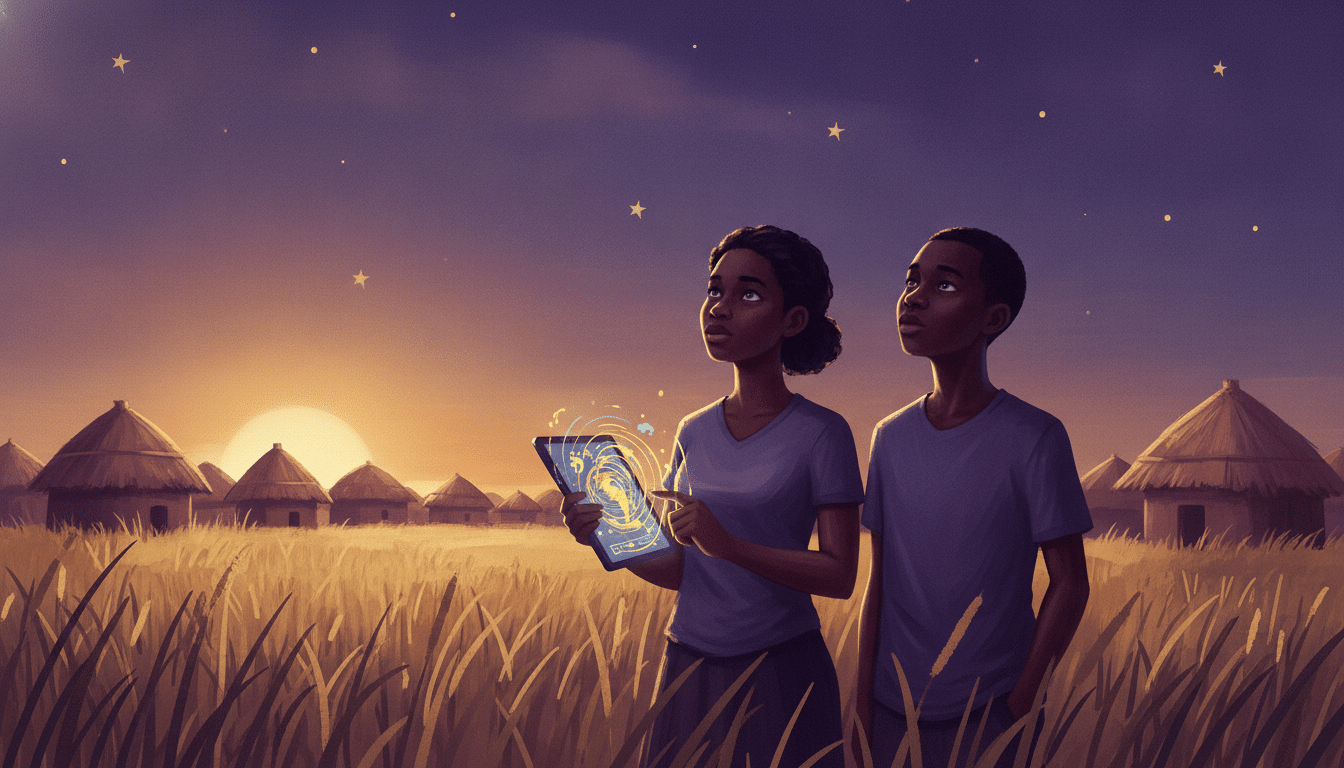

Young thinker,
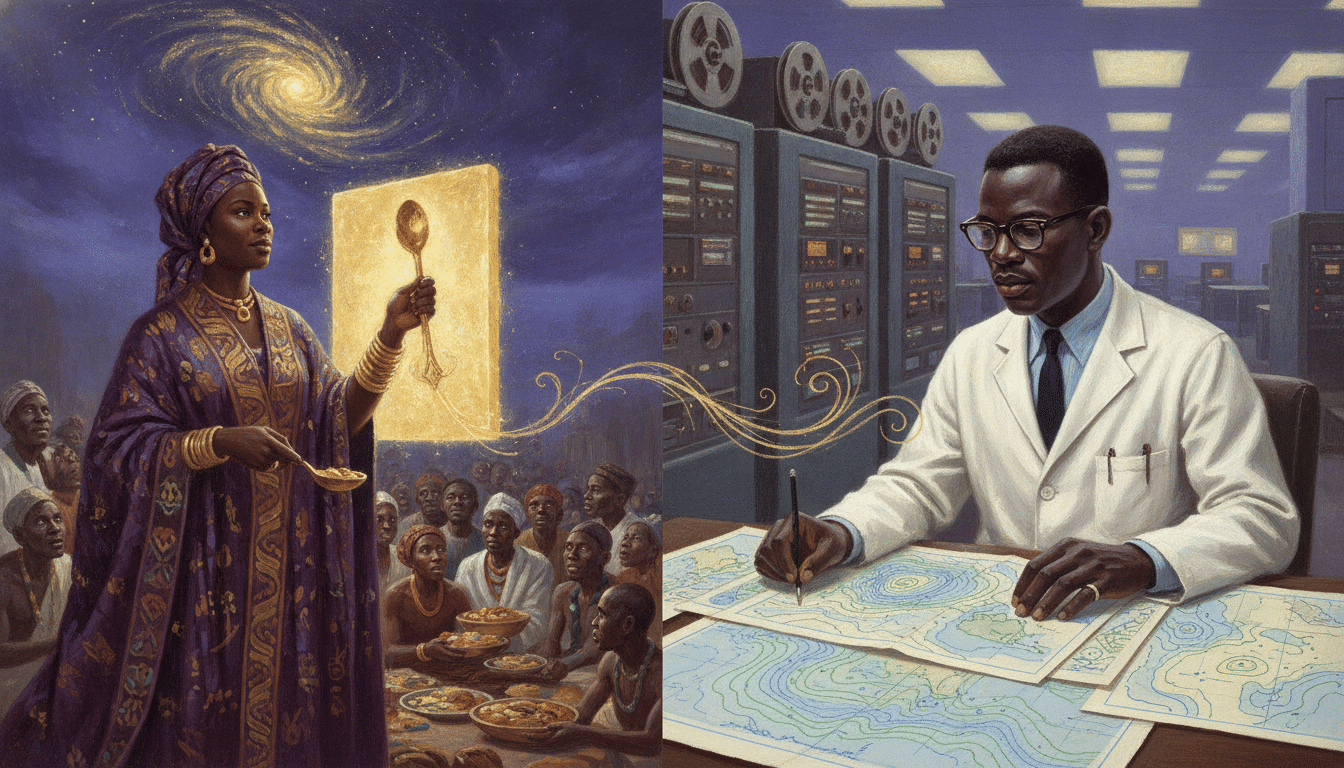
The Bini (Edo) people of Benin in southern Nigeria tell a story about a time when the sky hung so low that anyone who was hungry could reach up, break off a piece, and eat it. The sky fed everyone, until people started taking more than they needed.
Pair it with a real life from the United States: Dr. Warren M. Washington, the atmospheric scientist who helped build some of the first computer models of the whole Earth’s atmosphere, so people could understand how the sky above us is changing.
Two stories, one lesson: take only what you need, then study what feeds you, so you can protect it.
Pocket fable: Why the Sky Is Far Away
This is a folktale of the Bini (Edo) people, told in many versions; it is folklore, not history.
In the beginning, the elders say, the sky was close to the earth. It tasted of whatever you hoped for: sometimes meat stew, sometimes roasted corn, sometimes sweet fruit. Nobody had to plow or plant. People had time to carve, weave, and tell stories.
But people grew careless. They broke off more sky than they could eat and threw the rest away. The sky grew sad, then angry, and it warned them: “If you keep wasting my gifts, I will move far away.”
For a while, everyone was careful. Then came a great festival in honor of the king. In one well-known telling, a woman named Osato ate and ate, and when the feast was over she still wanted one more taste. She pulled down a huge slab of sky, far more than she could finish. She called her family and her neighbors to help, but everyone was already full. The leftover sky was thrown away.
That night the sky rose up, higher and higher, beyond anyone’s reach. From then on, the people had to learn to farm, to hunt, and to respect the earth.
It is a folktale, not history. But the lesson is very real: a gift that feels endless can still run out when we waste it.
The real-life echo: Dr. Warren M. Washington
Warren Morton Washington was born on 28 August 1936 in Portland, Oregon, and he loved science from grade school. He earned a bachelor’s degree in physics (1958) and a master’s degree in meteorology (1960) from Oregon State University, then a PhD in meteorology from Pennsylvania State University in 1964. In his own words, that made him the second African American to earn a PhD in the atmospheric sciences, after Dr. Charles E. Anderson, who later became his mentor.
In 1963 he joined the National Center for Atmospheric Research (NCAR) in Boulder, Colorado. Starting in 1964, he and scientist Akira Kasahara built one of the first general circulation models: a computer program that uses the laws of physics to simulate how air moves and how weather and climate behave across the whole planet. Over the years, he added the oceans and sea ice to these models, and today’s versions also include land, water, and plants.
The models Washington helped develop were used in the 2007 Intergovernmental Panel on Climate Change assessment, and NCAR scientists including Washington were among the many researchers who shared in that year’s Nobel Peace Prize awarded to the panel. He co-wrote a standard textbook on climate modeling, advised several U.S. presidents on science, received the National Medal of Science in 2010, and shared the 2019 Tyler Prize for Environmental Achievement. NCAR says the medal also honored his “inspiring mentorship of young people of all backgrounds and origins.”
The Bini sky and Dr. Washington’s work say the same thing from two directions: the sky is a gift, and learning to read it is how we learn to care for it.
Intellectual encouragement
The people in the fable did not lose the sky because they were weak. They lost it because they stopped paying attention. Paying attention is a skill, and science is that skill sharpened: you watch, measure, write it down, and test what you think you know.
Dr. Washington did not just look up and wonder. He turned wind, heat, and water into equations, and those equations into programs that a computer could run. That took years of math and patience at a time when very few Black scientists worked in those rooms.
You do not need to be finished to begin. You need a question, a notebook, and the discipline to come back tomorrow. Take only what you need, learn how things work, and leave the world better than you found it.
Tech motivation checklist (this week)
- Keep a sky log: For seven days, write down the temperature, cloud cover, and wind at the same time each day. At the end of the week, look for a pattern.
- Compare with a forecast: Check a weather service forecast each morning and mark whether it was right. Ask yourself why forecasts miss sometimes.
- Make your first model: In a spreadsheet or a few lines of Python, average your temperatures and graph them. That is the same idea as a climate model, just very small.
- Count your waste: Track the food, water, or electricity your home wastes in one day, and pick one thing to cut, the way the fable asks us to.
- Find a mentor in science: Ask a teacher, a librarian, or a local college department about weather, climate, or coding programs for young people. Dr. Washington had mentors, and so can you.
Sources and further reading (checked 23 October 2026)
- NCAR: Warren Washington, Distinguished Scholar
- UCAR Archives: A Short Biography of Warren M. Washington
- UCAR Archives: Timeline, 1963 to 1969
- UCAR Archives: Early history of global atmospheric and climate modeling at NCAR
- Warren M. Washington, Odyssey in Climate Modeling, Global Warming, and Advising Five Presidents (autobiography).
- Mary-Joan Gerson and Carla Golembe, Why the Sky Is Far Away: A Nigerian Folktale (Little, Brown): publisher page
- Unitarian Universalist Association, World of Wonder curriculum: Why the Sky Is Far Away (a retelling that includes the character Osato).

Read the Sky is brought to you by Soul Journey of Life.








You must be logged in to post a comment.