


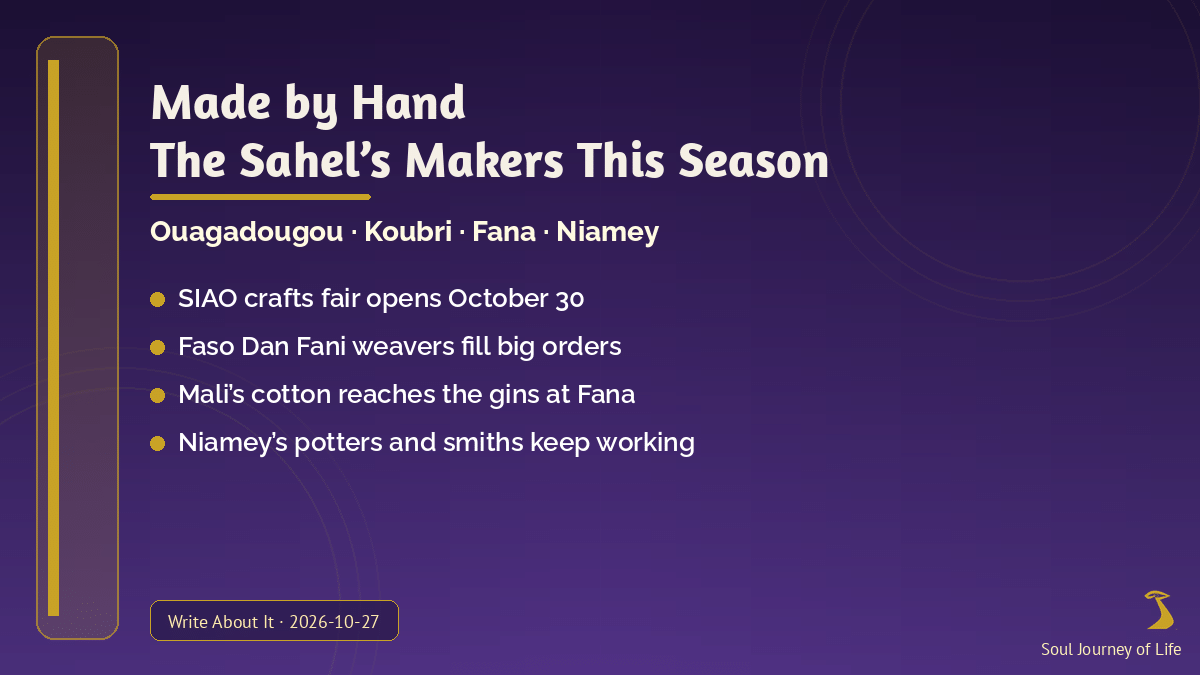

This week’s stories from Burkina Faso, Mali and Niger are about hands: hands that pick cotton, spin it, weave it, shape clay and beat iron into hoes. As Ouagadougou prepares to welcome thousands of artisans from across the continent, here is what the people doing the work told reporters about their craft, their customers and the problems they still face.
Ouagadougou readies Africa’s big crafts fair
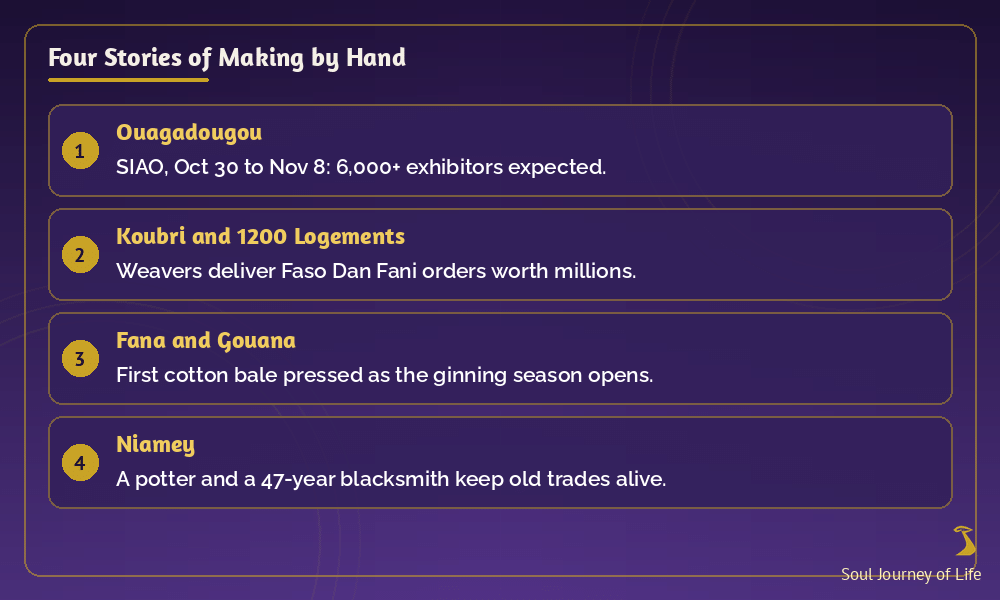
The 18th Salon International de l’Artisanat de Ouagadougou, known as SIAO, opens on Friday, October 30 and runs until Sunday, November 8. At a press conference on October 23, the national organising committee said it expects more than 6,000 exhibitors on 800 stands, about 800,000 visitors, more than 100 professional buyers and at least 30 countries, C’Finance reported. Ghana is the guest of honour, and Mali and Niger take part as special guest countries.
This year’s theme is “African crafts and industrialisation: what synergy for better organisation and promotion of local products and cultural heritage.” The first weekend, October 31 and November 1, is open to the general public, with demonstrations, concerts and fashion shows. Business meetings between exhibitors and accredited buyers follow from November 2 to 4, and prizes, including a creativity prize named for Thomas Sankara, are handed out at the closing on November 8. Organisers have announced air-conditioned pavilions and an online ticketing platform, and some activities will move to the neighbouring Village Artisanal to ease crowding. The fair, founded in 1988, is held every two years.
Burkina’s weavers fill big Faso Dan Fani orders
For the women who weave Faso Dan Fani, Burkina Faso’s handwoven cloth, demand is rising. In a report by Oumarou Konaté of Bird Story Agency, published in early October, weaver Denise Kafando, who has worked her loom in Ouagadougou’s 1200 Logements neighbourhood since 1986, said she had delivered an order worth 4 million CFA francs to a local bank the week before, and another worth nearly 2 million to a non-governmental organisation in April.
In Koubri, near the capital, Sidonie Sawadogo, who has woven for about 22 years, said her cloths sell for 6,000 to 20,000 CFA francs depending on quality and design. She credits better yarn, much of it made by the Burkinabè spinning company FILSAH, for the higher quality of today’s cloth. About 125 kilometres from Ouagadougou, organic cotton grower Mamata Konaté of Koumbogoro in Sissili province said she made a net profit of 100,000 CFA francs last year.
Imports of weaving thread and woven cloth have been banned in Burkina Faso since September 24, 2024, under the government’s “buy local” drive, and the report says the cloth is now part of dress codes for courts, schools, universities and the military. Counterfeits remain a major worry. Despite the ban, fake yarn and cloth still reach the market, and on April 15 customs announced the interception of 31,200 counterfeit cloths at Dakola, on the border with Ghana. Closer to home, a women’s textile training centre at Tampouy in Ouagadougou was inaugurated on October 2 after being rehabilitated and equipped for 200 million CFA francs with European Union funding, Faso7 reported.
Mali’s cotton reaches the gins
In Mali, the season’s cotton is moving from the fields to the factories. On October 19 at Fana, the head of Mali’s national cotton company, the Compagnie malienne pour le développement des textiles (CMDT), Dr Kouloumégué Dembélé, launched the 2026–2027 buying and ginning season as the first bale was pressed, Mali Actu reported. His delegation visited the five-hectare field of farmer Bah Diarra at Gouana, where talk turned to the patchy rains and late deliveries of fertiliser and other inputs. Farmers were reminded to keep the harvested cotton out of the last rains, dry it well and store it away from damp so it keeps its quality.
Some outlets reported that the CMDT forecast about 600,000 tonnes. The CMDT corrected this on October 22, saying its head had announced no figure and that its teams were still counting cotton bolls in the fields to estimate yields. A September report by the United States Department of Agriculture’s office in Dakar said late, irregular rains and delayed fertiliser had led some Malian farmers to plant less cotton and more maize, sesame and groundnuts.
Niamey’s potters and smiths keep the fire lit
In Niamey, the national news agency, Agence Nigérienne de Presse (ANP), visited two old trades. Potter Aïssata shapes jars, water pots and cooking pots by hand from white clay, dries them and fires them with millet stalks, using methods passed down through generations. Her main problem is selling: “After making and firing the pieces, we have to wait for customers, who rarely come,” she said. In villages, jars and water pots are still used to store water and other goods, but in the city more buyers now want them for decoration. Rabi, a shopper buying in front of the museum, said she uses them as flower pots to decorate her room.
At Katako market, blacksmith Mahaman, originally from Bouza, has worked his forge for 47 years after learning from his father. He makes hoes, knives, axes, machetes and other farm tools. “Thanks to this trade I was able to marry two wives and feed my eight children,” he said.
Why it matters
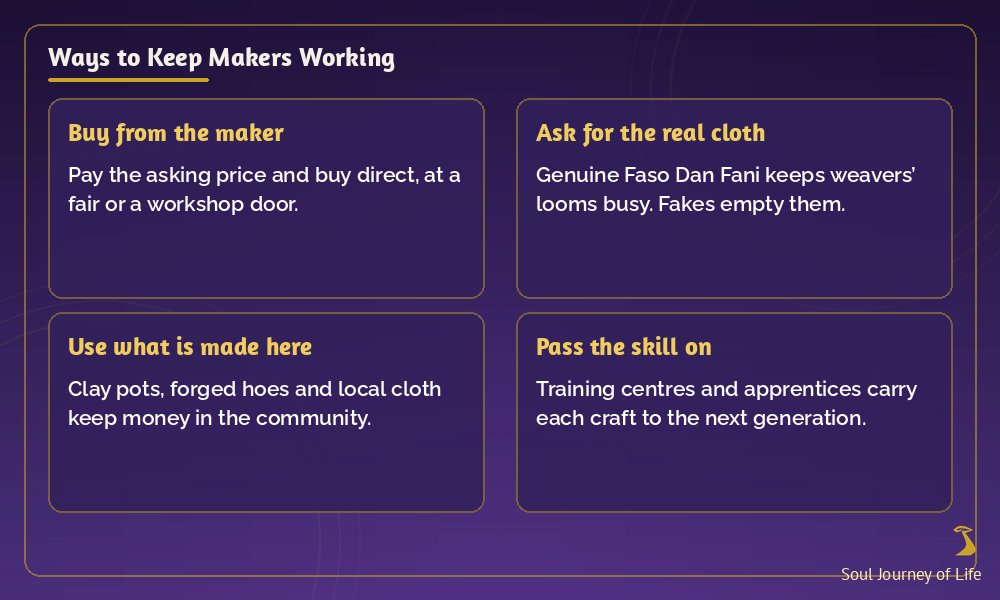
In our view, from the cotton field at Gouana to the loom in Koubri and the forge at Katako, these trades keep money and skill inside the community. The makers themselves name what would help most: more customers, fair prices, protection from fakes and better training. The SIAO is a chance to meet them in person. Wherever you are, buying directly from an African maker, and paying the asking price, is a simple way to keep these hands at work.
Sources
- C’Finance: SIAO 2026, more than 6,000 exhibitors and 800,000 visitors expected (organisers’ projections)
- SIAO official site: SIAO 2026 programme
- Bird Story Agency (Oumarou Konaté): In Burkina Faso, women weavers give Faso Dan Fani fresh momentum
- Faso7: Women’s textile training centre inaugurated at Tampouy
- Mali Actu: At Fana, the first cotton bale launches the 2026–2027 ginning season
- CMDT statement via Maliweb: clarification on 2026–2027 cotton production estimates
- USDA Foreign Agricultural Service, Dakar: Cotton and Products Update (September 2026)
- Agence Nigérienne de Presse: Traditional pottery and its changing uses
- Agence Nigérienne de Presse: The traditional forge keeps its place in a changing world
Quotes are translated from French. The SIAO visitor and exhibitor numbers are the organising committee’s projections.

Write About It is brought to you by Soul Journey of Life.










You must be logged in to post a comment.