




Young builder —
There is an Ashanti craft legend from Bonwire, in Ghana, about how people first learned to weave kente: not by rushing, but by watching a spider’s careful web, counting the threads, and practicing until many strands became one cloth.
Pair it with a real life from the United States: Mary Winston Jackson (1921–2005), the mathematician who studied after hours, won permission to take the training that opened the engineer path, and became NASA’s first Black female engineer — a story many know from Hidden Figures.
Two stories, one lesson: beauty and breakthroughs come from learning the pattern — count the threads, check the numbers, then rise.
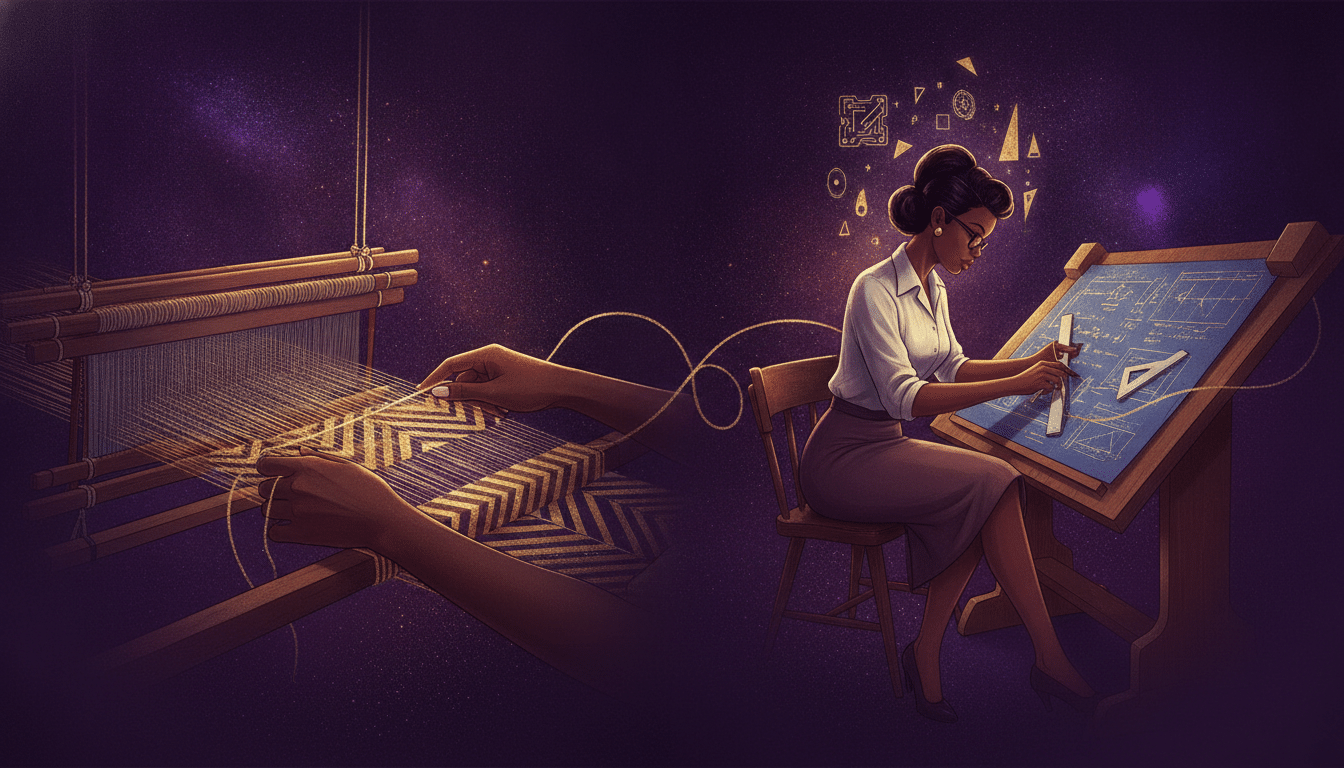
Pocket fable: The Spider’s Cloth at Bonwire
Long ago, near the town of Bonwire in the Ashanti lands of Ghana, two hunters, said in the telling to be brothers, stopped on a forest path and stared. Names vary by teller; in researcher Dickson Adom’s account they are Opoku Kuragu and Kwakye Ameyaw.
A spider was weaving.
Not a messy tangle, but a living pattern: threads crossing threads, spaces measured, each line placed with patience. The hunters watched. They studied how one careful strand held the next.
Then they tried it themselves, first with raffia fibres, until many threads became one cloth. Later weavers of Bonwire built the first loom and added colours and geometric patterns. That cloth, the elders say, grew into the royal beauty we know as kente: colours and geometry that speak of history, honour, and skill.
Historians also remind us that West African weaving traditions are older and wider than any single story, and that Bonwire is not the only Asante town with a claim to kente’s beginnings — Adanwomase is another. The legend still teaches what every weaver knows in their hands: you do not invent beauty by hurrying. You learn the pattern first.
The real-life echo: Mary Winston Jackson (1921–2005)
Mary Winston Jackson was born in Hampton, Virginia, on 9 April 1921. She earned a Bachelor of Science in mathematics and physical science from Hampton Institute (now Hampton University) in 1942. She taught school, kept books, and worked as a secretary before her aerospace career began.
In April 1951 she joined the National Advisory Committee for Aeronautics (NACA) — the organization that became NASA in 1958 — as a “human computer” in the segregated West Area Computing section at Langley, in her hometown. After about two years she accepted an offer to work with engineer Kazimierz Czarnecki in the 4-foot by 4-foot Supersonic Pressure Tunnel, a powerful wind tunnel that blasted models with winds approaching twice the speed of sound. There she gained hands-on experience running experiments.
Czarnecki encouraged her to enter a training program that could promote her from mathematician to engineer. She had to complete graduate-level math and physics courses held after work and managed by the University of Virginia. The classes took place at then-segregated Hampton High School, so she needed special permission from the City of Hampton to sit with her white classmates. She asked, she received permission, and she finished the work.
In 1958 Mary Jackson became NASA’s first Black female engineer. That same year she co-authored her first research report, Effects of Nose Angle and Mach Number on Transition on Cones at Supersonic Speeds. For nearly two decades she studied the behaviour of air around aircraft, and by 1975 she had authored or co-authored 12 NACA and NASA technical publications. In 1979, after being denied management-level positions, she accepted a demotion to join Langley’s Federal Women’s Program, where she worked to improve the hiring and promotion of women in science and engineering careers. She retired in 1985 and died in Hampton on 11 February 2005. In June 2020 NASA announced that its Washington headquarters would carry her name, and the building was formally named for her in a ceremony on 26 February 2021.
The spider’s cloth and Mary Jackson’s career say the same thing: master the pattern before you rush the finish. Patient practice opens doors.
Intellectual encouragement
Kente is not one lucky thread. It is many counted strands. An engineer’s breakthrough is not one lucky guess. It is hours of equations, experiments, and quiet courage when the classroom door is closed and you still ask to enter.
You may feel behind. You may feel that talent is a gift other people already got. The Bonwire legend and Mary Jackson’s life answer gently: watch carefully, practice daily, ask for the training you need, then weave what you learned into something the world can wear.
Pride says, “I already know the pattern.” Discipline says, “Show me again.” The finish line belongs to those who counted the threads.
Tech motivation checklist (this week)
- Watch one pattern for 20 minutes: Study a weaving video from Ghana, a coding tutorial, a circuit diagram, or a math proof. Pause and sketch the repeating steps.
- Count before you build: Before your next project, write the pattern as a list: Step 1, Step 2, Step 3. Do not skip a step to look faster.
- Practice after hours: Choose one hard skill (algebra, Python, design, electronics). Spend 30 focused minutes after school or work, the way Mary Jackson studied for her engineer courses.
- Ask for the training door: Email a teacher, club leader, or mentor and ask what course, book, or lab would move you from “interested” to “qualified.”
- Share one thread: Teach a friend one small pattern you learned this week — a formula, a stitch of code, a how-to. Many threads become one cloth when knowledge is shared.
Sources & further reading
- NASA history biography: Mary W. Jackson
- NASA biography: Mary W. Jackson
- NASA news: NASA Names Headquarters After ‘Hidden Figure’ Mary W. Jackson (24 June 2020)
- NASA news: NASA Celebrates ‘Hidden Figure’ Mary W. Jackson With Building Naming Ceremony (26 February 2021)
- Britannica: Mary Jackson
- National Park Service: Places of Hidden Figures
- Dickson Adom on Asante kente origins (Bonwire spider-weaving legend; also notes the Bonwire–Adanwomase debate): The Conversation
- Smarthistory overview of kente and the spider’s-web legend: Kente cloth
- Margot Lee Shetterly, Hidden Figures (William Morrow, 2016) — Mary Jackson’s story in fuller historical context.

Learn the Pattern is brought to you by Soul Journey of Life.
Recommend0 recommendationsPublished in Write About It










You must be logged in to post a comment.