


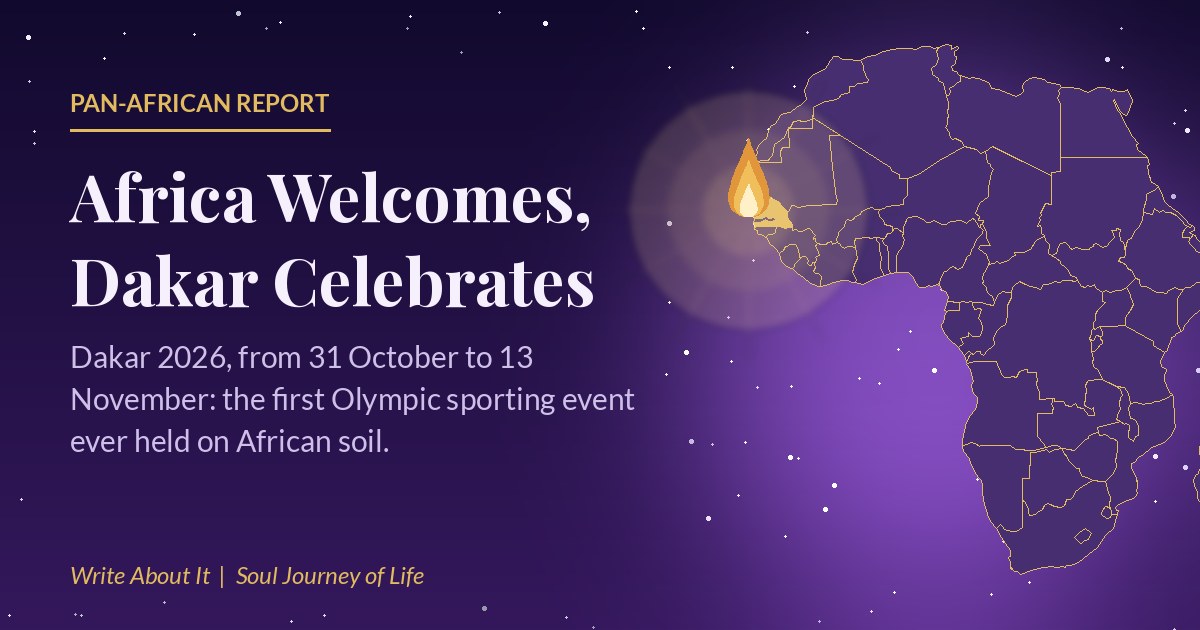

On Saturday evening, 31 October, a flame that has traveled through all 14 regions of Senegal will reach the Abdoulaye Wade Stadium in Diamniadio, and a cauldron will be lit for the Dakar 2026 Youth Olympic Games. For the first time since the modern Games began in Athens in 1896, an Olympic sporting event will be held on African soil.
The motto says it in three languages: “Africa Welcomes, Dakar Celebrates,” in French “L’Afrique accueille, Dakar célèbre,” and in Wolof “Afrig Dalal, Ndakaaru Jëmël.” This is more than a sports story. It is a story about Africa’s young people, and about a city that has opened its doors to the African world before.
A first for Africa
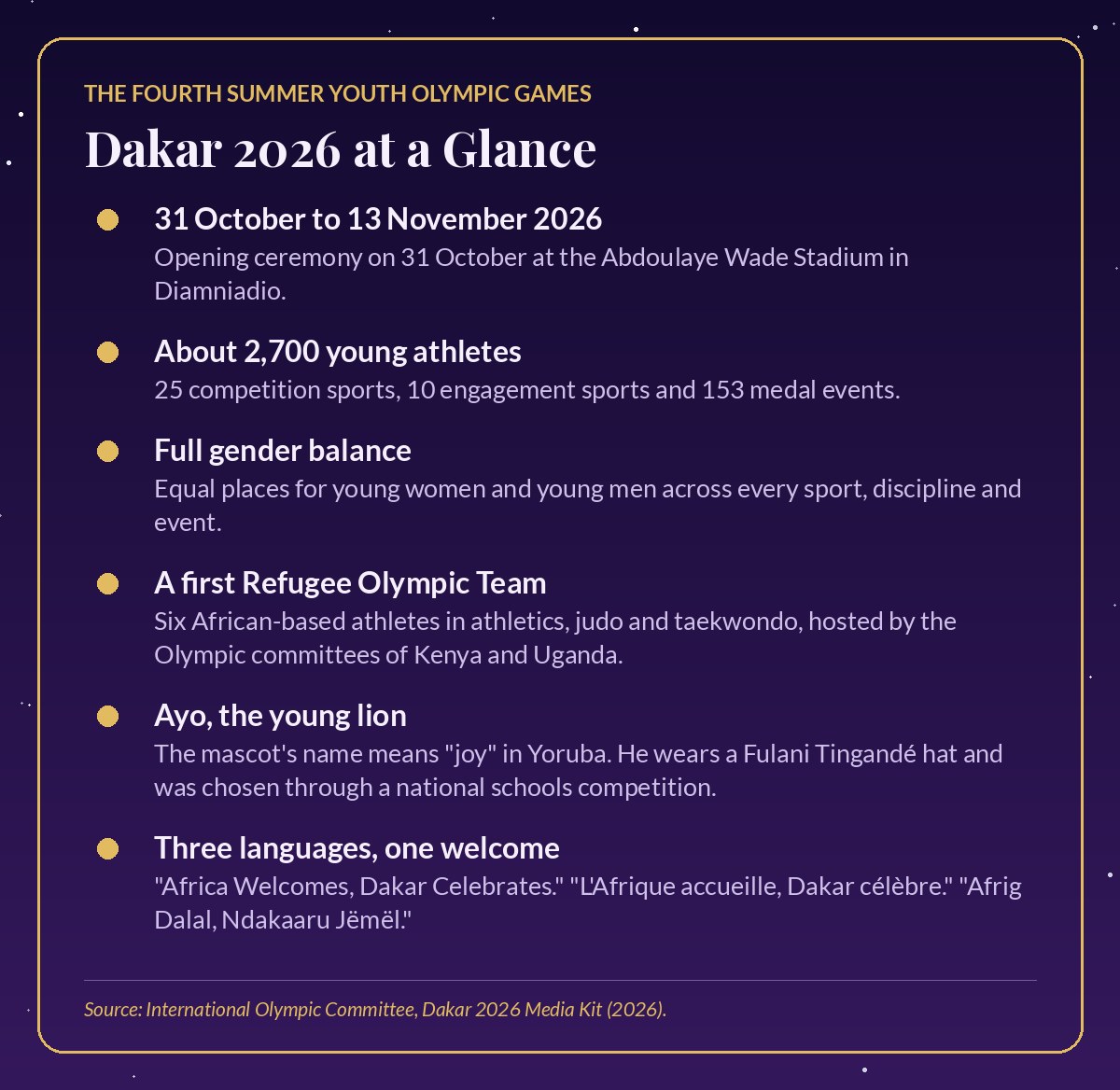
The International Olympic Committee created the Youth Olympic Games in 2007 for the world’s best young athletes, joining high-level competition with education and culture. Dakar 2026 is the fourth summer edition, after Singapore, Nanjing and Buenos Aires. From 31 October to 13 November, about 2,700 athletes will compete in 25 sports and 153 medal events, with full gender balance across every sport, discipline and event.
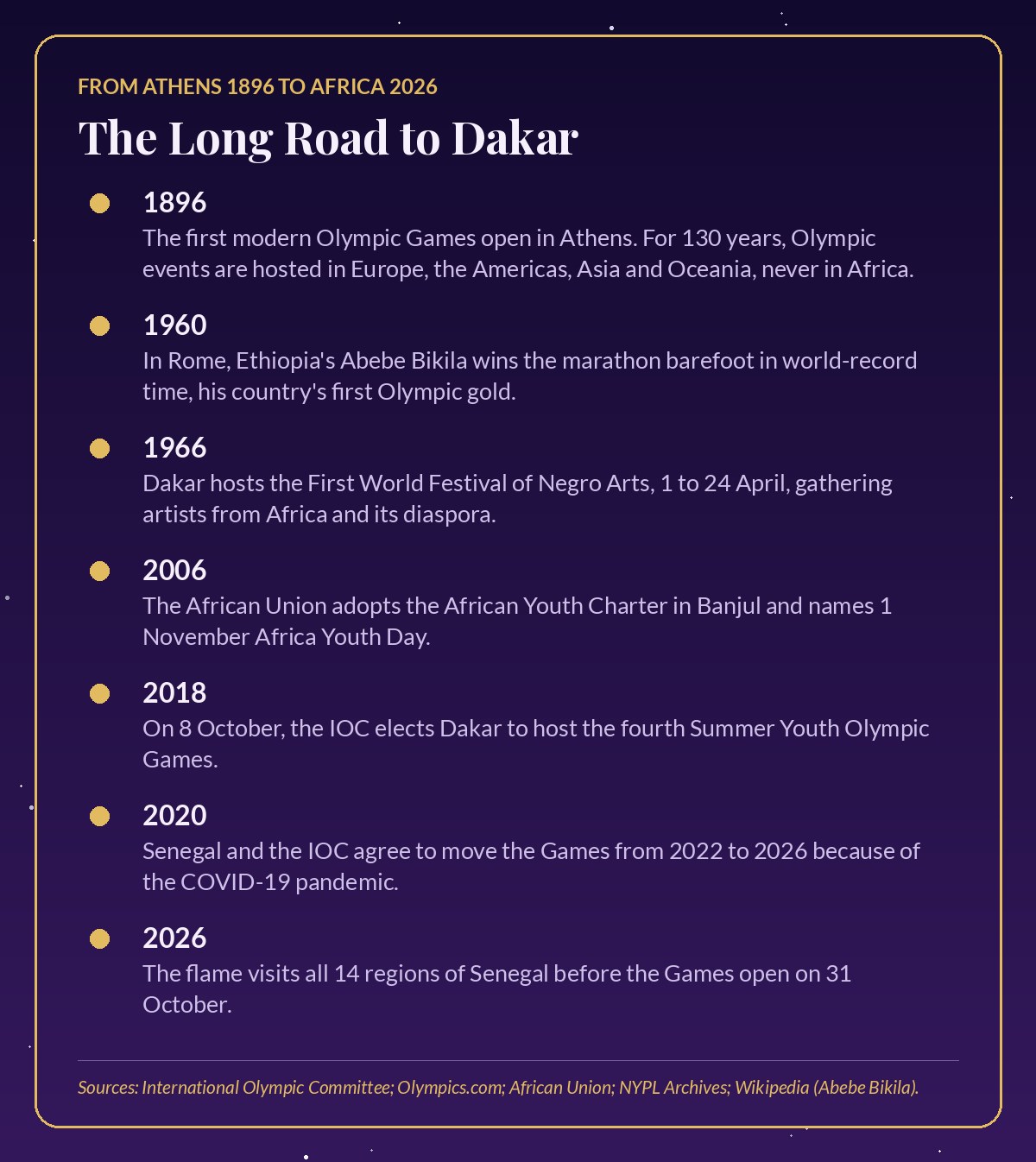
The road here was long. Senegal was elected host on 8 October 2018, and the Games were first planned for 2022. In July 2020, Senegal and the IOC agreed to move them to 2026 because of the COVID-19 pandemic. Senegal waited, prepared and kept faith.
Some details carry special meaning. Dakar 2026 is the first Youth Olympic Games with a Refugee Olympic Team: six African-based athletes in athletics, judo and taekwondo, hosted by the Olympic committees of Kenya and Uganda. The mascot, Ayo, is a young lion whose name means “joy” in Yoruba. He wears a Fulani Tingandé hat, and he was chosen through a nationwide competition for middle- and secondary-school students that drew more than 500 entries. Africa’s children helped design Africa’s welcome.
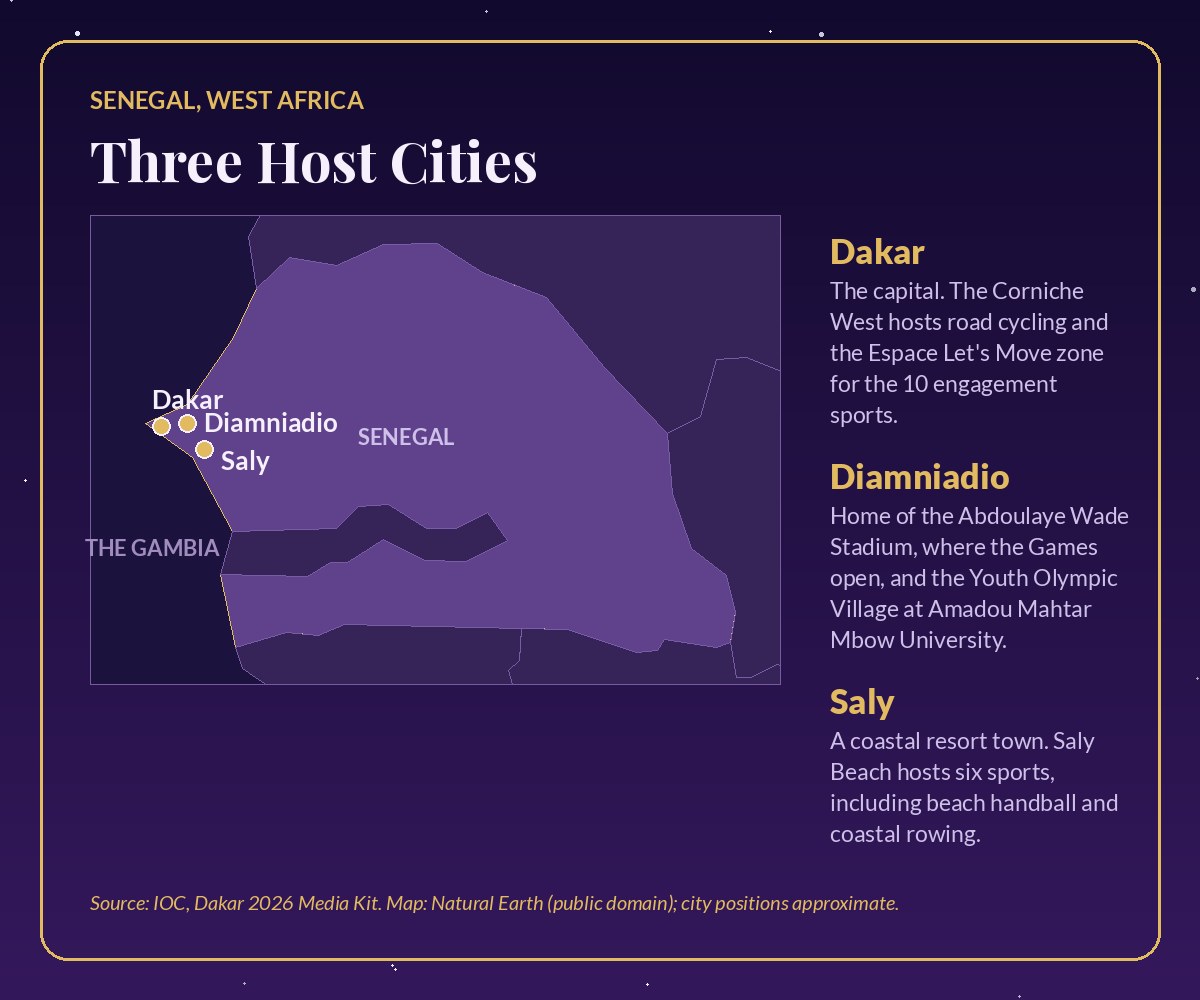
The competitions will spread across three host cities, Dakar, Diamniadio and Saly, with eight venues in all, from Saly Beach to the Corniche West in Dakar. The Youth Olympic Village is at Amadou Mahtar Mbow University in Diamniadio.
Timed for Africa’s youth
The dates were chosen with care. The IOC noted that the Games coincide with Africa Youth Day on 1 November, an important celebration in Senegal that gives school pupils more time to take part. The African Union named 1 November Africa Youth Day when it adopted the African Youth Charter in Banjul, The Gambia, in 2006. The Charter is the continent’s main legally binding instrument on the rights and development of young people aged 15 to 35.
In our view, there is something fitting in this. On the very weekend Africa celebrates its youth, the world will watch Africa’s youth compete, host and lead.
Dakar has done this before
Sixty years ago, from 1 to 24 April 1966, President Léopold Sédar Senghor’s Senegal hosted the First World Festival of Negro Arts in Dakar. More than 2,500 artists, writers, musicians and performers gathered from Africa and its diaspora, among them Duke Ellington, Langston Hughes, Josephine Baker, Aimé Césaire and Wole Soyinka. Senghor, a poet as well as a president, had helped launch the Negritude movement in 1930s Paris, inspired by the Harlem Renaissance and the jazz age. In his opening speech, he called the festival “an undertaking much more revolutionary than the exploration of the cosmos.”
Ellington never forgot it. Years later he recalled: “The cats in the bleachers really dig it … it gives us a once-in-a-lifetime feeling of having broken through to our brothers.” (As quoted by historian David Murphy in The Conversation.)
The festival had its critics, too. Historians note that it was shaped by Cold War politics, and younger, more militant voices saw many of its guests as too conservative. Still, it set a pattern: Dakar as a meeting place where Africa and its scattered children find each other again.
Barefoot into history
Africa’s Olympic story did not begin in Dakar. On 10 September 1960 in Rome, Abebe Bikila, a soldier of Ethiopia’s Imperial Guard, ran the Olympic marathon barefoot and won in 2:15:16.2, a world record and Ethiopia’s first Olympic gold medal. His route twice passed the Obelisk of Axum, which Italian forces had taken from Ethiopia in 1937 and which was not returned until 2005. Four years later in Tokyo, wearing shoes, he became the first athlete to defend an Olympic marathon title.
Sixty-six years after a barefoot African champion ran past a looted African treasure in Rome, the Olympic flame has come to Africa. Opinion: this is how history turns. Not all at once, but step by step, carried by people who keep running.
How we can stand with Dakar
- Watch and cheer. Follow the opening ceremony on 31 October and the competitions on Olympics.com, and cheer for young athletes from across Africa and the diaspora.
- Mark Africa Youth Day. On 1 November, ask a young person in your family or community what they dream of building, and help them take one step toward it.
- Learn the story. Read about the 1966 festival in Dakar and about Abebe Bikila with your children. Our victories are part of our history.
- Support youth sport at home. Give time, gear or funds to a local youth team or coach. Every champion starts on a neighborhood field.
Watch: Dakar 2026 Youth Olympic Games | Official video (IHF)
Africa welcomes. Dakar celebrates. Let us celebrate with them. Share this with a young athlete in your life, and tell us in the comments who you will be cheering for.
Sources
- International Olympic Committee: Dakar 2026 Media Kit
- International Olympic Committee: Dates for Dakar 2026 approved by IOC Executive Board
- Olympics.com: 500 days to Dakar 2026: Why the next Youth Olympic Games will be historic
- Olympics.com: 5 things to know about the opening ceremony of the Dakar 2026 Youth Olympic Games
- IOC Newsroom: Olympic history being scripted in Senegal with ten days to go until Dakar 2026 (20 October 2026)
- African Union: African Youth Charter
- African Union: African Youth Day
- NYPL Archives: United States Committee for the First World Festival of Negro Arts
- The Conversation: The first black arts festival was shaped by Cold War politics (David Murphy, 2016)
- UNESCO Multimedia Archives: First World Festival of Negro Arts, Duke Ellington (1966)
- Wikipedia: Abebe Bikila
- Wikipedia: Obelisk of Axum








You must be logged in to post a comment.