



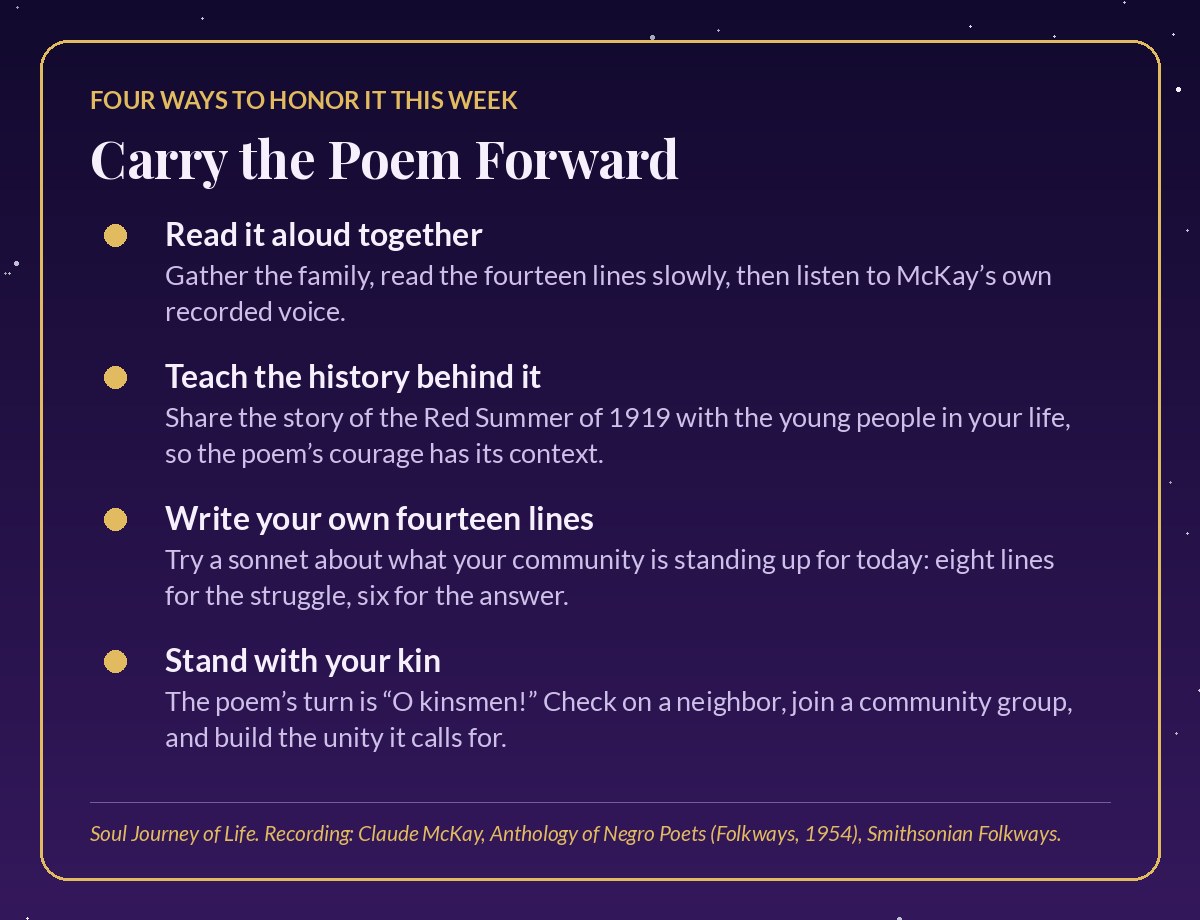
Some poems are written for a classroom. Others are written for a people in danger. In the summer of 1919, a young Jamaican-born poet working on the American railroads wrote fourteen lines that our people have carried ever since. His name was Claude McKay, and the poem was “If We Must Die.”
In this edition of Write About It, we sit with that sonnet: the terror that called it forth, the man who wrote it, and why its turning point, “O kinsmen!”, is still a call to unity for Africans at home and across the diaspora.
The year the poem was born
After the First World War, Black soldiers came home expecting the freedom they had fought for abroad. Instead they met a wave of violence. According to the Smithsonian’s National Museum of African American History and Culture, “more than 25 cities across the country suffered outbursts of racial violence” during the summer and fall of 1919, and “Seventy-two people were lynched in 1919 alone.” James Weldon Johnson of the NAACP gave those months the name that has stayed with us: the Red Summer.
In Chicago, on 27 July, a Black teenager named Eugene Williams drowned in Lake Michigan after white youths threw stones at him. Days of violence followed, leaving 38 people dead (23 Black and 15 white) and more than 500 injured. In Elaine, Arkansas, Black sharecroppers who were organizing for better crop prices were attacked; the museum estimates that “over 200 African Americans were killed.” (Verification note: estimates for Elaine vary; the National Archives gives “over 100.”)
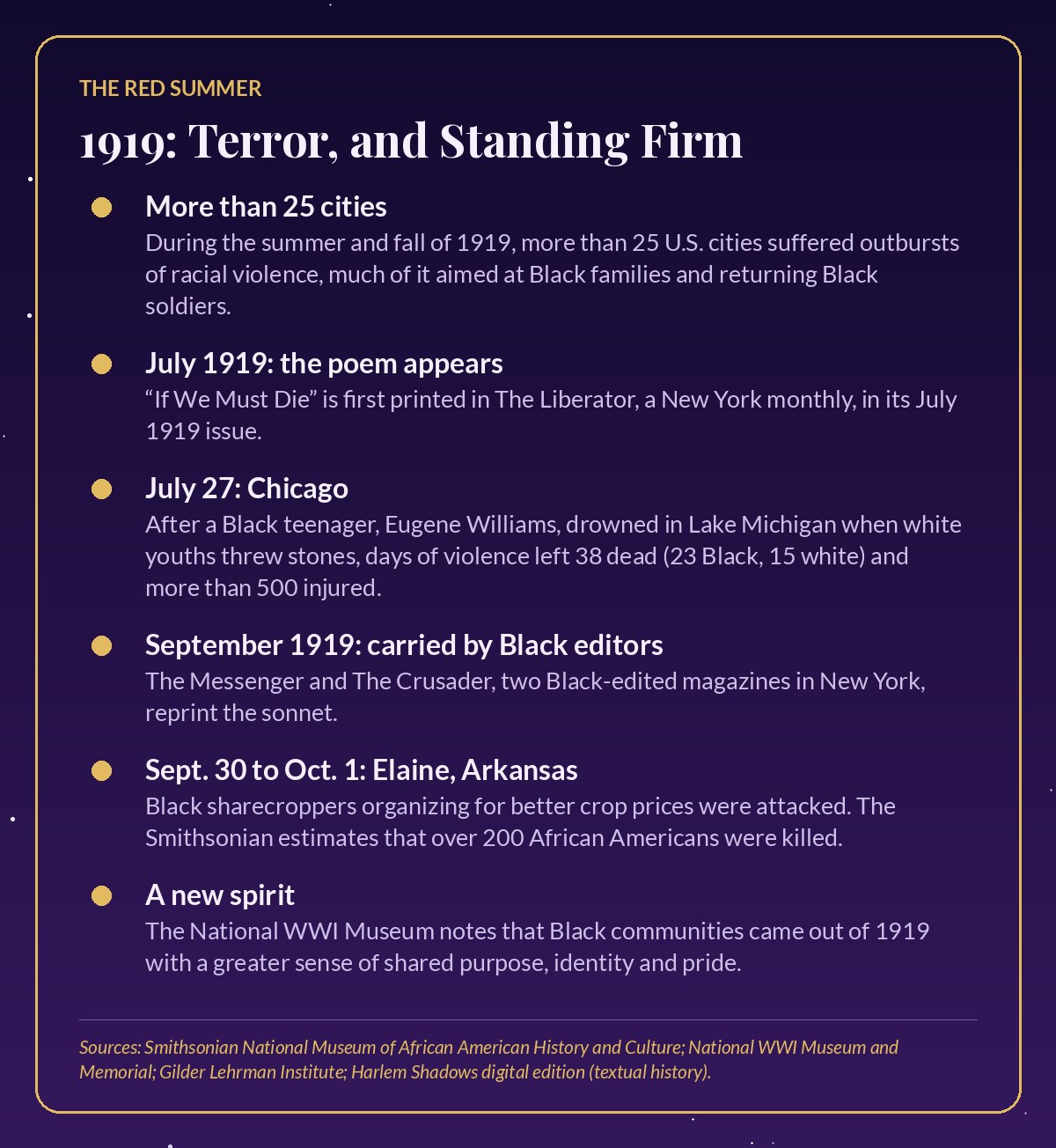
McKay later described those months in his autobiography, A Long Way from Home (1937): “Our Negro newspapers were morbid, full of details of clashes between colored and white, murderous shootings and hangings.” He and his fellow Black railroad workers, he wrote, “stuck together, some of us armed, going from the railroad station to our quarters.” It was in that atmosphere that the sonnet came to him.
The poem
Here is “If We Must Die” as McKay collected it in his book Harlem Shadows (1922). The poem is in the public domain in the United States.
If we must die, let it not be like hogs
Claude McKay, “If We Must Die,” Harlem Shadows (1922)
Hunted and penned in an inglorious spot,
While round us bark the mad and hungry dogs,
Making their mock at our accursèd lot.
If we must die, O let us nobly die,
So that our precious blood may not be shed
In vain; then even the monsters we defy
Shall be constrained to honor us though dead!
O kinsmen! we must meet the common foe!
Though far outnumbered let us show us brave,
And for their thousand blows deal one death-blow!
What though before us lies the open grave?
Like men we’ll face the murderous, cowardly pack,
Pressed to the wall, dying, but fighting back!
(Text note: the first printing, in The Liberator of July 1919, differs slightly. For example, line 10 there reads “Though far outnumbered, let us still be brave,” as transcribed by the Gilder Lehrman Institute of American History.)
A Caribbean voice for the whole diaspora
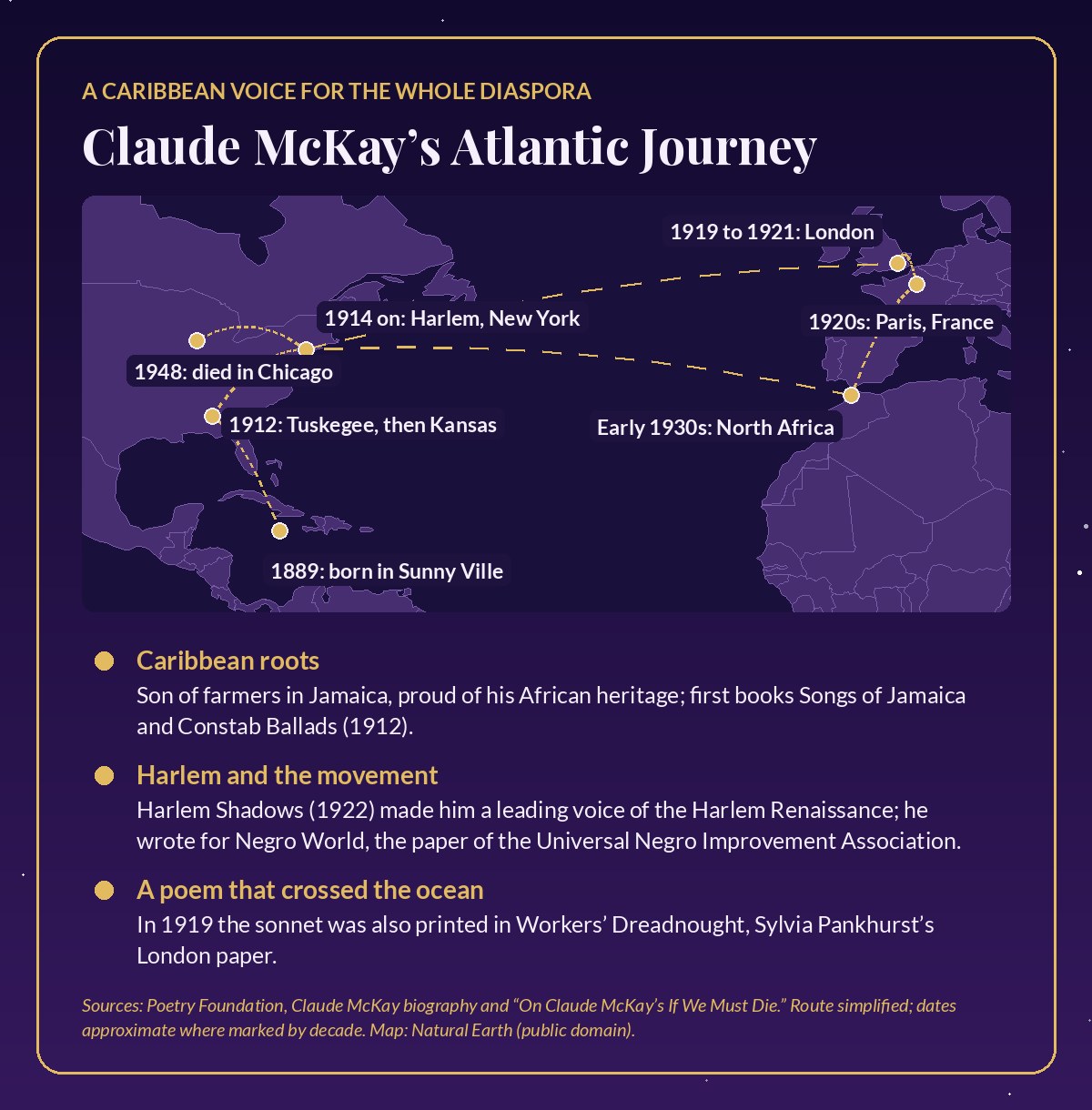
McKay was born in 1889 in Sunny Ville, Jamaica, the son of farmers. The Poetry Foundation writes that he “was infused with pride in his African heritage.” He published his first two books of poems, Songs of Jamaica and Constab Ballads, in 1912, then sailed to the United States, studying briefly at Tuskegee Institute and Kansas State College before settling in New York in 1914.
His story is a Pan-African story. A son of the Caribbean, he became one of the leading voices of the Harlem Renaissance, wrote for Negro World, the newspaper of Marcus Garvey’s Universal Negro Improvement Association, and lived for years in Europe and North Africa before returning to Harlem in the 1930s. He died in Chicago in 1948.
The poem travelled the same roads. After The Liberator printed it, two Black-edited New York magazines reprinted it that September: The Messenger, co-founded by A. Philip Randolph, and The Crusader, edited by the Nevis-born Cyril Briggs, which took “Africa for the Africans” as its credo, according to BlackPast. In London, Sylvia Pankhurst’s Workers’ Dreadnought printed it too.
The turn: “O kinsmen!”
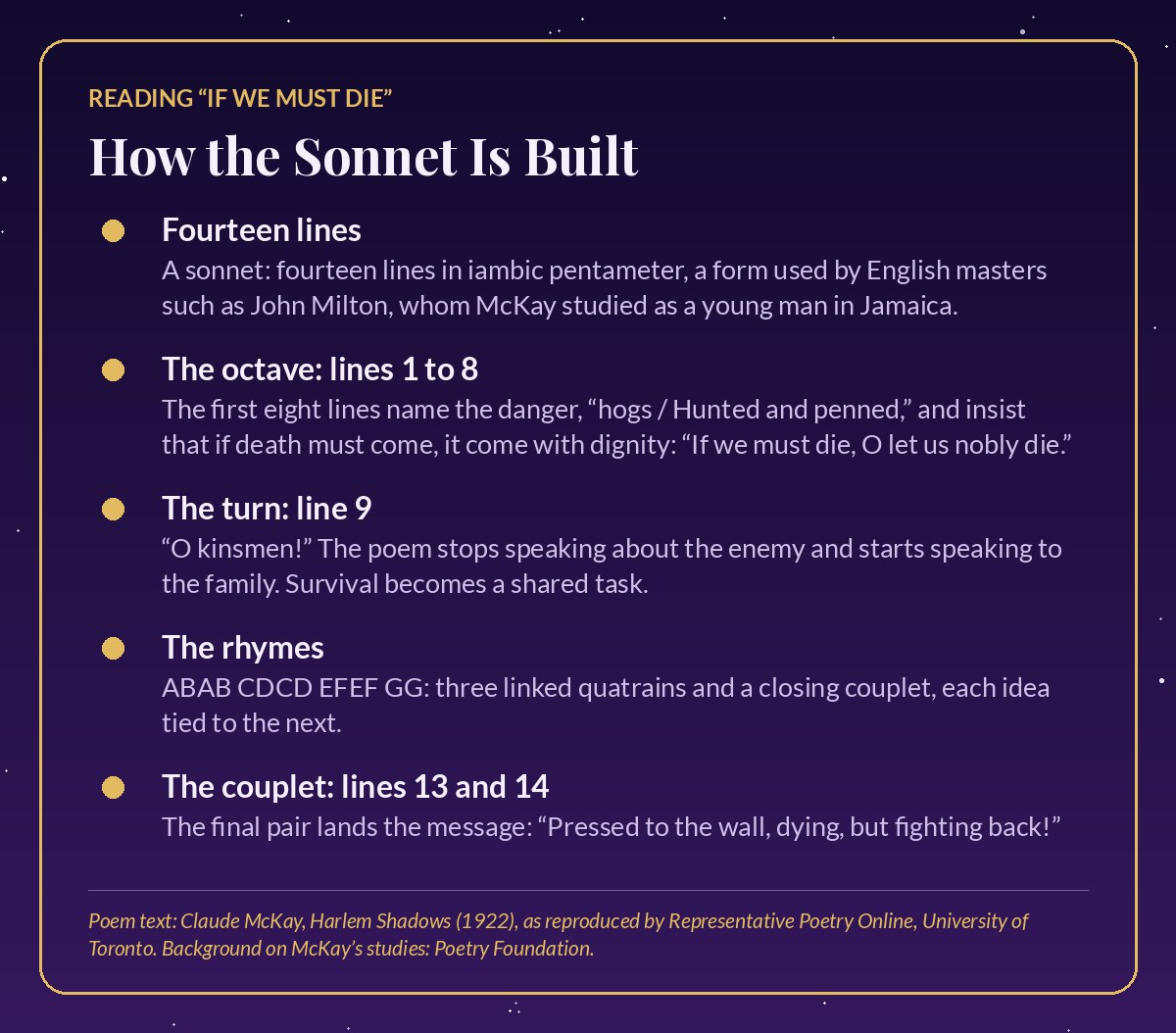
McKay chose the sonnet, an old and formal English shape, and filled it with fire. The first eight lines face the danger and refuse to be treated like “hogs / Hunted and penned.” Then, at line 9, the poem turns. It stops talking about the enemy and speaks to family: “O kinsmen! we must meet the common foe!”
In our view, that turn is the heart of the poem. Dignity alone is not enough; dignity is carried together. A people “far outnumbered” becomes strong when it answers as one. That is the lesson Pan-Africanism has always taught, from Kingston to Harlem to Accra.
A poem for everyone pressed to the wall
Notice that the poem never names a race. In a spoken introduction he recorded for the poem, later released on the Folkways album Anthology of Negro Poets (1954), McKay said he had “always felt that my gift of song was something bigger than the narrow confining limits of any one people and its problems.” He told of hearing the poem read on the radio in 1944 after it was found on the body of a young white American soldier, and said: “I felt assurance that ‘If We Must Die’ was just what I intended it to be, a universal poem.” (Quotations as transcribed from that recording by the Harlem Shadows digital edition.)
The critic Jean Wagner, quoted by the Poetry Foundation, wrote that the poem “voices also the will of oppressed people of every age who, whatever their race and wherever their region, are fighting with their backs against the wall to win their freedom.”
In our view, this is not a contradiction. The poem was born from Black suffering and Black courage, and because it was true to us, it became true for others too. Our particular struggle has a universal voice.
What the poem asks of us now
“If We Must Die” is not a call to seek out violence. It is a refusal to accept humiliation, and a call to meet hardship with courage, unity and self-respect. The Red Summer did not break our people. The National WWI Museum and Memorial notes that African Americans “emerged from the violence of that bloody year with a greater sense of shared purpose, identity and pride, which served as a vital foundation for the civil rights movement to come.”
Today the threats look different, but the question McKay posed remains: when pressure comes, will we face it scattered, or as kin?
Watch: Claude McKay performs “If We Must Die” (Audio Only), from ModPo on YouTube
Hear it in McKay’s own voice. His reading was released on Anthology of Negro Poets (Folkways Records, 1954), now held by Smithsonian Folkways.
May we honor the ancestors who stood with their backs against the wall, and may we stand with one another. Read the poem aloud tonight with someone you love, and when you reach “O kinsmen!”, look at the people beside you.
Sources
- Representative Poetry Online, University of Toronto: “If We Must Die” (text from Harlem Shadows, 1922)
- Gilder Lehrman Institute of American History: “If We Must Die” (1919), first printing in The Liberator
- Harlem Shadows digital edition: “If We Must Die,” textual history and McKay’s own accounts
- Poetry Foundation: Claude McKay biography
- Poetry Foundation: On Claude McKay’s “If We Must Die”
- Smithsonian National Museum of African American History and Culture: Red Summer Race Riots
- National Archives: Racial Violence and the Red Summer
- National WWI Museum and Memorial: Red Summer
- BlackPast: The Crusader (1918–1922)
- American Historical Association, Perspectives on History: An Act of “Tactical History” (the term Red Summer)
- Smithsonian Folkways: Claude McKay, “If We Must Die,” Anthology of Negro Poets (1954)
Written by Glowing Candle for Soul Journey of Life.

Write About It is brought to you by Soul Journey of Life. Conscious. Constructive. United.









You must be logged in to post a comment.