




Young thinker —
There is a West African folktale about a mosquito who told one small, silly untruth. Nobody stopped to ask whether it was true, and by morning the whole forest was in trouble and the sun had not come up.
Pair it with a real life of our time: Dr. Joy Buolamwini, the Ghanaian-American computer scientist who noticed that a computer could not “see” her face, and then tested the machines until the truth came out.
Two stories, one lesson: before you believe it, share it, or build on it, check it.
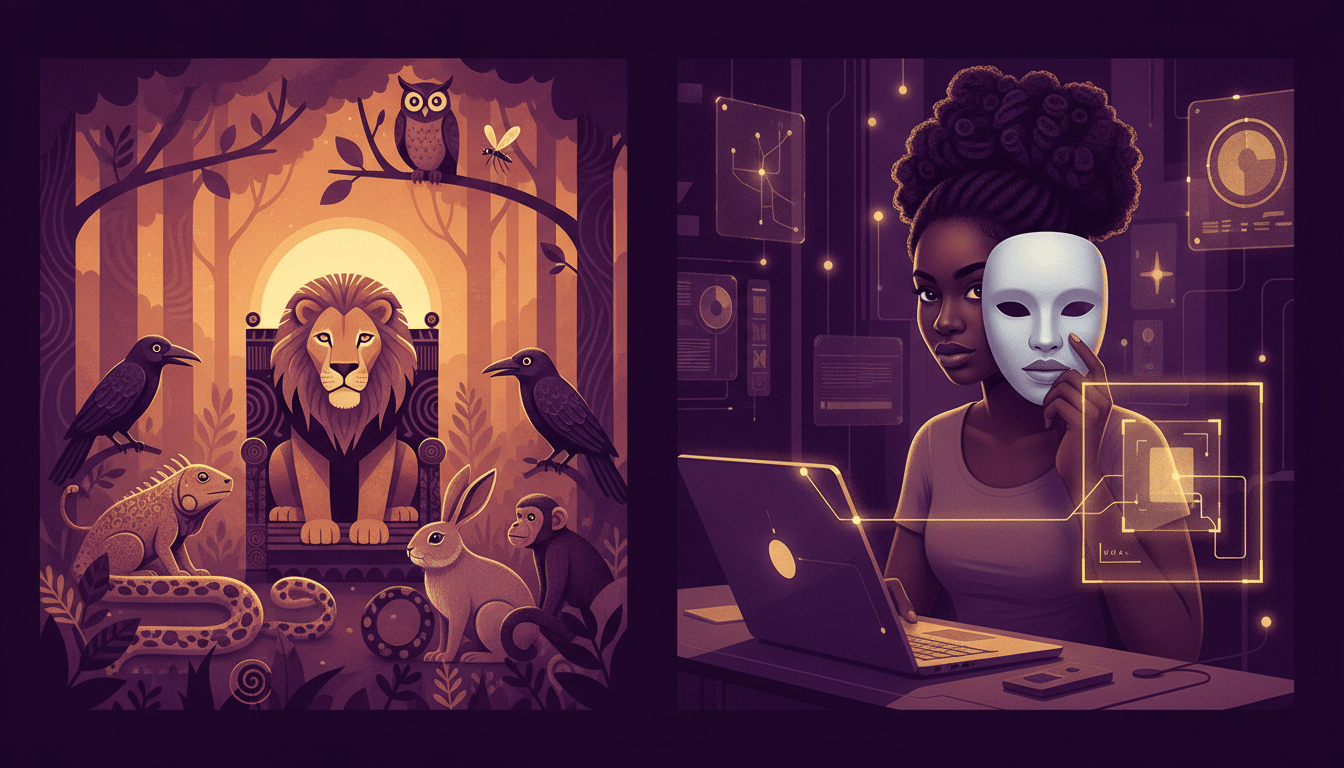
Pocket fable: Why Mosquitoes Buzz in People’s Ears
One morning, Mosquito told Iguana that she had seen a farmer digging yams almost as big as Mosquito herself. “What nonsense!” said Iguana. He did not want to hear any more of it, so he pushed two sticks into his ears and walked off.
Because his ears were stopped, Iguana did not hear Python greet him. Python thought, “Iguana is angry with me. He must be planning something!” So Python slid into Rabbit’s burrow to hide. Rabbit ran out in fright. Crow saw Rabbit running and flew off crying danger. Monkey heard Crow, leaped through the trees to warn everyone, and broke a dead branch. The branch fell on an owl’s nest, and one of Mother Owl’s owlets was killed.
Mother Owl was so full of sorrow that she would not hoot to wake the sun. The night went on and on.
King Lion called a council. He asked each animal, one by one, “Why did you do it?” Each one pointed to the one before: Mother Owl to Monkey, Monkey to Crow, Crow to Rabbit, Rabbit to Python, Python to Iguana. Iguana took the sticks out of his ears and said, “It was Mosquito, telling me a tale I did not want to hear!” The council agreed Mosquito should answer for it. Mother Owl, satisfied, hooted, and the sun came up.
Mosquito hid and was never punished. But to this day, the story says, she flies close to our ears and whines, “Zeee! Is everyone still angry at me?” And she gets an honest answer: Kpao! (Verified: this follows Verna Aardema’s published retelling, Why Mosquitoes Buzz in People’s Ears, Dial, 1975.)
Folktale retold in our own words; versions vary by teller. It is a story, not history.
Notice: the mosquito started it, but every animal guessed instead of asking. One untrue story only becomes a disaster when nobody checks it.
The real-life echo: Dr. Joy Buolamwini
Joy Buolamwini was born in Edmonton, Canada, to Ghanaian parents. She spent her early childhood in Ghana and moved to the United States at age four, when her father took a post at the University of Mississippi. (Verified: Carnegie Corporation of New York, Great Immigrants profile.)
As a computer science student at the Georgia Institute of Technology, she programmed a social robot to play peekaboo. There was one problem: the robot’s face-detection software had trouble recognizing her dark-skinned face. To finish the assignment, she had to use a white housemate’s face. Later, at the MIT Media Lab, she found that some software only detected her face when she held up a plain white mask.
She did not just shrug and move on. She asked a scientist’s question: Is this machine really as accurate as people say, and for whom? With Dr. Timnit Gebru, she built a new set of test faces balanced by gender and skin type and checked three commercial gender-classification systems. Their 2018 study, Gender Shades, found error rates of up to 34.7% for darker-skinned women, while the maximum error rate for lighter-skinned men was 0.8%. (Verified: Buolamwini & Gebru, Gender Shades, PMLR 81, 2018; the three systems tested were from IBM, Microsoft and Face++. The MIT Media Lab results page confirms the 34.7% figure.)
In 2016 she founded the Algorithmic Justice League to make technology more fair and accountable. (Verified: founding year 2016, per the Carnegie profile.) She was a Rhodes Scholar and a Fulbright Fellow, holds master’s degrees from the University of Oxford and MIT, and calls herself a “poet of code,” using spoken word as well as research to explain what she found. Her book is Unmasking AI (2023).
The fable and Dr. Buolamwini say the same thing from two directions: a story, a rumor, or a machine can be wrong, and the brave and brilliant thing is to test it.
Intellectual encouragement
Checking is not rudeness. It is respect: respect for the truth, for the people a mistake could hurt, and for your own mind. In the fable, one honest question at any point would have saved the night. Iguana could have asked Mosquito, “Did you really see that?” Python could have asked Iguana, “Are you angry with me?”
Science, good journalism, and good engineering all run on the same habit: ask for the evidence, test it fairly, write down what you find, and change your mind when the facts say so. Dr. Buolamwini’s discovery started with something she noticed about her own face. Your experiences count as evidence too. Pay attention to them.
Be the one who asks, “How do we know that’s true?” Then go find out.
Tech motivation checklist (this week)
- Do a three-question check: Before you share a post, ask: Who said it? Where is the proof? Do two other trustworthy sources say the same thing?
- Trace a rumor: Pick a story going around online and try to find where it first started, the way King Lion traced the chain back to Mosquito.
- Test a machine: Try a phone’s face unlock, a photo filter, or a voice assistant in different lighting, accents, or settings, and write down when it works and when it fails. That is a small fairness test.
- Learn what “training data” means: Look up how computers learn from examples, then ask who was, and was not, included in those examples.
- Write it as a poem: Dr. Buolamwini is a “poet of code.” Write four lines about something you discovered this week, then share it with a friend or teacher.
Sources & further reading
- Joy Buolamwini and Timnit Gebru, “Gender Shades: Intersectional Accuracy Disparities in Commercial Gender Classification,” Proceedings of Machine Learning Research 81 (2018): paper
- MIT Media Lab: Gender Shades results
- MIT Media Lab: Joy Buolamwini, overview
- Carnegie Corporation of New York, Great Immigrants: Joy Buolamwini
- Joy Buolamwini, Unmasking AI: My Mission to Protect What Is Human in a World of Machines (Random House, 2023).
- Verna Aardema, Why Mosquitoes Buzz in People’s Ears: A West African Tale, illustrated by Leo and Diane Dillon (Dial, 1975): Penguin Random House page
- American Library Association: 1976 Caldecott Medal, Why Mosquitoes Buzz in People’s Ears. Leo Dillon, an illustrator of the book, became the first African American artist to win the Caldecott Medal. (Verified: the American Library Association lists the book as the 1976 Caldecott Medal winner, illustrated by Leo and Diane Dillon.)

Check the Story Before You Pass It On is brought to you by Soul Journey of Life.
Featured and supporting images: AI-generated illustrations.
Recommend0 recommendationsPublished in Write About It









You must be logged in to post a comment.