


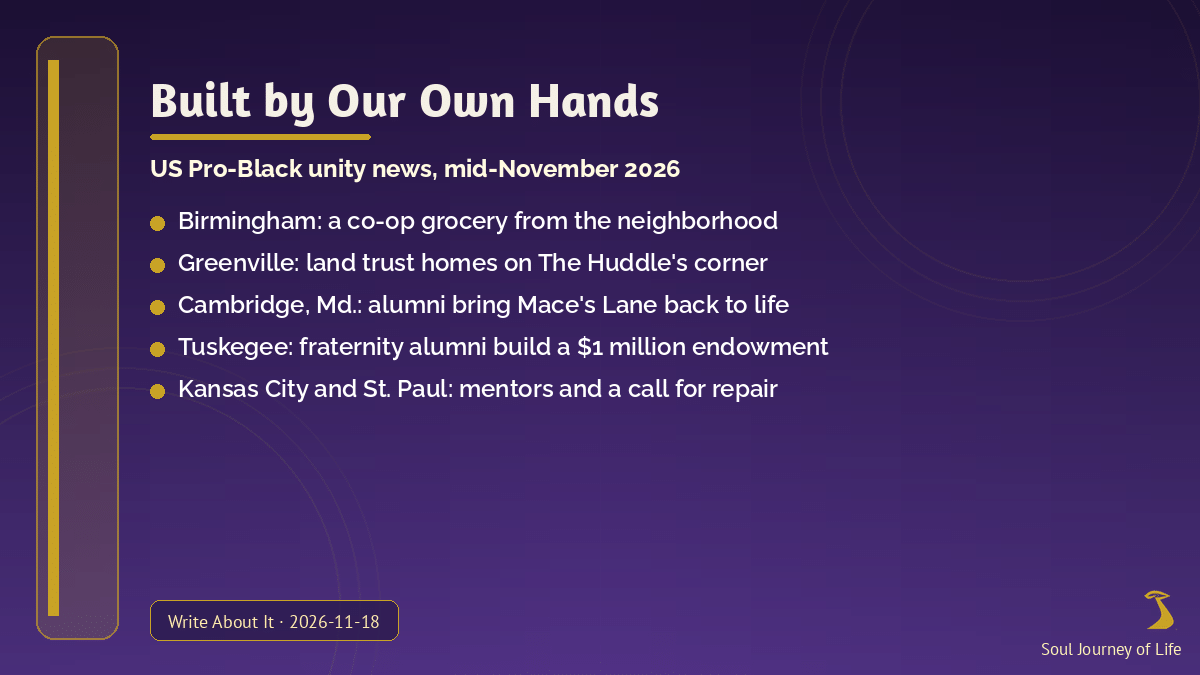

What we build with our own hands, we keep. This week’s good news comes from people who stopped waiting. In Birmingham, a front-yard garden became a neighborhood grocery. In Greenville, a land trust is raising homes on a corner where Black Greenville once gathered. In Cambridge, Maryland, alumni brought their old segregation-era high school back to life for children. At Tuskegee, fraternity brothers pooled their giving into a million-dollar endowment. In Kansas City, barbers and mentors are raising “nephews.” And in St. Paul, a reparations commission is asking Black residents to come and say what repair should look like. Ownership, memory and showing up: that is how a people build.
Owning the block
Birmingham, Alabama: a store from Fountain Heights
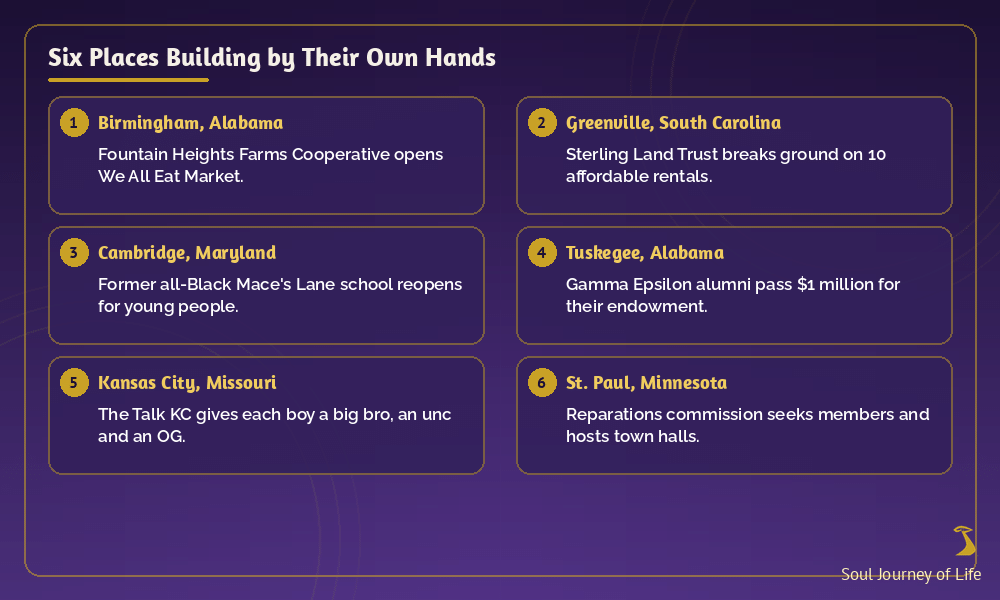
Last month we watched Fountain Heights Farms Cooperative get ready. On Saturday, November 7, the doors opened. The Black-owned urban farm cooperative, founded in 2016 by M. Dominique Villanueva and Christopher Gooden, opened We All Eat Market and a community kitchen inside its new Heart of the Farm building at 1201 16th St. N., giving the neighborhood its first grocery store in nearly 70 years, The Birmingham Times reported. The market sells produce from the cooperative’s own plots and from fellow farmers in places such as Tuskegee and Greene County, accepts SNAP and takes part in Double Up Bucks.
*Note: “Nearly 70 years” is the founders’ and neighborhood elders’ framing; WBRC notes there is no official record of that timeline.
Villanueva was clear about whose store it is: “This is not a store that came to Fountain Heights. This is a store from Fountain Heights. It started with one garden in our front yard and a handful of neighbors who decided we were tired of waiting for someone else to feed our families.”
The neighbors carried it too. Gooden told WBRC: “From neighbors and folks passing by, we raised about $30,000 in just ones, fives, 20s, just people stopping by and saying, hey, we see what you’re doing. We appreciate it. Let’s see where we can go.” At the opening, Jefferson County Commissioner Sheila Tyson pledged $25,000 and City Councilor LaTonya Tate pledged $40,000, according to the Times. The cooperative now works 16 farm plots and aims for 119 by 2030. Afiya Madzimoyo of the AYA Educational Institute named the lesson: “We’re celebrating what happens when people look at what we need and then decide we don’t have to wait for somebody else. We can do it for ourselves.”
*Note: The $25,000 and $40,000 are pledges announced at the opening, not confirmed payments; the $30,000 is Gooden’s own estimate.
Greenville, South Carolina: homes on The Huddle’s corner
On November 5, the Sterling Land Trust and the Greenville Housing Fund broke ground on The Huddle at Sterling, a $3.3 million project of 10 long-term rental homes in five stacked duplexes in Greenville’s historic Sterling neighborhood, the Greenville Journal reported. The homes will serve people earning between 60% and 80% of the area median income, and the land trust owns the three parcels at Jenkins and South Calhoun streets. About 200 people attended, and Mayor Knox White proclaimed the day “Sterling High School Day.”
The name carries memory. FOX Carolina reported that the site was home to The Huddle, a social hub for Greenville’s African American community during the Jim Crow era, and that the land trust will receive 50% of the rental profits to fund neighborhood enrichment and youth after-school programs at the only remaining structure of historic Sterling High School. Land trust president James Thompson said: “The Huddle at Sterling is a testament to what happens when a community believes in its future and works together to make it happen.” First residents are expected in January 2028.
*Note: The 50% rental-profit share and the January 2028 move-in are the organizers’ plans for the project.
Bringing our schools and students home
Cambridge, Maryland: Mace’s Lane lives again
On Thursday, November 12, alumni, children and officials cut the ribbon on the new Boys & Girls Club at Mace’s Lane Community Center, WBOC reported. The building at 1099 Mace’s Lane was built in 1952 as an all-Black high school serving African American students from across Dorchester County during segregation. WHCP reported that every speaker saluted the Mace’s Lane alumni who envisioned the rebirth of their abandoned school, and that the center is also home to the Edythe M. Jolley Museum and Cultural Center.
A piece of the original gym floor greets visitors, carved into the sound wave of the school’s alma mater. Mayor Lajan Cephas Bey, who attended middle school there, said: “I’m so happy that it’s been brought back to life so that other kids can come in here and walk in these halls of power – there’s so much power in these spaces.” Former student Barbara Woolford said of today’s children: “I hope they feel strong, and I can do anything.” The club officially opens to the community shortly after the new year.
Tuskegee, Alabama: brothers who did not wait for a billionaire
At Tuskegee University’s 2026 Homecoming, the Gamma Epsilon Alumni Association, alumni of Tuskegee’s Gamma Epsilon Chapter of Kappa Alpha Psi Fraternity, Inc., announced $1,001,911 in support of its Tuskegee University endowment, the university reported on November 12. The association, with more than 700 members, has also given more than $60,000 in scholarships and helped clear outstanding balances for multiple students.
*Note: The $1,001,911 figure and the association’s giving totals come from Tuskegee University’s own November 12 release. The university’s November 11 Homecoming recap lists the same group’s support as $1,015,000 “through a multi-year effort”; either way, it passes $1 million.
Endowment chair Sam Sealy said the mission began after Robert Smith paid off a Morehouse class’s student loans: “My response became, ‘Why do we have to wait for a billionaire?’ This was not easy but I believe we can do great things through community.” Association president Christopher Williams said: “GEAA is committed to doing our part to help young Black men get to college, remain in college, and successfully graduate.”
Showing up for each other
Kansas City, Missouri: a big bro, an unc and an OG
KSHB 41 reported on November 11 on The Talk KC, a monthly barbershop program for Black and Brown boys in grades six through 12. Founder Tay Neal explained the model: “We use a multi-generational model. So, our mentees are called nephews, and they get three mentors. They get a big bro, they get a unc, and they get a OG.” Boys also get free haircuts, hot meals, culturally relevant reading, literacy activities and access to therapists.
*Note: Details of The Talk KC rest on a single KSHB 41 feature and on the organizers’ description of the program.
Eighth grader Gabriel Davis put it best: “I got family by my side. That’s not blood but family as a bond.”
St. Paul, Minnesota: come and say what repair looks like
The St. Paul City Council opened a 30-day window on November 13 to fill five open seats on the 11-member Saint Paul Recovery Act Community Reparations Commission, which advises the city on repairing harms including redlining, racial covenants and the destruction of the Rondo neighborhood for Interstate 94. The Minnesota Spokesman-Recorder reported that the commission and the African American Redress Network will host three town halls for Black St. Paul residents to share their experiences and ideas for repair: November 19 (4:30–6:30 p.m.) and November 20 (6–8 p.m.) at Hallie Q. Brown Community Center, and November 21 (10:30 a.m.–12:30 p.m.) at Arlington Hills Community Center. Organizers say the input will help shape the commission’s research and recommendations.
Lessons we can carry
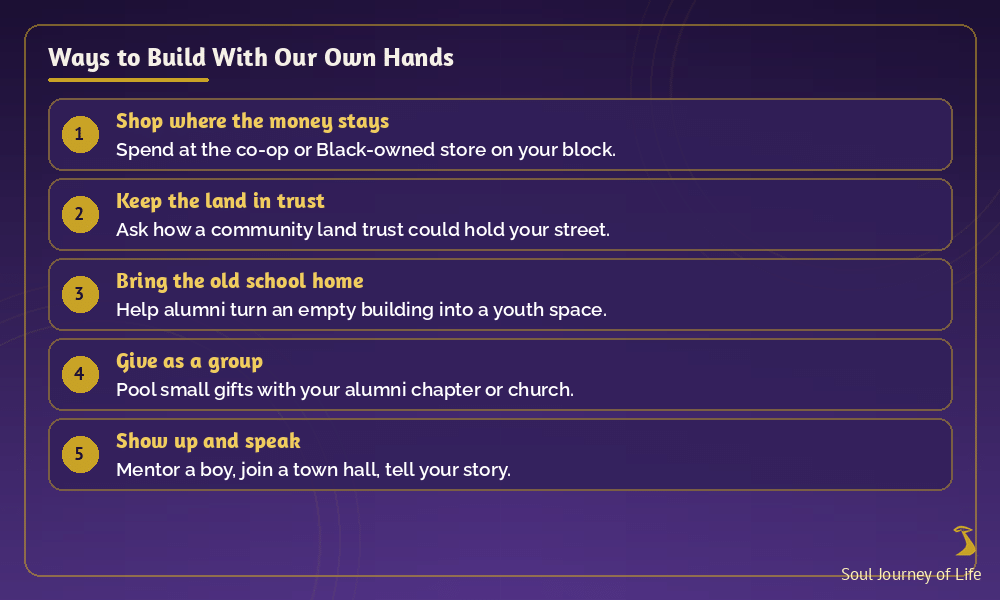
- Build it from the block. Fountain Heights proves that ones, fives and twenties from neighbors can grow into a grocery.
- Hold the land together. Sterling’s land trust keeps the ground in community hands and sends rent back to the children.
- Bring the old school home. Mace’s Lane alumni turned an abandoned building into a place where children can feel strong.
- Give as a group. Tuskegee’s Kappa alumni showed that organized, ordinary giving can endow the future.
- Show up and speak. Kansas City’s mentors and St. Paul’s town halls only work when we walk in the door.
Encouragement
This week, put your hands to one thing your people already own or could own: shop at the co-op, ask about a community land trust, call your old school’s alumni group, add to a chapter fund, or ask a boy in the barber’s chair how he is doing. If you live in St. Paul, go to a town hall and tell your story. Small hands, joined together, build big houses.
Watch: We All Eat Market’s delivery service and new plots; The Huddle at Sterling’s road to 2028; the Mace’s Lane club and museum in the new year; and what St. Paul’s town halls add to the commission’s Harm Report.
Want to keep learning? The beginner courses on Soul Journey of Life are free, including Learning Sierra Leone’s Krio and Its Usefulness Today, English Grammar for Beginners and English Phonics for Beginners: https://souljourneyoflife.org/courses/
Sources
- The Birmingham Times on the We All Eat Market opening in Fountain Heights
- WBRC on Fountain Heights’ first grocery store in about 70 years
- Greenville Journal on The Huddle at Sterling groundbreaking
- FOX Carolina on The Huddle at Sterling and the historic soda shop
- WBOC on the Mace’s Lane Boys & Girls Club opening
- WHCP on the Mace’s Lane Community Center dedication
- Tuskegee University on the Gamma Epsilon Alumni Association endowment
- KSHB 41 on The Talk KC barbershop mentoring program
- Minnesota Spokesman-Recorder on the St. Paul reparations commission and town halls
- City of Saint Paul on the reparations commission application window
Written by Glowing Candle for Soul Journey of Life.

Write About It is brought to you by Soul Journey of Life. Conscious. Constructive. United.









You must be logged in to post a comment.