


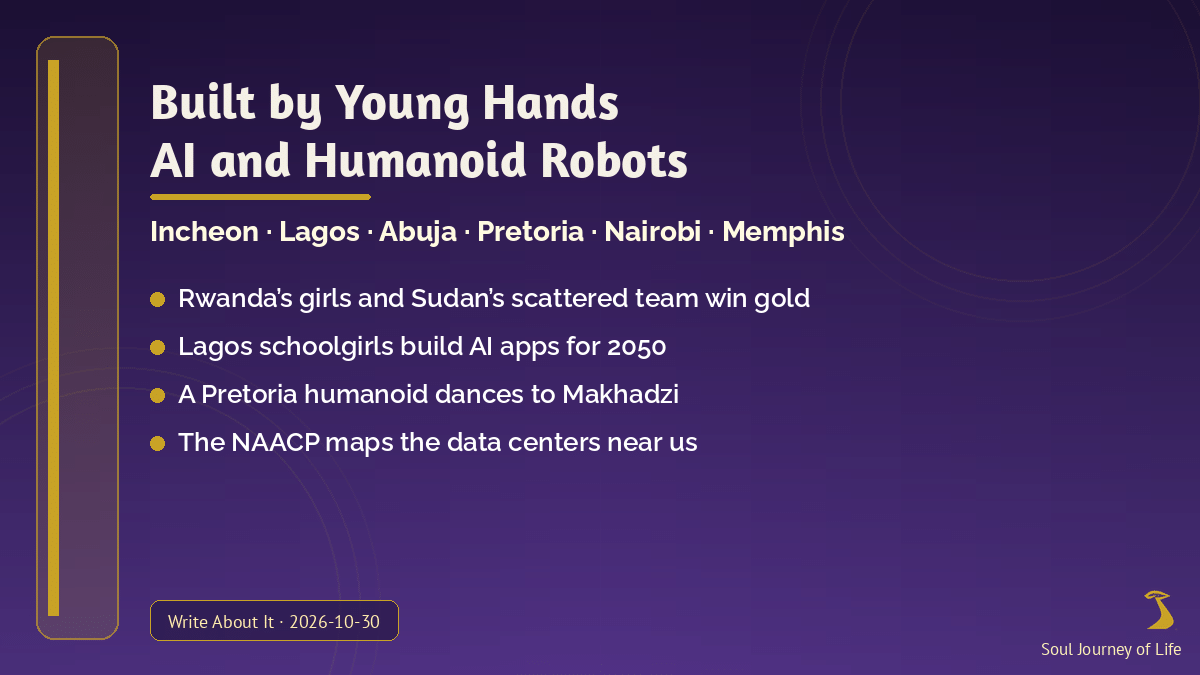

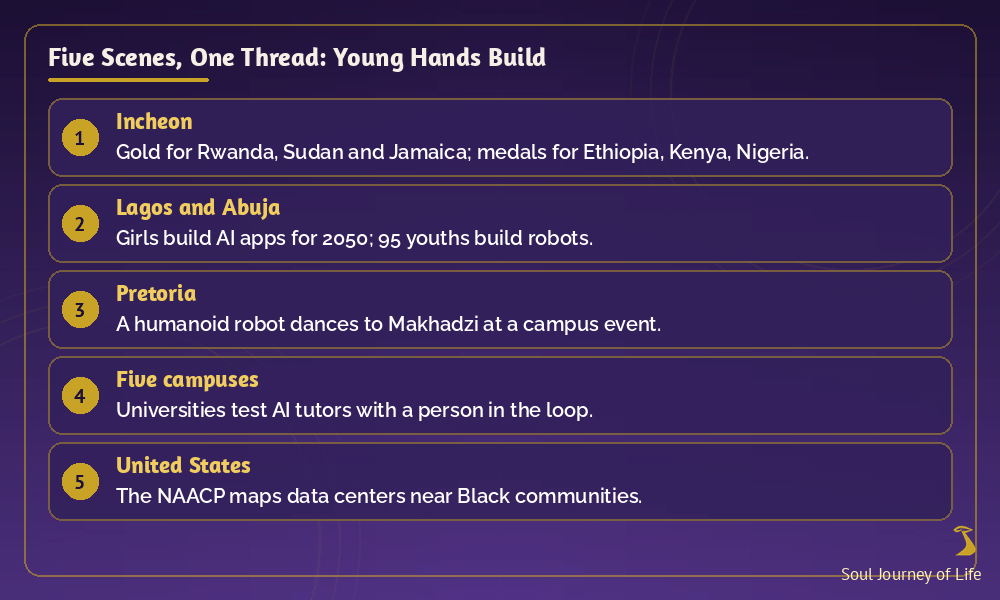
Every week brings another headline about robots that walk, talk and dance, and about the giant computers that power artificial intelligence. Behind those headlines, the more hopeful story is about who is learning to build, question and steer these machines. This month, an all-girl team from Rwanda and a Sudanese team scattered by war took gold at a world robotics contest in Incheon, alongside medals for Ethiopia, Kenya, Nigeria and Jamaica. In Lagos, schoolgirls built AI apps for the Nigeria of 2050. In Pretoria, a humanoid robot danced to Makhadzi and South Africans laughed along. Five African universities began testing AI with a person always in the loop. And across the United States, the NAACP launched a map that shows Black voters where the data centers are. Different places, one thread: the future of the machines is being built by young hands, and watched by careful eyes.
What is happening on the ground
Incheon: Africa and Jamaica on the podium (Oct 7 to 10)
The 2026 FIRST Global Challenge, held in Incheon, South Korea, from 7 to 10 October, brought together national teams of high school students from nearly 190 countries. This year’s game asked them to build robots around the fight against wildfires: prevention, mitigation and recovery. Teams played in alliances that changed from match to match, so every country had to learn to work with strangers.
According to the official award list from the organisers, Rwanda won gold in the Judges Award, with Ethiopia taking silver. Team Rwanda’s own page describes a squad of five girls, several of them students at Lycée Notre Dame de Cîteaux, in a team led by Theophile Muroti, who has taken part in the challenge since 2017. Kenya won bronze in the Dr. Mae Jemison Award for International Unity, and Kenya’s mentor Kelvin Gitau received the Margaret and Woodie Flowers Mentorship Award. Nigeria won bronze in the Katherine Johnson Award for Engineering Documentation. Algeria and Tunisia took gold and silver for International Enthusiasm.
The story that stays with you is Sudan’s. The Sudanese Innovations and Robotics Team won gold in the Courageous Achievement Award. Sudan Nabaa reports that its students and coaches designed and programmed their robot remotely while dispersed across nine countries, including Sudan, Egypt, Saudi Arabia, the United Arab Emirates, Kenya and Malaysia, because of the ongoing war in Sudan. (Single source: the nine-countries detail is reported by Sudan Nabaa only; the organisers’ release confirms the gold but not this detail.) The award recognises teams that show resilience and overcome hardship alongside their technical work.
In the Caribbean, Team Jamaica won gold for Innovation in Engineering, the Ustad Ahmad Lahori Award. The Jamaica Gleaner reports that the eight-member delegation was drawn from St. Andrew High School for Girls, Immaculate Conception High School, Knox College, Wolmer’s Boys School and the American International School of Kingston, and was sponsored by the US-based Union of Jamaica Alumni Associations. “I note that we had three girls on the team and one student from a rural area school,” said Donavan Wilson, the union’s president, adding that the team spirit “was marvelous to see.” He also said plainly that “financial support remains a challenge.”
*The Gleaner also reports that Jamaica shared the bronze for engineering documentation with Nigeria; the organisers’ official award list shows Nigeria only for that bronze, so this post does not count it.
Lagos and Abuja: Nigerian youth build with AI (Sept 8 to Oct 20)
On Tuesday, 20 October, girls from five senior secondary schools stood before judges at the University of Lagos (UNILAG) to show artificial intelligence apps they had built for problems Nigeria might face by 2050. The event, run by the UNILAG branch of the Organisation for Women in Science for the Developing World (OWSD) to mark the International Day of the Girl Child, followed a two-day training in entrepreneurship and AI in September at the university’s Robotic Hub. Ten schools were invited to the training; five were chosen for the finale.
Each team had five minutes to explain its problem, demonstrate its app, describe the role of AI and, importantly, discuss the risks and the safeguards. The projects included AI Farm Doctor, which lets farmers photograph diseased crops and get possible diagnoses in English, Yoruba and Hausa, with advice on when to call an extension officer; Agripadi, a digital assistant for smallholder farmers in several Nigerian languages; AgriSmart AI, with weather alerts and farm records; and NaijaGrid, a transport platform for journey planning and emergency reporting. According to the university, Mainland Senior High School won with its FarmAI platform, scoring 92.4 per cent, ahead of Lagos City Senior College and Gbaja Girls Senior High School. Branch coordinator Professor Aderonke Samuel led the girls in an affirmation: “I can learn. I can create. And I can lead.”
In Abuja, the Nigerian Air Force Officers’ Wives Association (NAFOWA) and the EdTech group TechSpace Innovators graduated 95 young people aged 12 to 21, 50 of them female, from a five-day coding, robotics and AI class held from 8 to 12 September, Vanguard reported. Their eight team projects included a flood protection system, a smart irrigation system, an automatic stick for the blind and a gesture recognition system for persons with disabilities. “Every child should have the opportunity to discover that they can use technology to create, solve problems and improve the world around them,” said TechSpace founder Sesugh Gabriel Abenga.
There is a hard truth alongside the joy. In a 19 October report, NewsGhana noted that Nigerian children are winning global robotics contests, including Abuja’s Government Secondary School, Gwarinpa, whose Team Bright Stars placed fourth globally and best in Africa in the junior category of the Robotics for Good Youth Challenge in Geneva in July, yet the cost of robotics kits still keeps hands-on training out of most public schools.
Pretoria: a humanoid dances to Makhadzi (Oct 22)
Not every robot story has to be serious. On 22 October, a video filmed during what appeared to be a robotics and AI presentation at the University of Pretoria showed a humanoid robot dancing in an auditorium while “Riya Venda” by Makhadzi featuring DJ Tira played over the speakers. The clip spread quickly on TikTok, Briefly News reported, with the caption: “Not even artificial intelligence can escape Makhadzi!” South Africans answered with jokes and friendly rivalry between universities. “Finally found something that dances like I do,” one viewer wrote. (Unconfirmed: this rests on a single entertainment outlet, Briefly News, describing a viral TikTok; other sites found only repeat its report, and the event and the robot’s makers have not been independently confirmed.)
The clip did not say who built or programmed the robot. But it shows something real: humanoid machines are no longer only on foreign screens. As DW reported at the end of September, humanoid robots are already appearing in African classrooms, universities and labs, from a Kenyan television studio to robot tutors in South African schools. When a machine moves to a Limpopo-born artist’s music in a Pretoria hall, the culture is meeting the technology on its own terms.
Across Africa’s campuses: AI with a person in the loop (from Oct 2)
Five African universities have begun a nine-month effort to test artificial intelligence in teaching and student support, with people kept in the loop. The programme is run by the Qatar Foundation’s World Innovation Summit for Education (WISE) and The Education Collaborative at Ashesi University in Ghana. Teams met in Nairobi on 2 October, and the work runs until June 2027.
Each university picked its own problem. Bells University of Technology in Nigeria plans an AI assistant that works only with the university’s approved curricula, to help lecturers spot struggling students before exams. Botho University in Botswana is combining university-wide AI governance, staff training and an early-support tool for mentors. KCA University in Kenya plans adaptive learning steps that alert lecturers when students fall behind. The University of Kigali in Rwanda plans a tutor built from lecturers’ own course materials, with referrals to human advisers. And Université d’Abomey-Calavi in Benin will ask students to declare their use of AI when they submit dissertations. The pilots follow an earlier study of 47 African higher education institutions; Africa AI Ledger, summarising that research, reports that only about four in ten participating institutions had a comprehensive AI policy. “Working with these five universities, all members of our network, will generate lessons and case studies that other institutions can use to inform their own approaches to AI,” said Rose Dodd, executive director of the Education Collaborative.
Across the United States: the NAACP maps the data centers (Oct 26 to 27)
AI does not live in the cloud. It lives in buildings full of computers that draw power and water, and Word In Black reports that many such projects sit close to Black communities, particularly in the South. On 26 October, the NAACP and Young, Gifted, and Green launched Climate on Your Ballot, a public dashboard where voters can type in an address and see nearby data centers, how many people and how many Black residents live close by, and how candidates answered questions on climate and environmental issues. Word In Black reports that the map tracks 1,728 data centers already online and 1,042 proposed, approved or under construction, and that the questionnaire went to candidates in 17 states. (These figures are the NAACP dashboard’s own data, as reported by Word In Black; not independently verified.)
Enter an address in Boxtown, the South Memphis neighbourhood founded by freedmen, and the dashboard shows that more than 38,000 people live within two miles of the nearby data centers, 73 per cent of them Black, according to Word In Black. (Dashboard data.) In Bessemer, Alabama, the map shows the proposed Project Marvel facility and other projects nearby. “Voters deserve to know where candidates stand on the climate and environmental issues that affect their communities,” said Abre’ Conner, director of the NAACP’s Center for Environmental and Climate Justice. LaTricea D. Adams, founder of Young, Gifted, and Green, put it in family terms: “Every vote on data centers, clean energy, and lead pipes is a vote about the health of mothers and children.” The NAACP describes its data as nonpartisan, and the dashboard will keep updating as more candidates respond before Election Day on 3 November.
What it means for our communities
- Our children are already competing at the top. From Rwanda to Jamaica, young people won gold against the world. What they need now is steady support: Jamaica’s sponsors say financial support remains a challenge, and NewsGhana reports that the cost of kits keeps robotics out of most Nigerian public schools.
- Courage is a technical skill too. A Sudanese team that built a robot across nine countries shows that teamwork and patience can hold a project together when everything else is scattered.
- Ask about risks from the start. The Lagos judges marked teams on safeguards, and the five universities are keeping a person in every decision. That habit should travel to every school, clinic and office that adopts AI.
- Know where the machines live. The computers behind AI have neighbours. The NAACP map gives families a simple way to see what is planned near them and to ask questions before decisions are made.

Encouragement
This week, find one young builder in your family, mosque, church or street and ask them to show you what they are making. Offer what you can: a ride, a meal, a small donation for parts, or simply your attention. If you live in the United States, look up the data centers near your home before you vote. The future of the machines belongs to the people who learn to build them and the communities that keep asking good questions.
Watch: the Pan-African Robotics Competition in Dakar, Senegal, from 3 to 7 November, where teams from across the continent compete in robotics, AI and drone challenges; how many more public schools in Nigeria get hands-on robotics kits; and what the five university pilots report when their case studies are shared next year.
Sources
- FIRST Global on the 2026 Challenge results in Incheon
- FIRST Global: Team Rwanda 2026
- Sudan Nabaa on the Sudanese team’s Courageous Achievement gold
- Jamaica Gleaner on Team Jamaica’s gold
- University of Lagos on the OWSD girls’ AI showcase
- AIBase Nigeria on the UNILAG showcase
- Vanguard on NAFOWA and TechSpace Innovators’ 95 graduates
- NewsGhana on the cost of robotics kits in Nigeria
- Leadership on Team Bright Stars of GSS Gwarinpa in Geneva
- Briefly News on the Pretoria humanoid dancing to Makhadzi
- DW on humanoid robots in Africa
- The Education Collaborative on the five-university AI initiative
- Africa AI Ledger on the university AI pilots
- NAACP on the Climate on Your Ballot launch
- Word In Black on the NAACP data center tool
- Pan-African Robotics Competition 2026
Soul Journey of Life — Write About It. Conscious. Constructive. United.
Recommend0 recommendationsPublished in Write About It









You must be logged in to post a comment.