


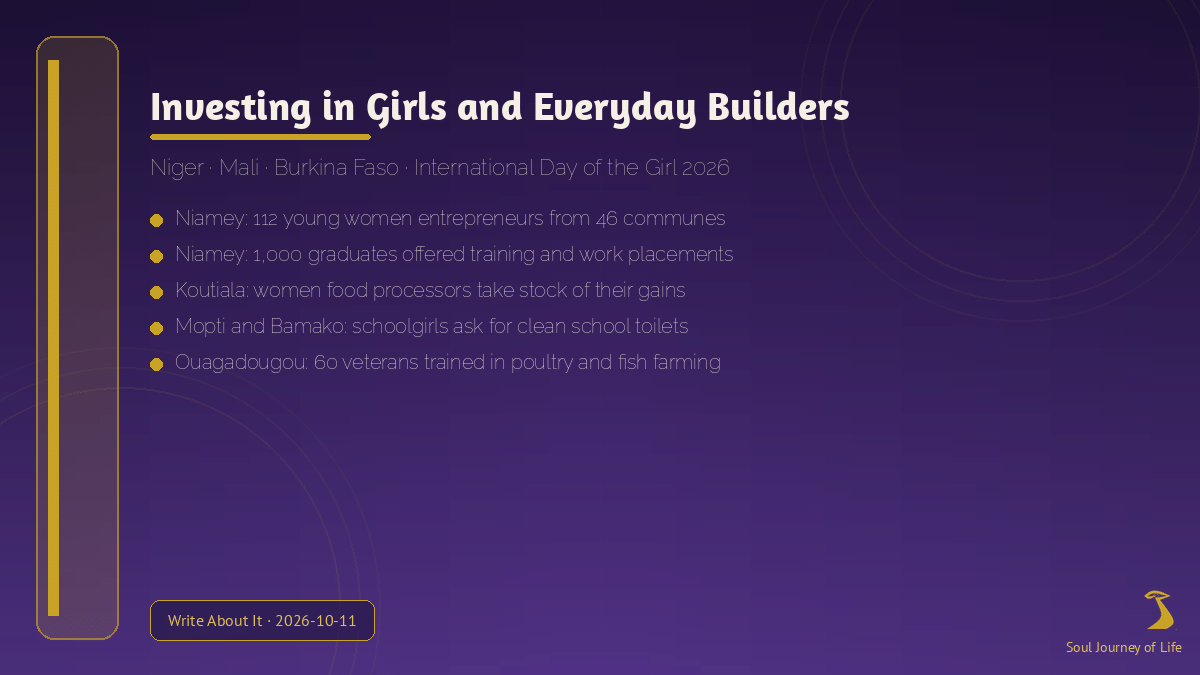

Today, October 11, is International Day of the Girl. Across Niger, Mali, and Burkina Faso this week, the most hopeful news did not come from summits. It came from a young woman behind a market stall in Niamey, from women in Koutiala who learned to make compost and process their own harvest, from schoolgirls in Mopti and Bamako asking for something as basic as a clean toilet, and from former soldiers in Ouagadougou learning to raise chickens and fish. This Write About It stays with those people.
Niger: 112 young women open their stalls in Niamey
From October 9 to 13, the Palais du 29-Juillet in Niamey is hosting the first trade fair for young women entrepreneurs, held for International Day of the Girl under this year’s theme, “Investing in girls’ rights.” The fair is organised by the nongovernmental organisation Transform Niger, with support from UNICEF and the United Nations Development Programme, under the patronage of the Ministry of Commerce and Industry, according to ActuNiger. Per ActuNiger, it brings together 112 young women from 46 communes across all eight of Niger’s regions, showing food processing, crafts, digital services, and other local businesses.
“They are not only beneficiaries of a project; they are entrepreneurs, leaders, and role models for our generation,” said Hadiza Mayaki Maïga, national executive director of Transform Niger, according to ActuNiger. She urged the participants to be bold, learn from their mistakes, and find mentors, and she reminded families and communities that their support matters.
UNICEF’s representative in Niger, Djanabou Mahondé, announced plans, per ActuNiger, to identify, support, and finance at least 20 groups of young women entrepreneurs. “But we must go beyond visibility,” she said, linking economic independence to schooling, health care, and protection from child marriage and violence. According to ActuNiger, a dialogue between mentors and the young exhibitors followed on the opening afternoon, so that experienced women could pass on what they have learned.
Niger: jobs for graduates and prizes for inventors
Two more Niamey stories this week put young people at the centre. On October 8, Niger’s Minister of Commerce and Industry, Abdoulaye Seydou, launched a project to help 1,000 young graduates into work, according to the Niger Press Agency. Per the agency, it is funded with 341.5 million CFA francs by the Solidarity Fund for the Safeguarding of the Homeland and offers skills training, a six-month work placement, and support for starting a business. Its stated goal is for at least 80 percent of participants to reach a job, an internship, or an income-earning activity.
A day earlier, the 10th African Salon of Invention and Innovative Enterprise closed in Niamey after three days of exhibits from inventors and start-ups across the 17 member states of the African Intellectual Property Organisation, with health, farming, renewable energy, and digital tools on show, according to the Niger Press Agency. The Islamic University of Niger took the top national prize. The President of the Republic’s prize for the best innovative company, worth five million CFA francs, went to Ousseini Salatikoye Mamane Kabirou for his company Likita Care. Per the agency, awards were also given in health, hygiene, machinery, agriculture, energy, and information technology, along with a prize for the best woman inventor.

Mali: Koutiala’s women processors take stock
In Koutiala, in southern Mali, about thirty women food processors met with local elected officials on Friday, October 9, to review what a food security and livelihoods programme has given them, according to Studio Tamani. The women spoke about learning to make compost, which they said helped raise their harvests, and about processing techniques that let them earn more from what they grow. It is a small gathering, but it is the kind of progress that is measured in a family’s pantry and school fees.
Mali: schoolgirls ask for clean toilets
The new school year began across Mali on October 1, and Studio Tamani went to see the state of school toilets. According to its reporting, in many schools they are dirty and smell so bad that pupils avoid them and hold on through the school day. In Mopti, a pupil named Fatoumata Konipo spoke for her classmates. “We girls are asking the administration to find someone who can maintain the toilets. It would really help us and would protect us from certain illnesses,” she told Studio Tamani. In Bamako, Assétou Koné said the toilets at her school are dirty and asked fellow pupils to take care of shared spaces.
School heads admit the problem, per Studio Tamani. In Yorosso, one director said his school simply lacks the money and supplies, such as bleach and soap. Some schools have found their own answer: at the Mamadou-Diarra school in Médina-Coura, Bamako, pupils from the school’s five primary classes share a weekly cleaning rota, and the toilets were in acceptable condition when reporters visited. Birama Daou, director of the Diola education academy, said upkeep is the job of school management committees and head teachers.
The reporting comes against a harder backdrop. More than 2,400 schools were not functioning because of insecurity, keeping more than 733,000 pupils out of class, according to an Education Cluster report from June cited by Studio Tamani. That makes every working classroom, and every clean and safe toilet in it, worth protecting.
Burkina Faso: veterans turn to poultry and fish farming
In Ouagadougou, 60 veterans and former soldiers finished a training course on October 9, according to the Burkina Information Agency. Organised from October 7 to 9 by the Delegation for Veterans and Former Soldiers, with the regional livestock office in Kadiogo, it trained 36 participants in poultry farming and 24 in fish farming. They covered housing for animals, animal health, feed, biosecurity, and how to build and run fish ponds.
Diessongo Nayaba, a regional animal production official, said, according to the agency, both trades can start on small plots with modest investment, and that more local fish could reduce the country’s heavy reliance on imported fish. “Your journey does not end with the end of your military career. It continues differently, in your families, in your communities, and in the work you are about to take up,” Colonel William Combary, the delegate for veterans, told the graduates, per the agency.
Burkina’s food supply was also in the news. On October 9, according to the Burkina Information Agency, the Ministry of Commerce suspended exports of millet, maize, and sorghum flour and related products until further notice, saying in its communiqué that the aim is to keep the flour available and affordable for consumers at home.
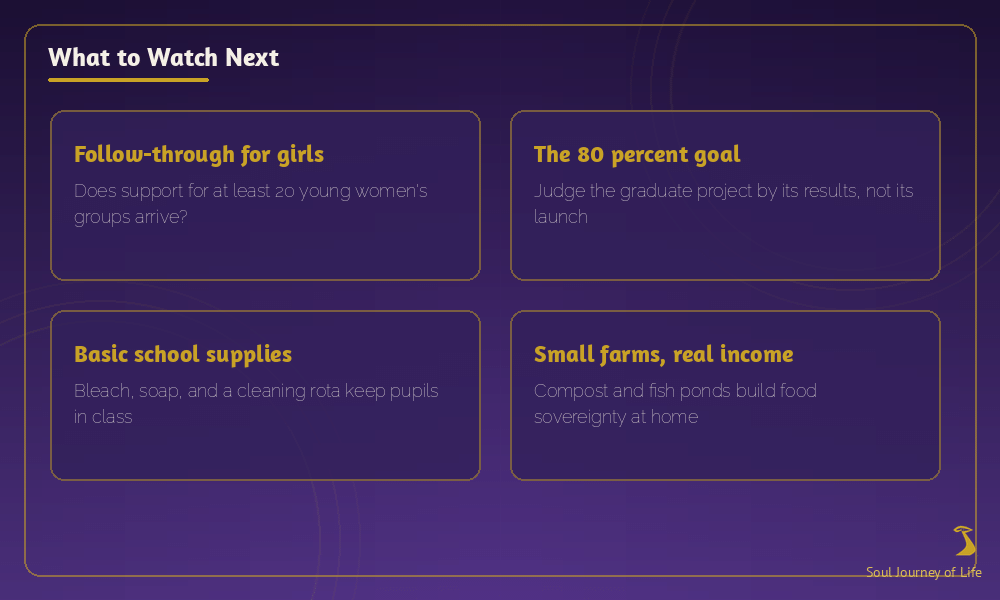
What to watch
- Follow-through for Niger’s young women. The real test of the Niamey fair is whether the promised support for at least 20 groups arrives, and how many businesses are still growing a year from now.
- The 80 percent goal. Niger’s graduate project has set a clear target; its results deserve the same attention as its launch.
- Basic supplies for schools. Bleach, soap, and a cleaning rota cost little compared with what girls and boys lose when they avoid school toilets.
- Small farms, real income. Koutiala’s compost and Ouagadougou’s fish ponds show how food sovereignty is built one household at a time.
On a day set aside for girls, the lesson from the Sahel is a simple one: when people are given skills, tools, and a fair chance, they build.
Soul Journey of Life — Write About It
Sources
- ActuNiger
- Niger Press Agency
- Niger Press Agency
- Studio Tamani
- Studio Tamani
- Studio Tamani
- Burkina Information Agency
- Burkina Information Agency













You must be logged in to post a comment.