



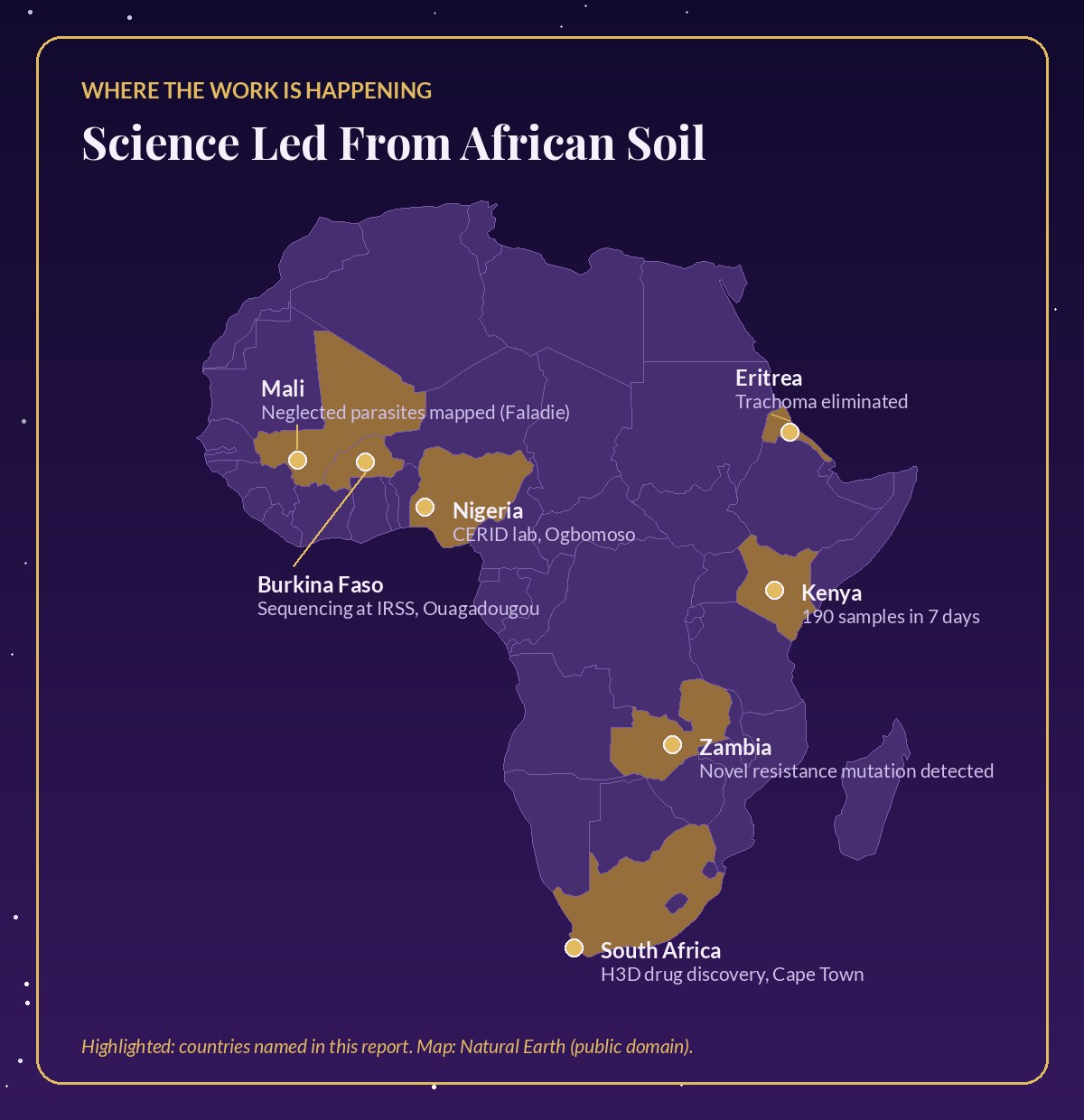
“Genomic sequencing no longer feels like something that must happen somewhere else. We can now do it here, with our own people, in our own laboratory, and in response to the questions that matter to our setting.” Those are the words of Olusola Ojurongbe of the Centre for Emerging and Re-emerging Infectious Diseases in Ogbomoso, Nigeria, quoted by Nature Africa this month. They are worth reading twice. For generations our samples, our data and our questions were carried away to be answered somewhere else. This November, from Ouagadougou and Bamako to Cape Town and Eritrea, African scientists and health workers are showing what it looks like when the work is done at home. Knowledge kept close is power kept close.
A century ago, Marcus Garvey called on African people everywhere to build institutions of their own. Laboratories, research centres and public health programmes are such institutions. Here is some of what they shared with the world in recent weeks.
Reading malaria’s genes at home
Malaria parasites change. Some mutations help them resist medicines; others help them slip past the rapid tests that clinics rely on. To catch those changes early, a country has to read the parasite’s DNA, and for years much of Africa’s malaria genomic data was produced only after samples were shipped to laboratories abroad.
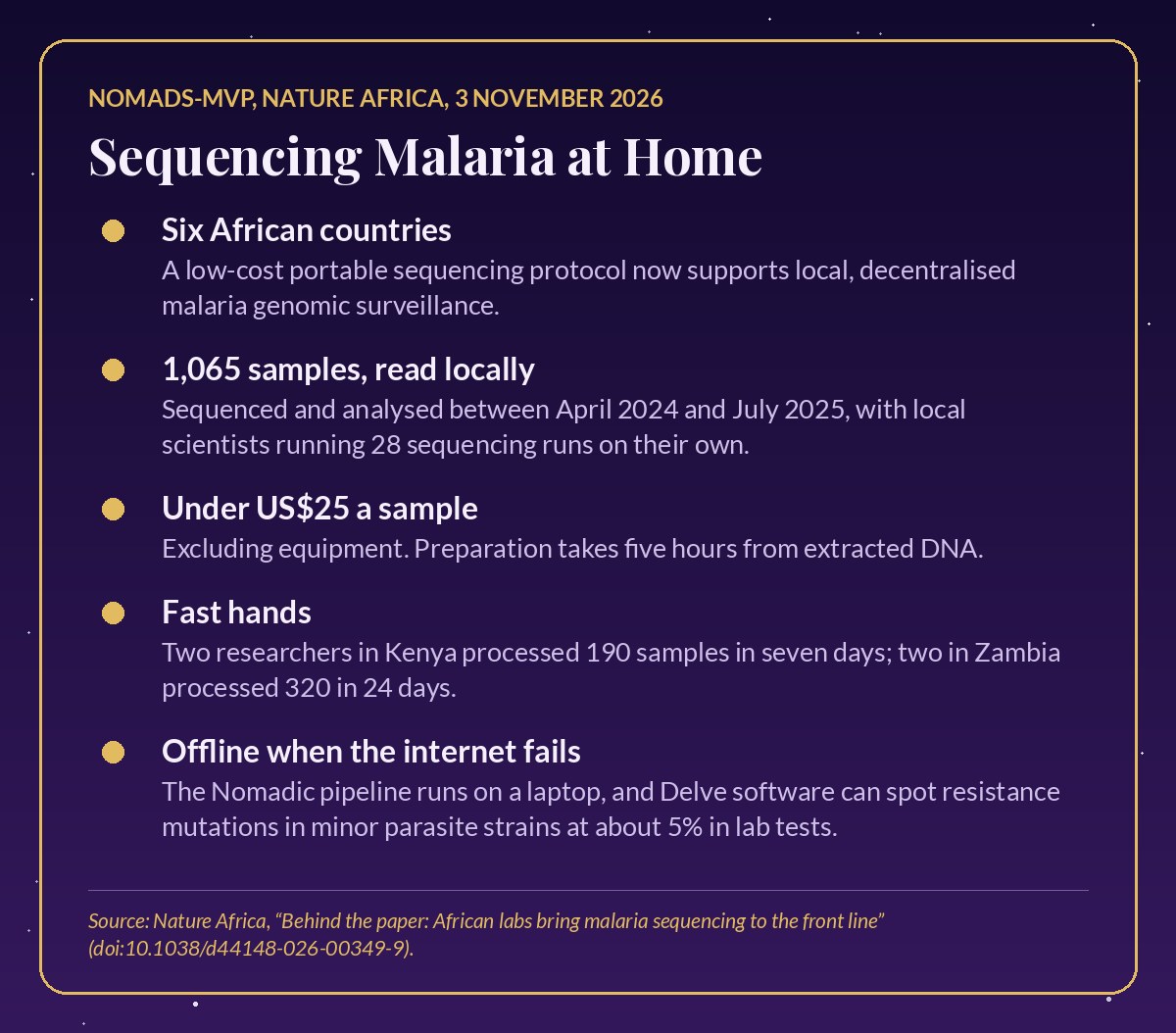
On 3 November, Nature Africa described how that is changing. Researchers working with African laboratories developed NOMADS-MVP, a fast, low-cost protocol using hand-held nanopore sequencers, described in a study in Nature Communications. It now supports local malaria genomic surveillance in six African countries. Between April 2024 and July 2025, researchers sequenced and analysed 1,065 malaria samples locally, with local scientists independently running 28 sequencing runs. The protocol costs less than US$25 per sample, not counting equipment, and preparation takes five hours from extracted DNA. In Kenya, two researchers processed 190 samples in seven days; in Zambia, two colleagues processed 320 samples in 24 days.
When unreliable internet delayed data uploads from Zambia by a week, the team built Nomadic, an offline analysis pipeline that runs on a gaming laptop. Their Delve software can detect resistance mutations carried by minor parasite strains at frequencies as low as about 5% in laboratory mixtures.
The results are already reaching decision makers. In Zambia, the team detected a novel antimalarial resistance-associated mutation and could report it quickly to the National Malaria Elimination Centre. In Burkina Faso, lead researcher Issiaka Soulama of the Institut de Recherche en Sciences de la Santé said: “Today, with our current capacities, it is no longer necessary to send samples abroad for sequencing.”
The study’s corresponding author, genomicist Jason Hendry, put the principle plainly: “We believe that malaria parasites and the genomic data generated about them should ideally be controlled by the country of origin.”
Mali maps the neglected parasites
Most malaria research focuses on Plasmodium falciparum, the species behind most severe cases and deaths. Yet P. ovale and P. malariae also infect millions of people, and they have long been neglected, partly because they cannot be grown in laboratory culture.
On 12 November, researchers from the Parasites and Microbes Research and Training Center in Mali and the Wellcome Sanger Institute published in PLOS Pathogens the most complete chromosome-level reference genomes to date for P. ovale and P. malariae, alongside P. falciparum. The blood samples came from young participants, aged six to 19, in Faladie, Mali, a rural area with intense seasonal malaria transmission. The team generated high-quality genomes from as little as two nanograms of DNA, and found that in P. ovale wallikeri one gene family linked to immune evasion has expanded to more than 2,000 genes, roughly a quarter of the parasite’s genome.
Professor Abdoulaye Djimdé, director of the Mali centre, said: “This milestone was only possible thanks to the long-standing international collaboration between our team in Mali and the genomic expertise at the Sanger Institute. The genomes developed through this partnership provide an essential toolkit for improving species identification across West Africa.”
The need is great. The Sanger Institute cites an estimated 282 million malaria cases and 610,000 malaria deaths worldwide in 2024.
Cape Town’s H3D: medicine discovered in Africa
On 9 November, the University of Cape Town announced that its Holistic Drug Discovery and Development Centre (H3D) had been highlighted in the “Accra Reset: Full Circle. A Sovereign Future for Health” report, launched during the United Nations General Assembly in September through an initiative of Ghana’s President John Dramani Mahama. The report, produced by a panel of 23 experts, names H3D as Africa’s first integrated drug discovery centre and notes that it developed the first antimalarial medicine to enter Phase 1 human clinical studies on the African continent. H3D is also building African-specific pharmacogenetic tools, so that medicines are suited to the people who will take them.
Its founder and director, Professor Kelly Chibale, said the recognition “demonstrates that Africa can lead in discovering and developing solutions to its own health challenges while contributing to global health advancement.”
Watch: Curing malaria and afro-pessimism with one pill | Kelly Chibale | TEDx Talks (YouTube)
Eritrea ends trachoma as a public health problem
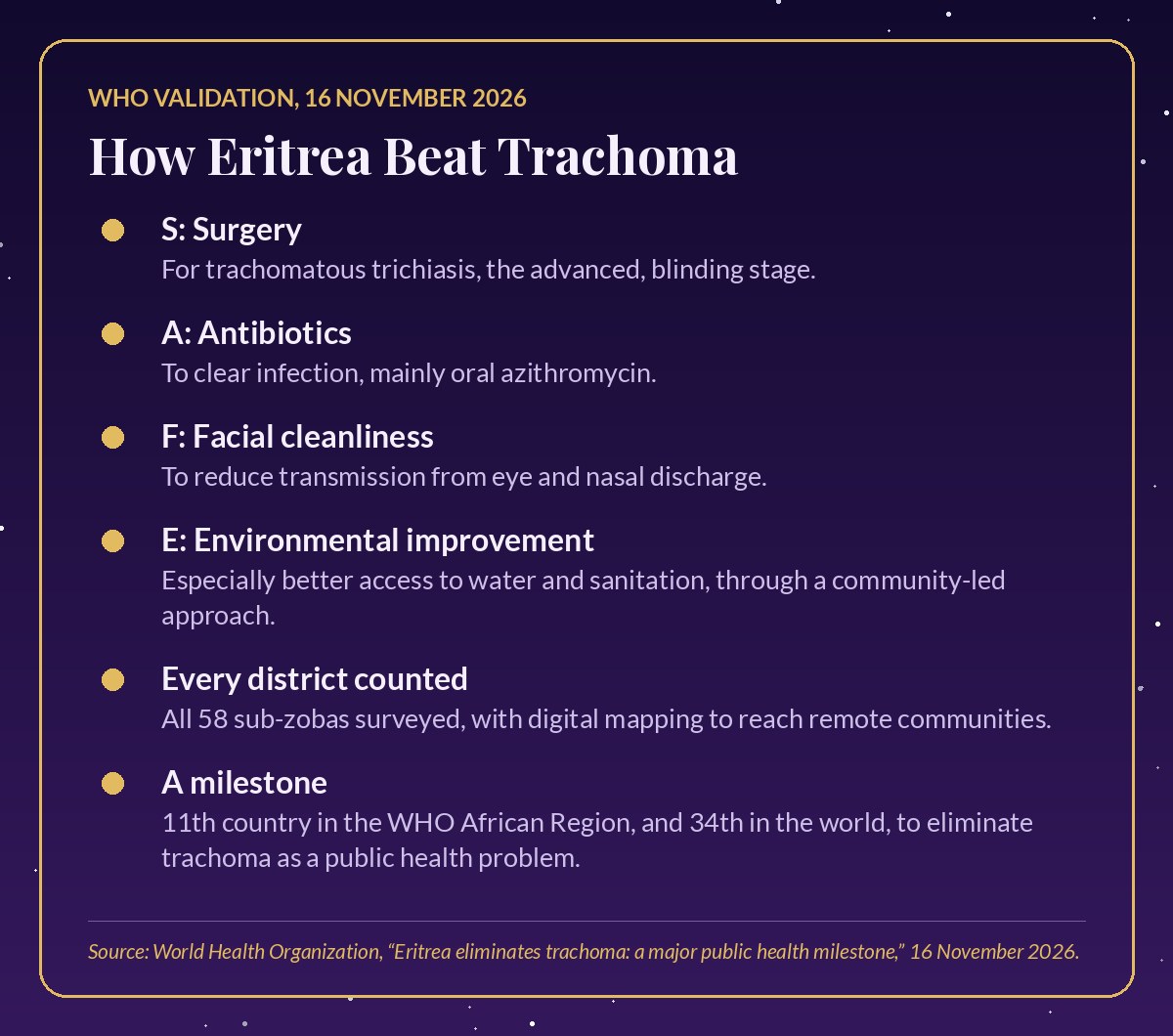
Trachoma is the world’s leading infectious cause of blindness. On 16 November, the World Health Organization validated that Eritrea has eliminated trachoma as a public health problem, the 11th country in WHO’s African Region and the 34th in the world to do so.
Eritrea followed the SAFE strategy (surgery, antibiotics, facial cleanliness and environmental improvement) and surveyed all 58 of its sub-zobas, the country’s second-level administrative areas. WHO notes that the programme’s community-led sanitation approach achieved significant gains with limited external funding, and that health workers used digital tools to map and reach remote communities. WHO Director-General Dr Tedros Adhanom Ghebreyesus said: “After two decades of determined effort, Eritrea has consigned trachoma as a public health problem to history.” WHO’s Representative to Eritrea, Dr Mary Stephen, added: “This success belongs first and foremost to the people of Eritrea.”
What these stories teach us
Four stories, one lesson. Science, and the data it produces, serves a people best when it is done by them, close to home and answerable to their own needs. Partnership still matters: every one of these achievements involved collaborators. But the direction is clear. African labs are leading, more of the sequencing is done at home, medicines are being designed with African patients in mind, and the victory over trachoma, in Dr Stephen’s words, belongs first to the people.
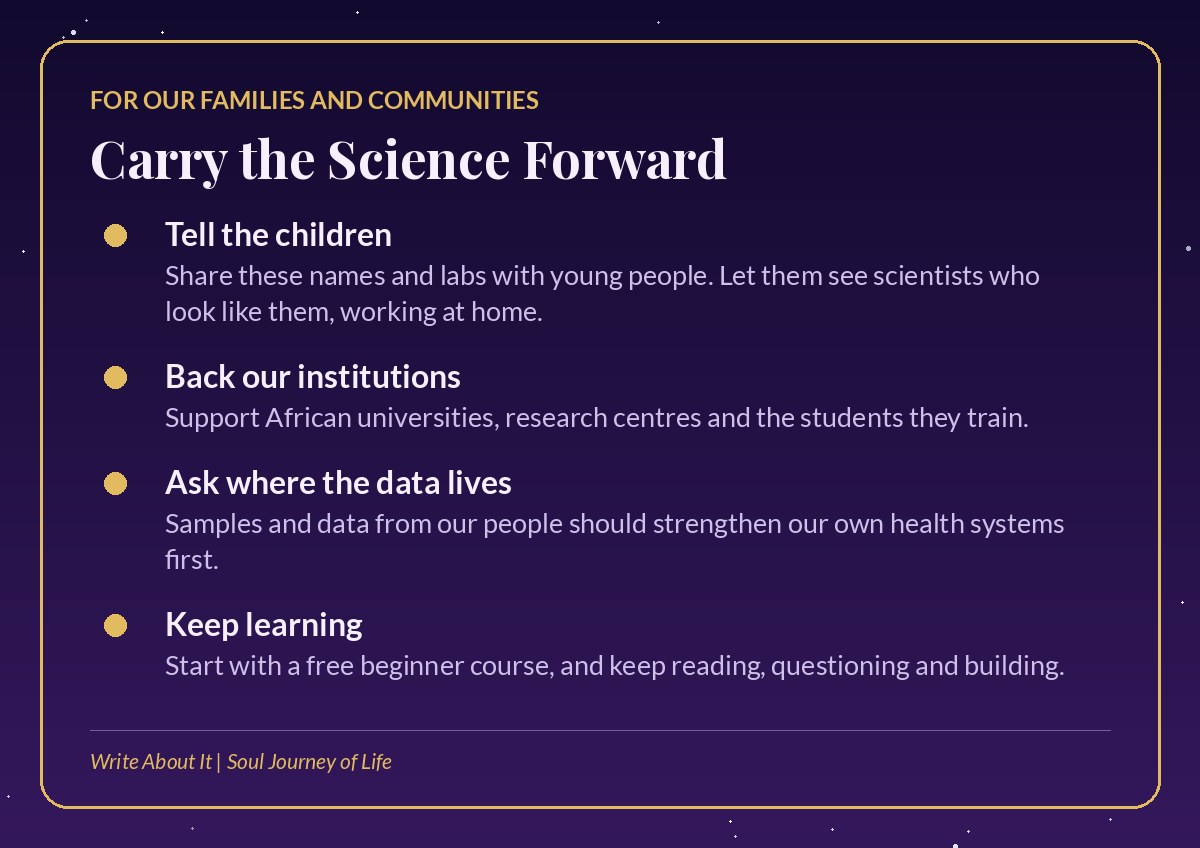
Let us tell our children these names: Ojurongbe, Soulama, Djimdé, Chibale. Let them know that the scientist in the white coat can look like them, speak like them, and work in their own country.
Are you a teacher, scientist or health worker with knowledge to share? You can build and teach your own course on Soul Journey of Life: https://souljourneyoflife.org/instructor-registration/
Sources
- Nature Africa: Behind the paper: African labs bring malaria sequencing to the front line (3 November 2026)
- Wellcome Sanger Institute: First complete genomes for neglected malaria parasites (12 November 2026)
- UCT News: UCT’s H3D centre recognised in major global health report (9 November 2026)
- World Health Organization: Eritrea eliminates trachoma: a major public health milestone (16 November 2026)
Written by Glowing Candle for Soul Journey of Life.
Write About It is brought to you by Soul Journey of Life. Conscious. Constructive. United.





You must be logged in to post a comment.