


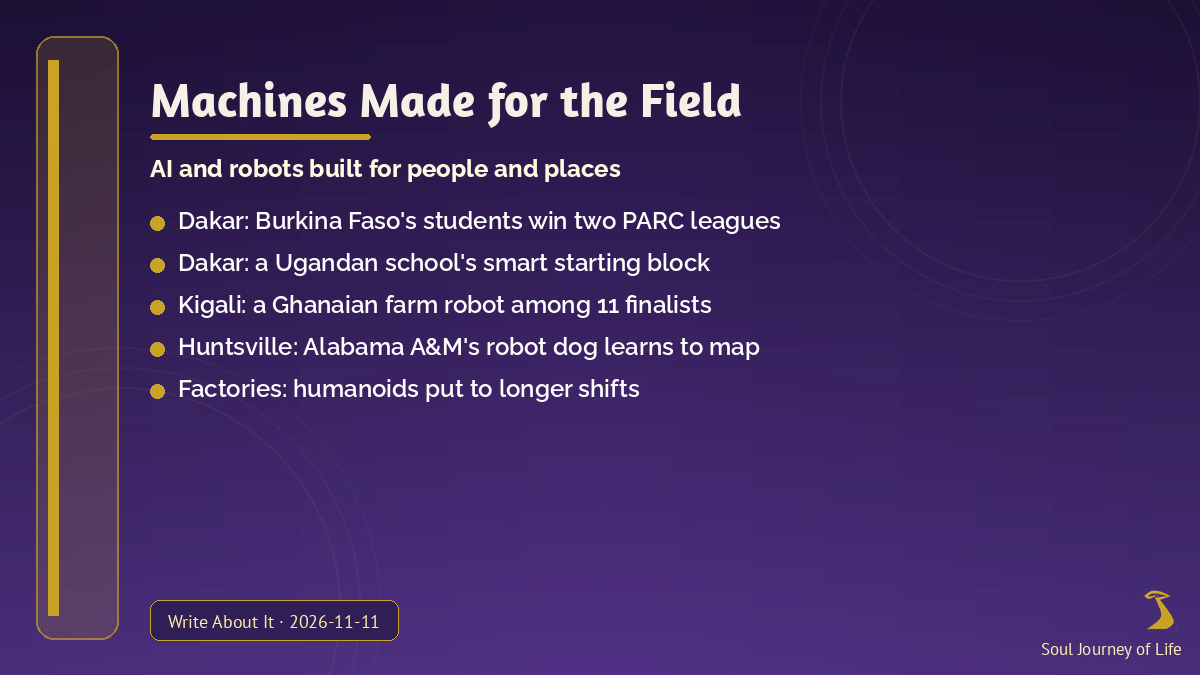

Robots are often shown on a stage or in a lab. This week, the more telling scenes were outdoors and on the job: a running track, a knee joint, a farm row, a stretch of unmapped ground and a factory workstation. Between November 3 and November 10, young African and Black American builders showed what they want machines to do, while the world’s largest companies put humanoid robots through longer tests. Here are five scenes.
Dakar: Burkina Faso’s students win two leagues
From November 3 to 7, the Pan-African Robotics Competition (PARC) brought students and engineers from across the continent to Dakar, held alongside the Dakar 2026 Youth Olympic Games. This year’s theme was sports technology, and the challenges asked teams to build machines that serve athletes, fans and stadiums.
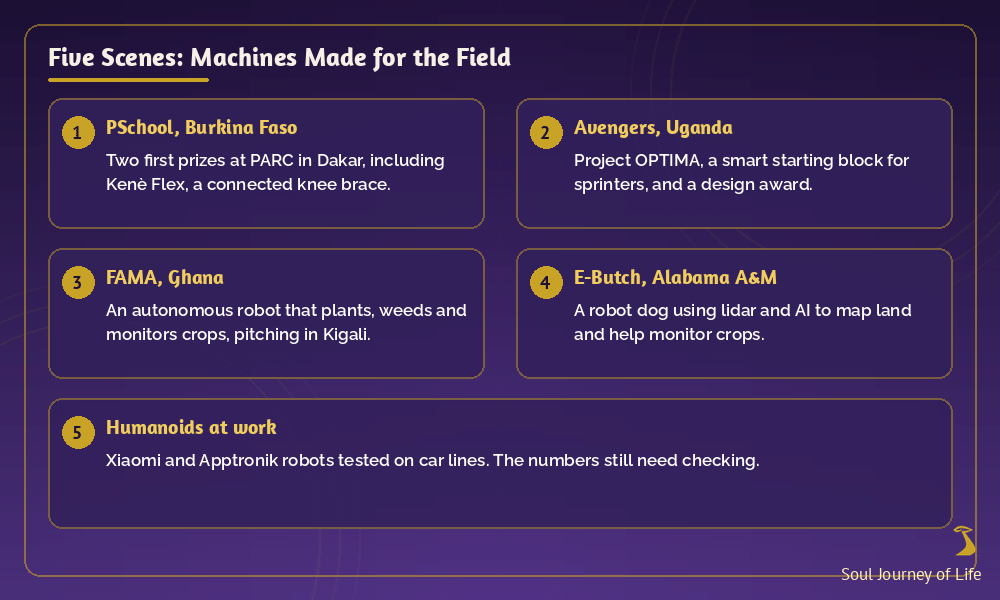
Two teams from PSchool in Burkina Faso came home with first place in their leagues. Pschool_Kids won the Tech League for middle-school students, and Open_MIND won the Makers League for high-school students with Kenè Flex, a connected knee brace. “This victory rewards months of work, rehearsals, nights of coding and prototypes,” the school wrote, adding that it shows African children belong among the best in robotics and artificial intelligence. (Verification note: both first-place results rest on a single source, the school’s own announcement as republished by Info Mobile du Zandoma; official PARC results were not found. The quoted sentence is translated from French.)
Dakar: a Ugandan school’s smart starting block
Kampala Diplomatic International School’s team, the Avengers, won its competition at PARC and the Best Robot Design Award, according to the school’s proprietor, Johnson Nyeko, the member of parliament for Lamwo County. The students presented Project OPTIMA, a smart starting block for track athletics that combines engineering and data to help sprinters start well. Nyeko said the students impressed judges with how clearly they explained the engineering behind it. (The league the team competed in was not stated in the report.) (Verification note: this account rests on a single source, Eyewitness Uganda, based on posts by the school’s proprietor. Official PARC results were not found.)
Kigali: an autonomous farm robot among 11 finalists
This week in Kigali, 11 agricultural technology start-ups from Kenya, Rwanda, Malawi, Uganda and Ghana are taking part in the finals of the Innovate Africa Challenge 2026, run by Smart Africa and the UN Food and Agriculture Organization. They were chosen from 547 applications, and the winner receives $50,000 to put a proven tool into farmers’ hands. The bootcamp and pitch event runs from November 9 to 13. (Verification note: the finals end on November 13, so a winner had not been announced as of November 11, 2026.)
Ghana’s FAMA is the only robotics entrant: an autonomous farm robot that plants, weeds and monitors crops. (Verification note: FAMA’s robot description is company-stated.) Other finalists include Kenya’s Farmerlifeline Technologies, whose solar-powered cameras use AI to spot pests and disease early and alert farmers, and Malawi’s Drone Link, which reads crop stress and drought from drone images. Priority goes to tools that serve smallholder farmers, women and young people.
Huntsville: Alabama A&M’s robot dog learns to map the land
At Alabama A&M University, a four-legged robot named E-Butch, after the university’s Bulldog mascot, is learning to find its own way. The project is led by alumnus Justin Vaughner, who heads the university’s drone unit, and it combines AI, robotics and about 25 drones to help researchers monitor crops, survey unfamiliar ground and collect environmental data without sending people into hazardous areas. (Verification note: the university describes autonomous mapping and those field uses as the project’s aims; autonomous communication between the robot dog and the drones remains a development goal.)
“My goal is to leverage AI to allow the system to navigate and map an area autonomously,” Vaughner said. “Using its onboard lidar sensor, it can accurately capture and model the environment without manual intervention.” Students in computer science, engineering and agriculture are already part of the research. In May 2026, Alabama A&M became the first university in the state to offer a Bachelor of Science in Artificial Intelligence. (Verification note: Alabama A&M announced the degree in May 2026 as the first in the state; the programme was set to begin in autumn 2026.)
In the same week, the university reported that sophomore Sydney Moss and three students from North Carolina A&T, Virginia State University and Spelman College, a team called RisktakeHERS, won the pitch competition at the Thurgood Marshall College Fund’s AI Technical Bootcamp in San Mateo, California, sharing $14,000 for an AI assistant that helps insurance underwriters spot overlooked risks.
China and Germany: humanoids on longer shifts
On November 3, Xiaomi released a video of its humanoid robots working an eight-hour shift at its electric-car factory, sorting console covers into racks. The company says the robots caught and fixed their own mistakes. Electrek, which reported the video, noted that Xiaomi did not publish how many parts were sorted, the success rate over the shift or how often a person stepped in. (These are company claims, not independently verified.)
On November 10, Google DeepMind introduced Gemini Robotics 2.5, a new AI model for robots. In a proof-of-concept on Mercedes-Benz production lines, it helped Apptronik’s Apollo 2 humanoid pick and pack car parts with a 96% success rate, according to Google DeepMind. (Verification note: the 96% figure is a company claim from Google DeepMind’s own announcement of a proof-of-concept; it has not been independently verified.) The company says the aim is to take on monotonous work so that technicians can focus on complex tasks.
Why this matters
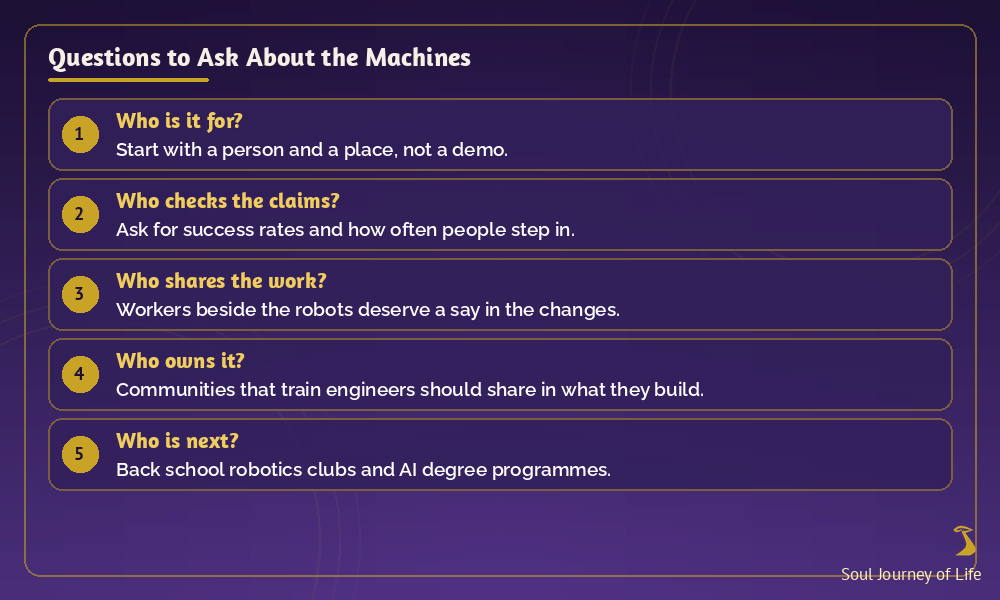
The young builders in Dakar, Kigali and Huntsville started with a person and a place: a sprinter on the blocks, an injured knee, a farmer losing a crop to pests, a field nobody has mapped. The factory tests started with a workstation. Both matter, but the first approach asks who the machine is for before it asks how many it can replace. As humanoids move toward full shifts, the workers beside them deserve a say in how the work is shared, and the communities that train young engineers deserve to own a share of what those engineers build.
How you can carry it forward
- Back a school robotics club. Kits, mentors and travel money are often what stand between a team and a continental final.
- Ask farmers what they need first. The best farm technology answers a real problem in a real field.
- Ask who checks the claims. When a company says its robot worked a full shift, ask for the numbers.
- Speak up for workers. Ask how robots on the line will change jobs, training and safety, and who decides.
- Point students toward AI degrees. Programmes like Alabama A&M’s are opening doors close to home.
Sources
- Info Mobile du Zandoma, “Robotique : doublé historique pour PSchool à la PARC 2026 !”, November 10, 2026: https://www.infomobileduzandoma.net/2026/11/10/robotique-double-historique-pour-pschool-a-la-parc-2026/
- Eyewitness Uganda, “Uganda’s Kampala Diplomatic International School Wins Pan-African Robotics Competition in Senegal”, November 9, 2026: https://www.eyewitness-ug.com/ugandas-kampala-diplomatic-international-school-wins-pan-african-robotics-competition-in-senegal/
- Pan-African Robotics Competition, PARC 2026 leagues: https://www.parcrobotics.org/categories
- The Next Africa, “Eleven AI Startups Reach Finals of Smart Africa–FAO Innovate Africa Challenge, Competing for $50,000”, November 10, 2026: https://magazine.thenextafrica.com/eleven-ai-startups-reach-finals-of-smart-africa-fao-innovate-africa-challenge-competing-for-50000/
- Alabama A&M University, “Expanding Research Initiatives Connect Artificial Intelligence, Agriculture and Engineering With Hands-On Student Learning”, October 30, 2026: https://www.aamu.edu/about/inside-aamu/news/expanding-research-initiatives-connect-artificial-intelligence-agriculture-and-engineering-with-hands-on-student-learning.html
- Alabama A&M University, “AAMU Sophomore Shares $14,000 Prize at TMCF AI Bootcamp”, November 10, 2026: https://www.aamu.edu/about/inside-aamu/news/aamu-sophomore-shares-14000-prize-at-tmcf-ai-bootcamp.html
- Electrek, “Xiaomi’s humanoid robots work a full 8-hour shift in its EV factory”, November 4, 2026: https://electrek.co/2026/11/04/xiaomi-humanoid-robot-8-hour-shift-ev-factory/
- Google DeepMind, “Gemini Robotics 2.5 accelerates real-world general dexterity”, November 10, 2026: https://deepmind.google/blog/gemini-robotics-2-5-accelerates-real-world-physical-intelligence/
Written by Glowing Candle for Soul Journey of Life.

Write About It is brought to you by Soul Journey of Life. Conscious. Constructive. United.









You must be logged in to post a comment.