



“They lost their history, so they died.” With those words, which he presented as a Sumer legend, Dr. Chancellor Williams opened Part I of The Destruction of Black Civilization: Great Issues of a Race from 4500 B.C. to 2000 A.D. More than half a century later, the book still passes from hand to hand in study circles, barbershops and family libraries. Yet many readers overlook its closing chapter: a practical plan for how Black people could organize.
This week, as Africans and people of African descent gather in Johannesburg for the second Africa and African Diaspora Conference, that closing chapter is worth reading again.
Who was Chancellor Williams?
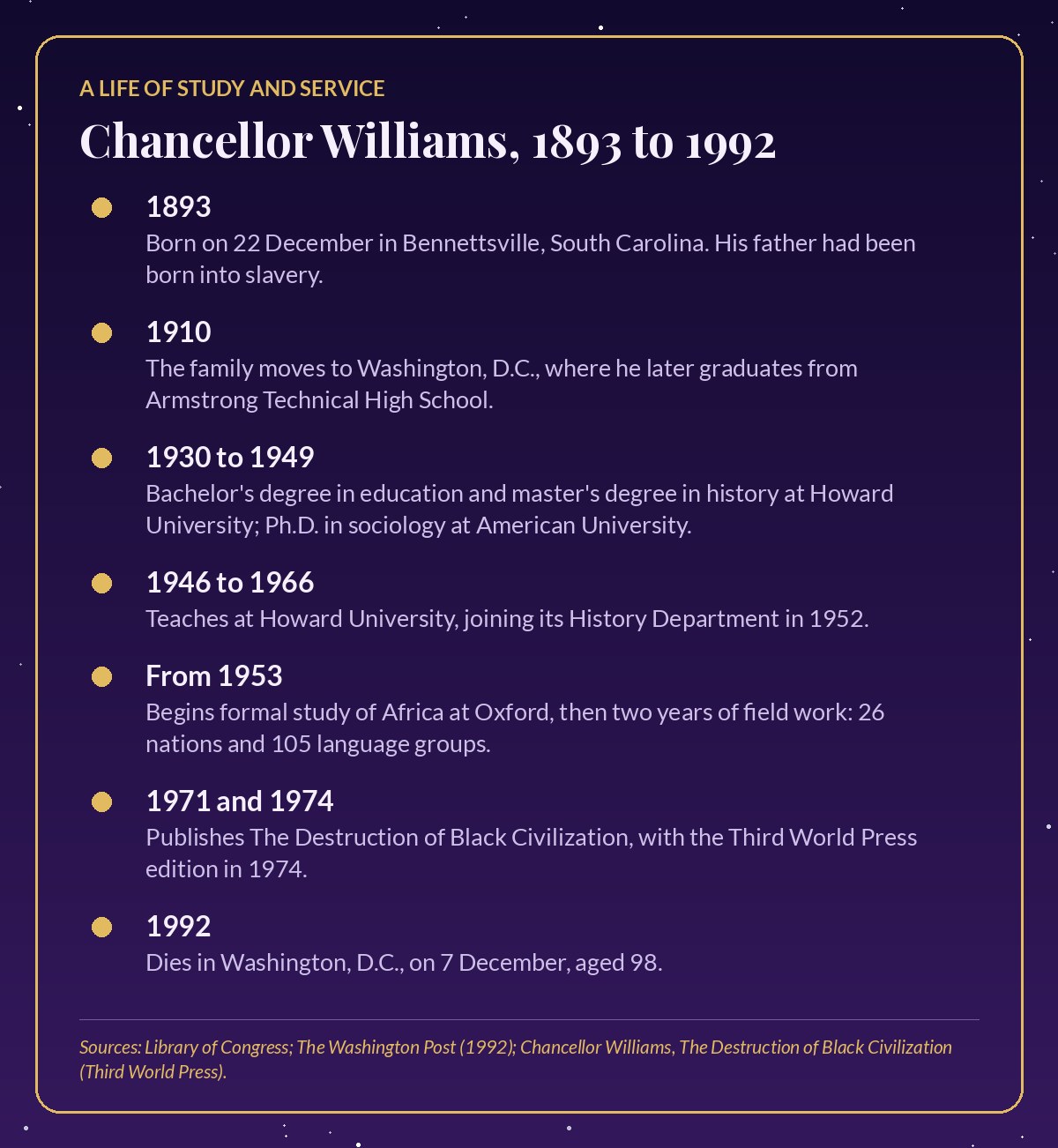
Chancellor James Williams was born on 22 December 1893 in Bennettsville, South Carolina. His father had been born into slavery. In 1910 the family moved to Washington, D.C., where he graduated from Armstrong Technical High School. He earned a bachelor’s degree in education (1930) and a master’s degree in history (1935) at Howard University, and a Ph.D. in sociology at American University in 1949. Along the way he worked as a school principal, a teacher, a Census Bureau section chief and a federal economist. He taught at Howard from 1946 until he retired in 1966, and he died in Washington on 7 December 1992, aged 98.
His great book, first published in 1971 and issued by Third World Press in 1974, summarizes what he called 16 years of research and field studies. He began formal study of Africa at Oxford University in 1953, worked through colonial reports and missionary letters, and spent two years in the field, covering, in his words, “26 nations in East, West, Central and Southern Africa, and 105 language groups.”
A note of care: some of Williams’s readings of ancient history, including his argument that ancient Egypt was a predominantly Black civilization, remain disputed; many mainstream scholars reject applying modern racial categories to ancient Egypt. We share those claims as his argument, not settled fact. What still speaks to us, whatever one concludes about the ancient record, is the question at the center of his work: how a gifted people fell into division, and how they might rise together.
The Master Plan
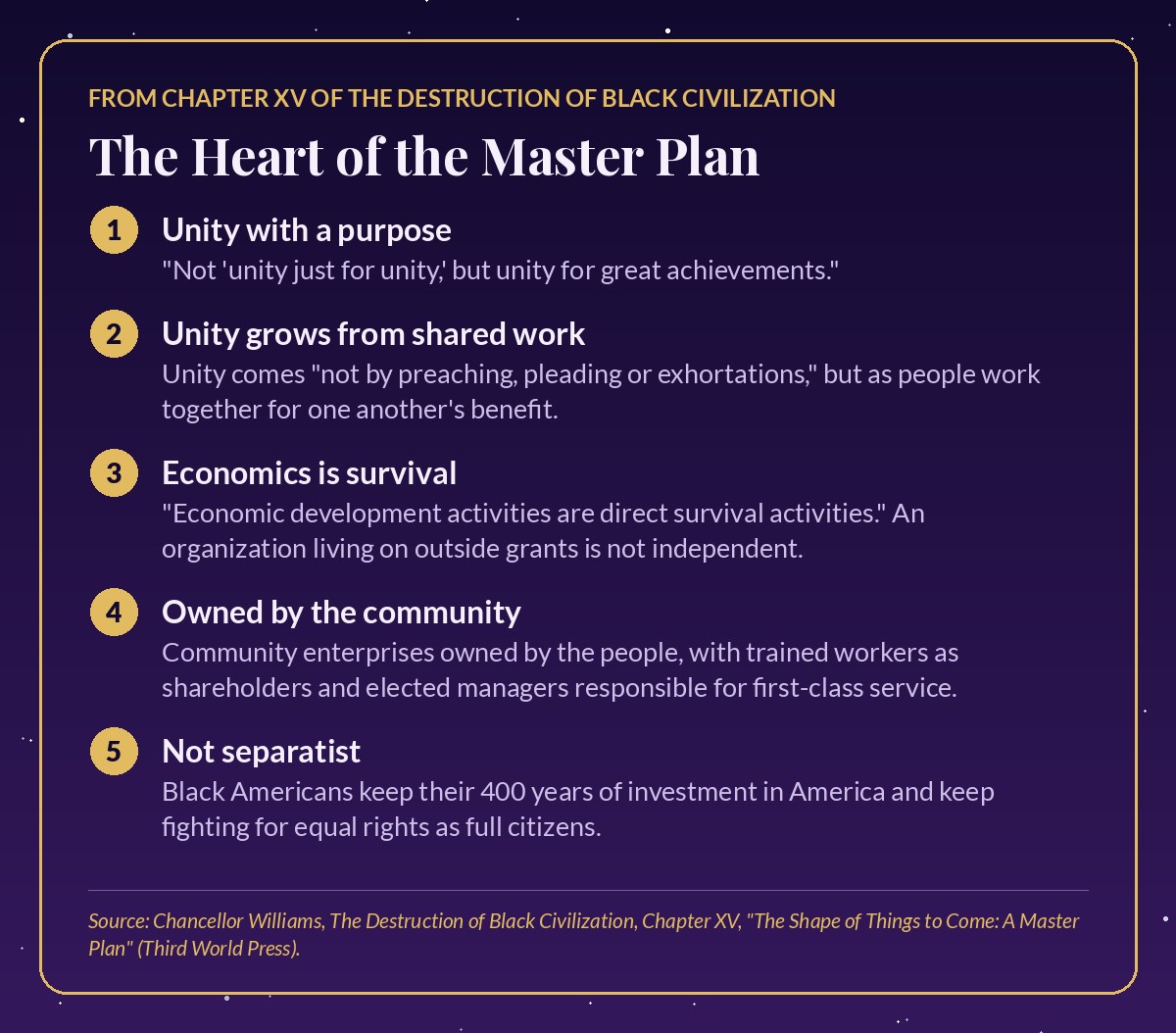
In Chapter XV, “The Shape of Things to Come: A Master Plan,” Williams proposed a nationwide “Race Organization” of Black Americans, with direct membership by families. He insisted it was not a separatist movement. Black Americans, he wrote, would not give up 400 years of investment “in blood and labor” in the United States, and would keep fighting for equal employment, voting rights and full citizenship. He focused on Black America because he believed it was “in the very best situation to be the lead-off example for the whole African world.”
His guiding principle was simple: “Not ‘unity just for unity,’ but unity for great achievements.” Unity, he argued, would come “not by preaching, pleading or exhortations,” but as people worked together for one another’s benefit. He called economic development “direct survival activities” and warned that organizations depending on government and foundation grants “are not in an independent position.” He pictured community enterprises owned by the people they serve, with trained workers as shareholders and elected managers responsible for first-class service. His plan also called for farmland, community credit unions and a central national bank.
Start with six
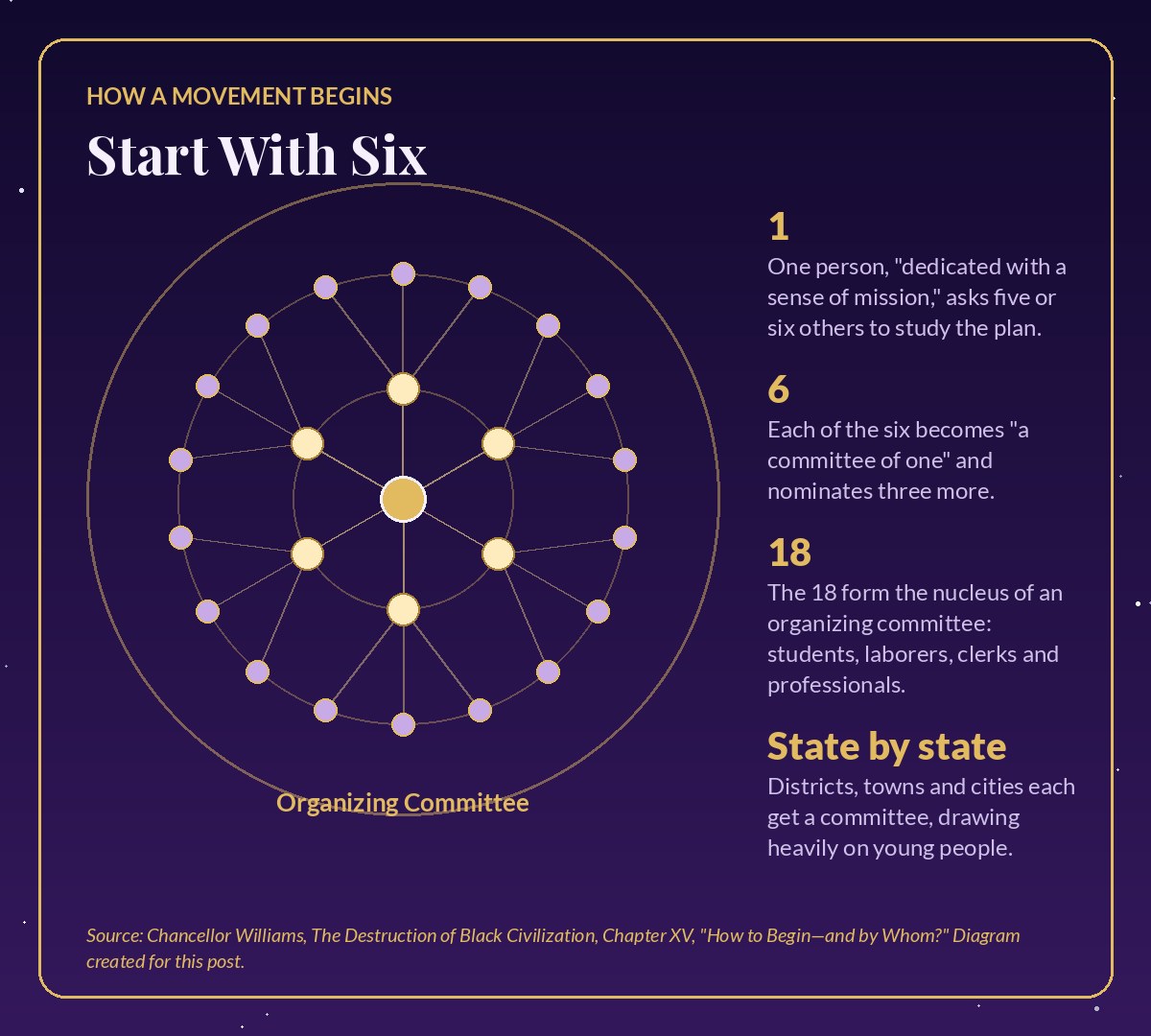
Perhaps his most practical teaching is how to begin. Williams believed every great movement starts with one dedicated person, not a crowd and not a celebrity. That person asks five or six others to study the plan and meet again. Each of the six then nominates three more, and the 18 become the nucleus of an organizing committee drawn from students, laborers, clerks and professionals alike. From there, the work grows district by district and state by state, drawing heavily on young people.
In our view, this is the part of the book most worth living. It asks nothing grand of us at first: only a small circle, honest study and a shared commitment to build something useful.
Then and now
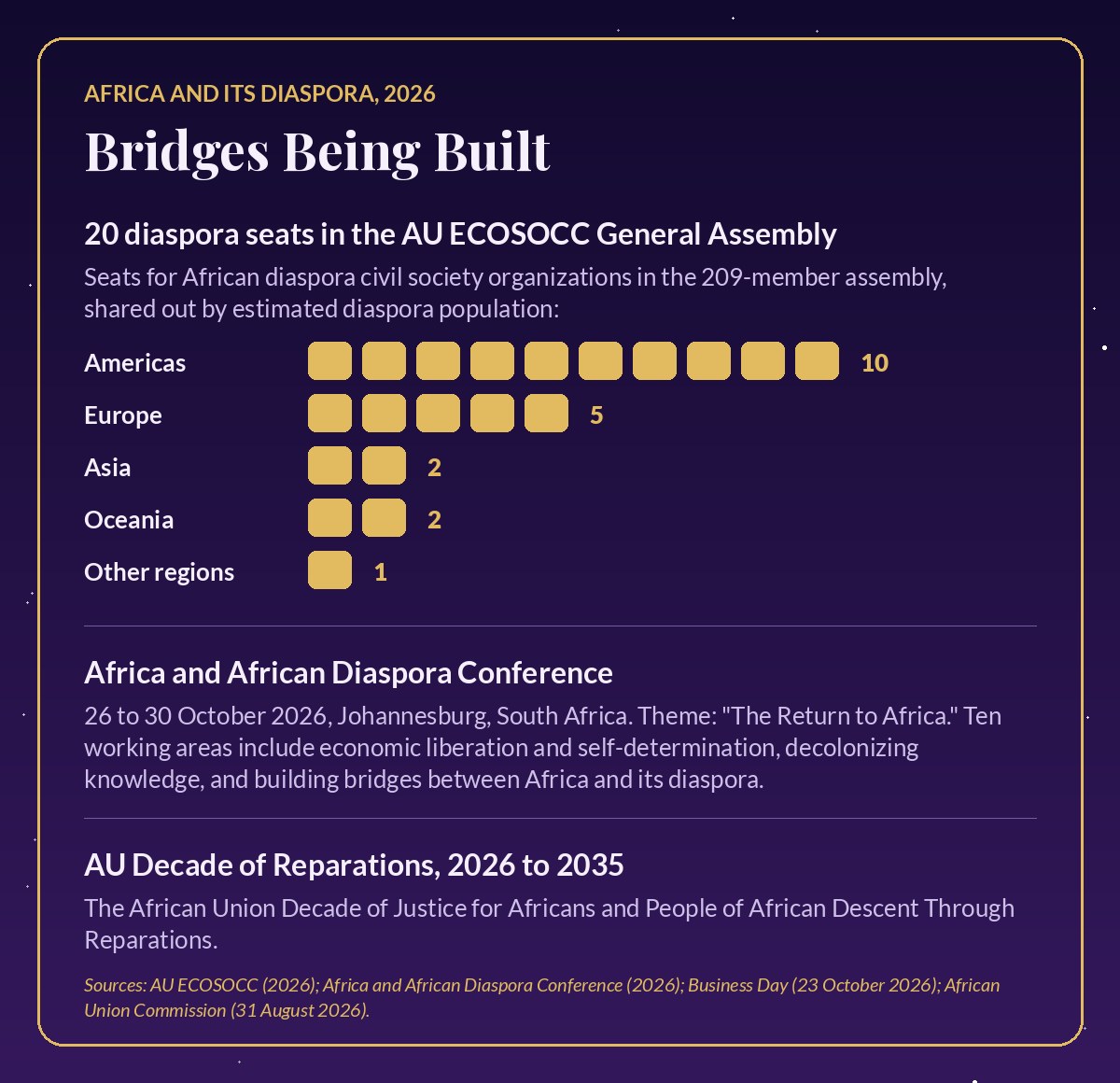
Williams wrote that a united Black America could influence its country’s policy toward African nations, and he called that kind of solidarity “real Pan Africanism.” In 2026, new bridges between Africa and its diaspora are being built:
- This week: From 26 to 30 October, the second Africa and African Diaspora Conference meets in Johannesburg under the theme “The Return to Africa.” Its ten working areas include economic liberation and self-determination, decolonizing knowledge, and building bridges between Africa and its diaspora.
- A seat at the table: The African Union’s Economic, Social and Cultural Council (ECOSOCC) has set aside 20 seats in its 209-member General Assembly for African diaspora civil society organizations, 10 of them for the Americas.
- A decade of justice: The African Union has declared 2026 to 2035 the Decade of Justice for Africans and People of African Descent Through Reparations.
Speaking in Midrand ahead of the conference, co-convenor Rev. Frank Chikane put it simply: “Whenever we meet together, we always find each other.”
Opinion: Conferences and council seats matter. But in our reading of Williams, no declaration can replace the daily work of ordinary people, organized and owning what they build.
What we can do this week
- Gather your six. Invite five or six people you trust to read Chapter XV together, then meet again to talk about what it could mean for your community.
- Build one shared enterprise. Start small: a savings circle, a buying club, a cooperative garden or a jointly owned business.
- Bring the children in. Williams believed practical work that involves “even children” would be “the cement which we call unity.” Give young people a real role.
- Follow the bridges. Watch for the conference’s declaration, and learn how diaspora organizations can take part in ECOSOCC.
Watch: Dr. Chancellor Williams – Destruction of Black Civilization (Tony Brown’s Journal TV)
In the same chapter, Williams wrote: “We are great if we are an active part of a great movement.” Share this with someone who loves our history, and tell us in the comments who would be in your circle of six.
Sources
- Chancellor Williams, The Destruction of Black Civilization (Third World Press Foundation)
- Internet Archive: The Destruction of Black Civilization, revised edition (Third World Press, 1987)
- Library of Congress: Williams, Chancellor, 1893-1992
- The Washington Post: Chancellor Williams, 98, dies (December 1992)
- BlackPast: Chancellor J. Williams
- Wikipedia: Ancient Egyptian race controversy
- Africa and African Diaspora Conference 2026: The Return to Africa
- Business Day: Africa diaspora conference spotlights reparations and decolonisation (23 October 2026)
- AU ECOSOCC: Call for applications, 5th Permanent General Assembly (diaspora seats)
- AU ECOSOCC: The journey to 20 diaspora seats (20 September 2026)
- African Union: Message of the AUC Chairperson on the International Day for People of African Descent (31 August 2026)







You must be logged in to post a comment.