


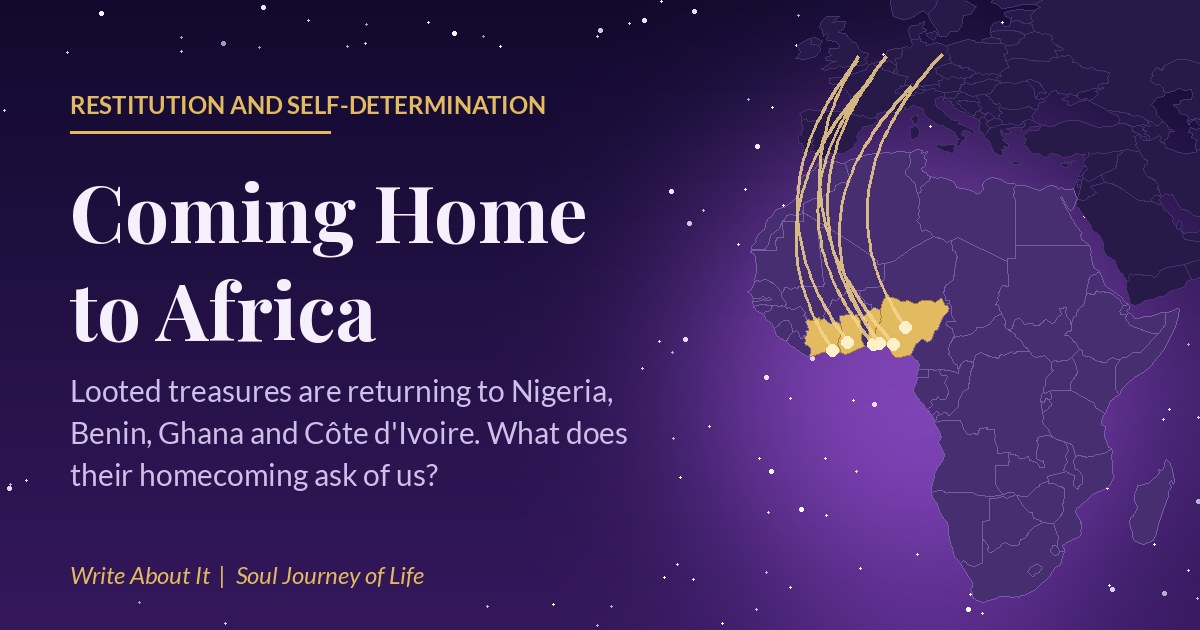

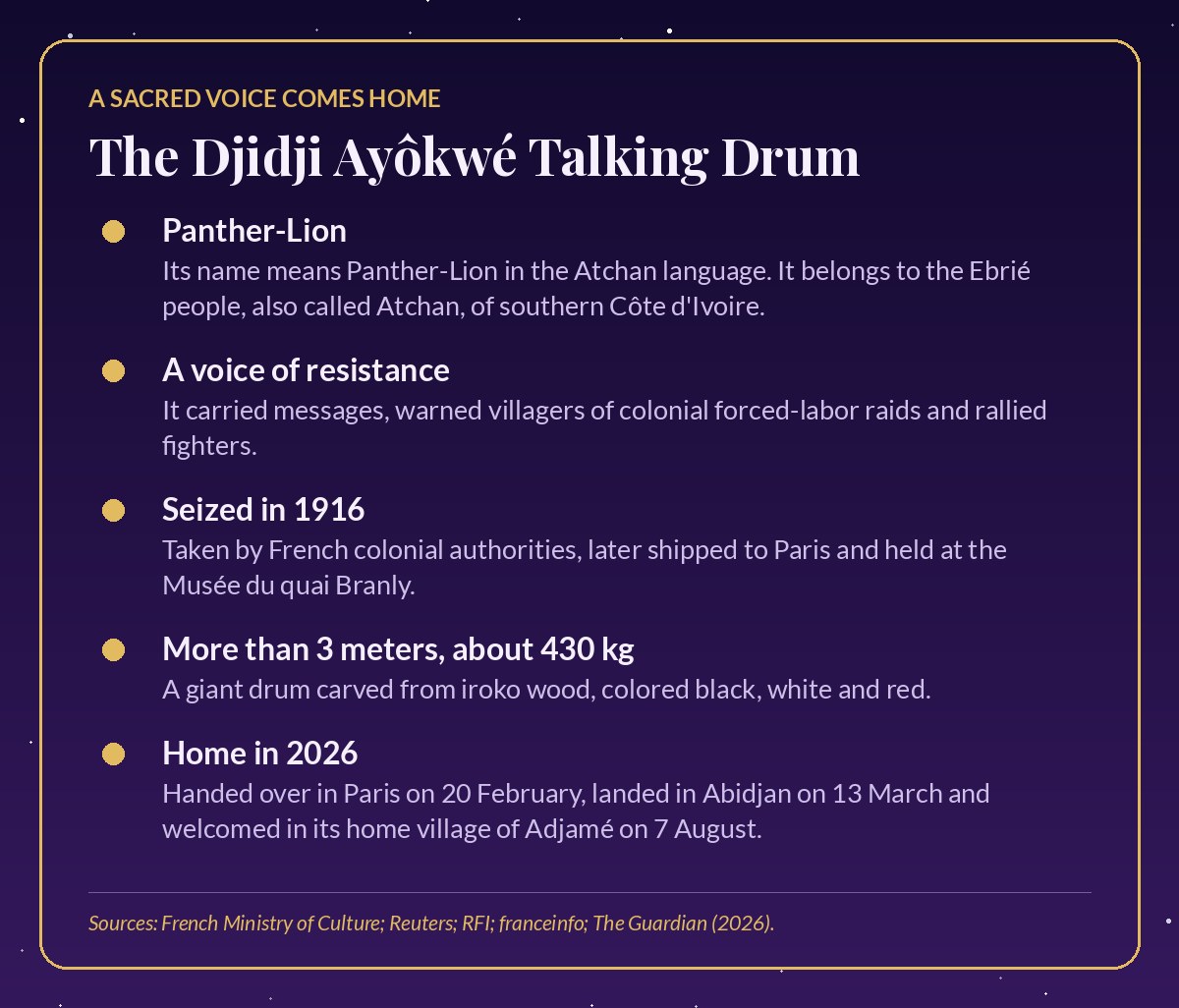
On 7 August 2026, Côte d’Ivoire’s Independence Day, a village in the district of Abidjan welcomed home a sacred elder that had been taken from its people 110 years earlier. The Djidji Ayôkwé, a giant talking drum of the Ebrié people, rode in a glass-fronted case on a decorated float until it reached Adjamé, the village where it was made. A dozen people poured libations to the ancestors, and for the first time, today’s Ivorians could see the drum with their own eyes.
Its name means Panther-Lion in the Atchan language. According to Reuters, the drum was used to warn people of colonial forced-labor raids and to rally fighters. French colonial authorities seized it in 1916, and it was later shipped to Paris, where it was most recently held at the Musée du quai Branly-Jacques Chirac. France formally handed it back on 20 February 2026, and it landed in Abidjan on 13 March. It is the first of 148 objects Côte d’Ivoire has asked France to return.
More than objects
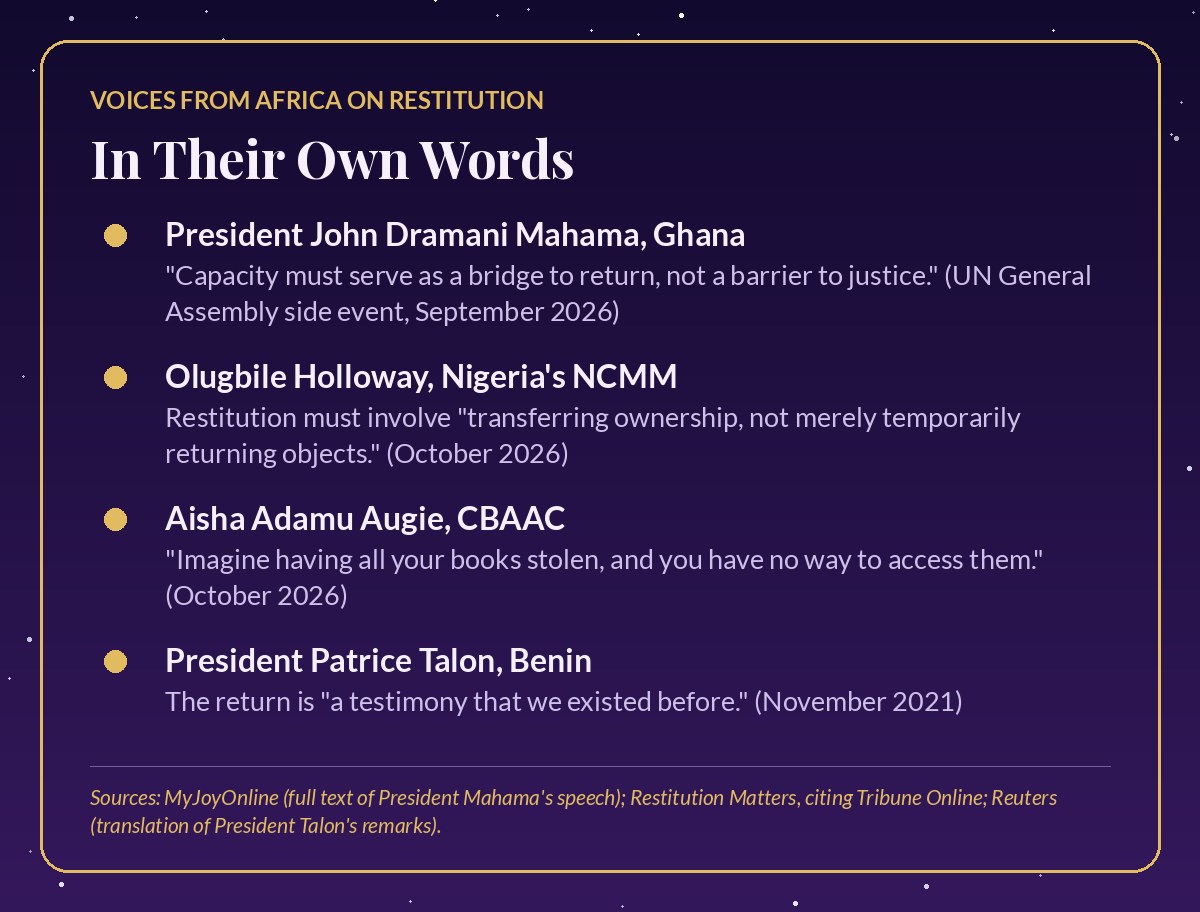
A drum that warned of danger. Bronzes that recorded the history of a royal court. Gold regalia worn by kings. These are not decorations. They are records, sacred instruments and the memory of living peoples. Speaking on a panel in October 2026, Aisha Adamu Augie, director general of Nigeria’s Centre for Black and African Arts and Civilization (CBAAC), put the loss plainly: “Imagine having all your books stolen, and you have no way to access them.”
In our view, this is why restitution belongs in any honest conversation about freedom from Westernization. For generations, much of the world learned about Africa through objects arranged, labeled and explained in someone else’s capital. When a people can hold, study and interpret its own heritage, it regains the power to tell its own story. Scholars such as Cheikh Anta Diop spent their lives arguing that Africans must reclaim the writing of their own history. The return of these treasures carries that same work into the museum.
A season of homecomings
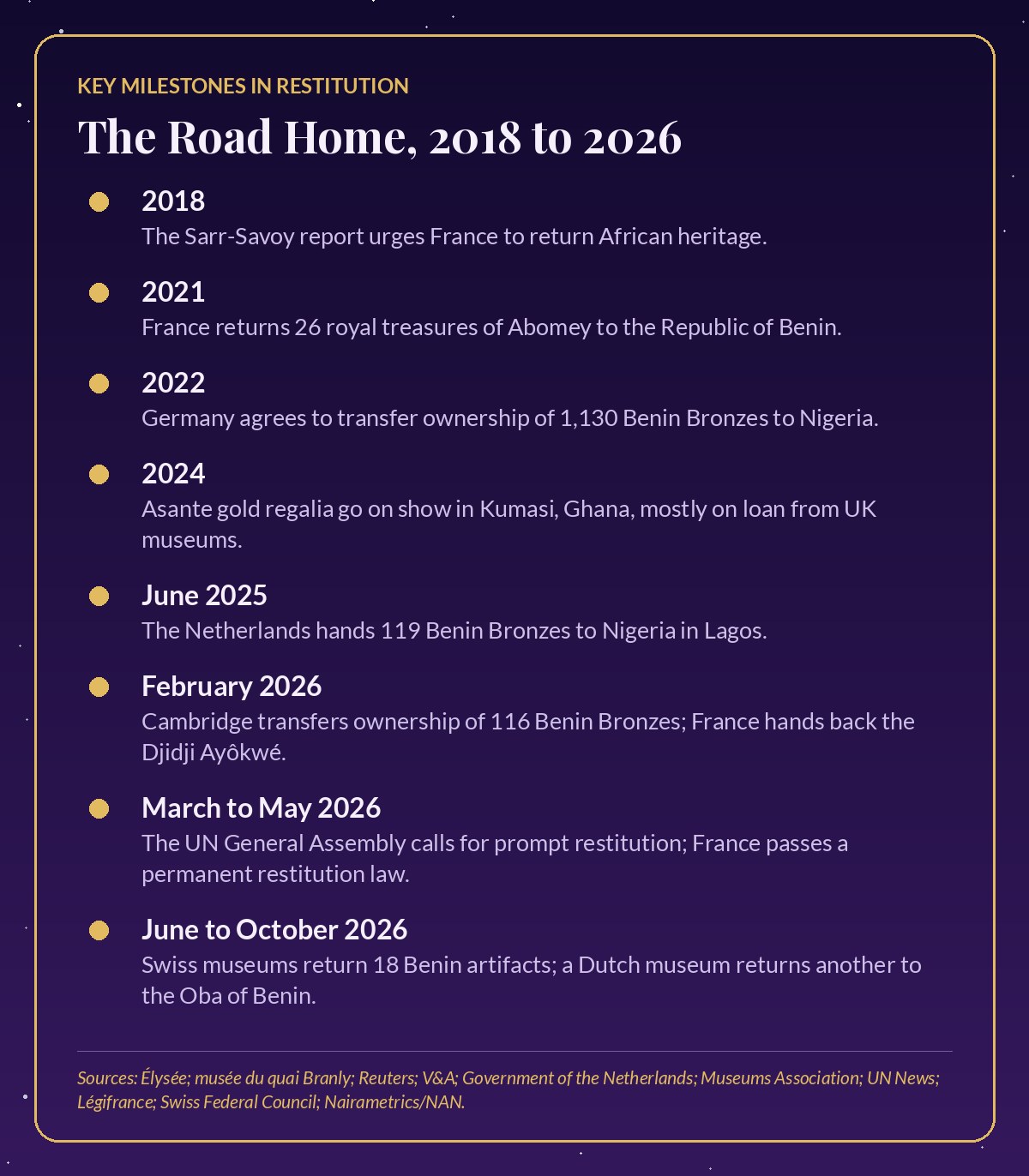
The Benin Bronzes, cast in metal and carved in ivory and wood over centuries at the royal court of the Kingdom of Benin, in today’s Nigeria, were looted when British forces attacked Benin City in 1897. Over the past year and a half, more of them have come home:
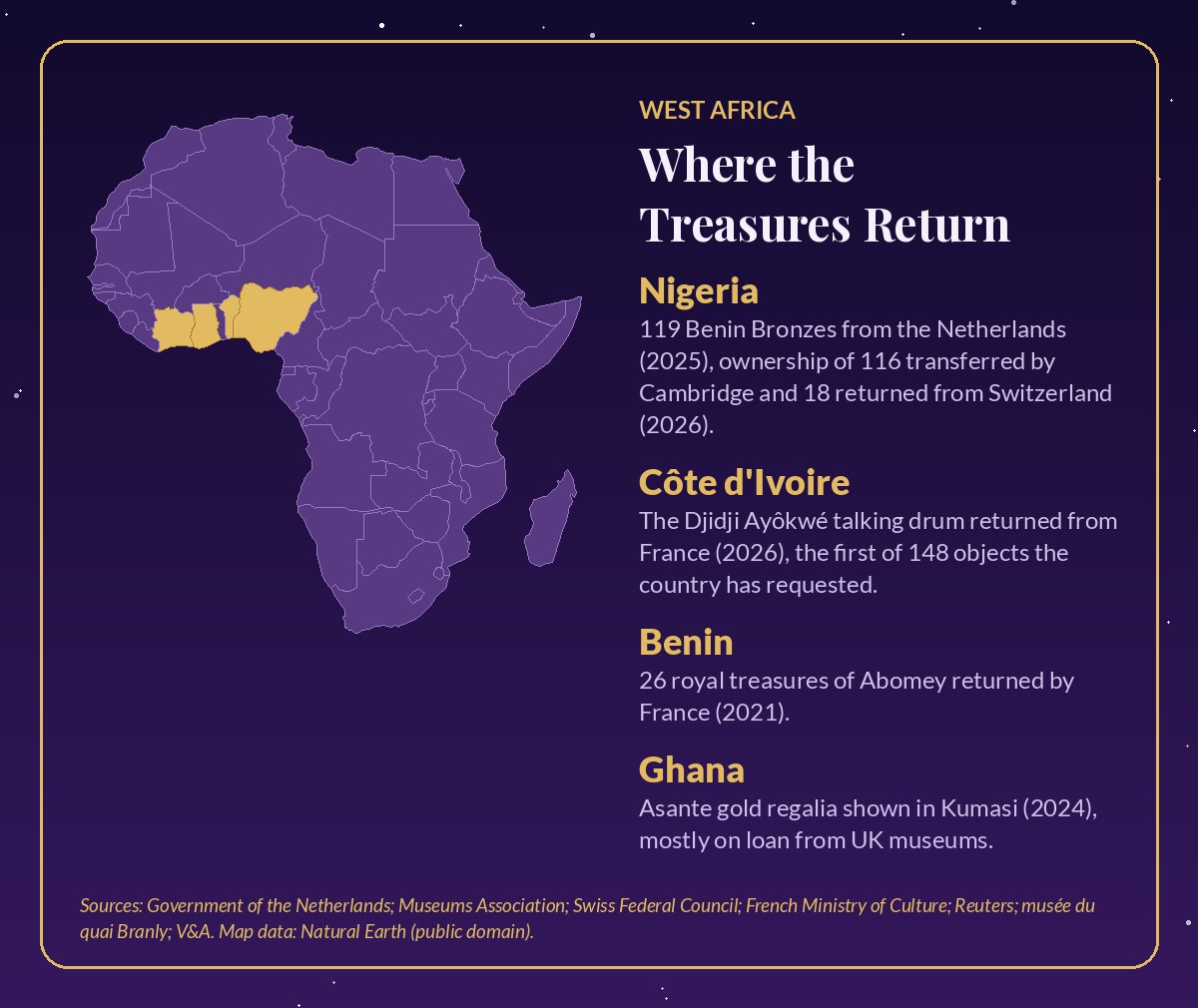
- June 2025: The Netherlands handed 119 Benin Bronzes to Nigeria at the National Museum in Lagos. The Dutch government called the return unconditional.
- February 2026: The University of Cambridge transferred legal ownership of 116 Benin Bronzes to Nigeria’s National Commission for Museums and Monuments (NCMM). Most will travel to Nigeria in due course, while 17 stay on loan in Cambridge for three years in the first instance.
- June 2026: Three Swiss museums returned 18 Benin artifacts at a ceremony in Lagos on 29 June.
- October 2026: On 20 October, the Netherlands presented another Benin artifact, from Museum De Fundatie, to Oba Ewuare II at his palace in Benin City during celebrations of his 10th coronation anniversary, according to the News Agency of Nigeria.
These returns build on earlier milestones. In 2021, France returned 26 royal treasures of Abomey to the Republic of Benin. In 2022, Germany agreed to transfer ownership of all 1,130 Benin Bronzes in its public museums to Nigeria and handed over the first 20 in Abuja that December. In 2024, Asante gold regalia went on show at the Manhyia Palace Museum in Kumasi, Ghana, for the first time in 150 years.
Ownership, not loans
Not every homecoming is a full return. The 32 Asante pieces from the British Museum and the Victoria and Albert Museum (V&A) are in Kumasi on loan for an initial three years, because some of Britain’s main national museums are barred by law from giving away most of their collections, as Reuters reported. Seven more pieces, formerly held by the Fowler Museum in California, were shown alongside them.
Nigeria has made its position clear. In October 2026, Olugbile Holloway, director general of the NCMM, said restitution must involve “transferring ownership, not merely temporarily returning objects,” and called the suggestion that Nigeria borrow looted bronzes from the British Museum “quite insulting,” according to Tribune Online.
Opinion: We agree. A loan leaves the final word with the institution that took the object. Ownership returns that word to the people whose ancestors made it.
New rules for an old wrong
The legal ground is shifting. On 25 March 2026, the UN General Assembly adopted Resolution 80/250, led by Ghana, declaring the trafficking of enslaved Africans and the racialized chattel enslavement of Africans the gravest crime against humanity. It passed by 123 votes to 3, with 52 abstentions, and calls for the prompt and unhindered restitution of cultural property to its countries of origin, without charge.
In France, Law No. 2026-351 of 9 May 2026 created a lasting process for returning cultural property taken by theft, pillage or coercion between 1815 and 1972. Each request is reviewed by a scientific committee formed together with the requesting country. Before this law, each return, including Abomey’s treasures and the Djidji Ayôkwé, needed its own act of parliament.
On the sidelines of the 81st UN General Assembly in September 2026, Ghana’s President John Dramani Mahama rejected the argument that restitution must wait until African museums are ready: “Capacity must serve as a bridge to return, not a barrier to justice.” He added: “Our young people must inherit more than the story of what Africa lost. They must inherit the story of what Africa created.”
What self-determination asks of us
Restitution is not charity, and it is not the end of the story. In our view, the deeper work is ours: to receive these treasures with knowledge, to support our own museums and to teach our children the names and meaning behind what our ancestors made. Here are three ways to begin:
- Learn one story. Choose one returned treasure, such as the Djidji Ayôkwé or a Benin plaque, and learn who made it, what it was for and how it was taken.
- Visit and support African museums. Places such as the National Museum in Lagos, the Musée des Civilisations de Côte d’Ivoire in Abidjan and the Manhyia Palace Museum in Kumasi are where this heritage now lives.
- Ask where it came from. When you visit a museum abroad, ask how its African collection was acquired. Every question adds to the call for open provenance research.
Watch: Netherlands returns 119 looted artifacts to Nigeria (AP Archive)
When Abomey’s treasures came home in 2021, Benin’s President Patrice Talon called their return “a testimony that we existed before.” Each homecoming reminds us that our story did not begin with conquest. Share this with someone who loves our history, and tell us in the comments which returned treasure speaks to you.
Sources
- French Ministry of Culture: restitution of the Djidji Ayôkwé talking drum (20 February 2026)
- Reuters: Ivory Coast welcomes talking drum, first artifact sent back from France (13 March 2026)
- RFI: Ivorian drum, looted by France, goes on display for first time at home (8 August 2026)
- Government of the Netherlands: Benin Bronzes returning home to Nigeria (18 June 2025)
- Museums Association: Cambridge University transfers ownership of 116 Benin bronzes to Nigeria (9 February 2026)
- Swiss Federal Council: Swiss museums return 18 major artefacts to Nigeria (29 June 2026)
- Nairametrics: Netherlands returns looted Benin artefact to Nigeria after 129 years (21 October 2026)
- Restitution Matters: Nigeria rejects British Museum’s proposal to loan Benin Bronzes (12 October 2026)
- Reuters: Looted gold, royal treasures go on show back home in Ghana (2 May 2024)
- Musée du quai Branly-Jacques Chirac: restitution of 26 works to the Republic of Benin
- Reuters: Germany hands over 20 looted Benin Bronzes to Nigeria (20 December 2022)
- UN News: UN resolution urges reparations for slavery’s historical wrongs (25 March 2026)
- French Senate: Law No. 2026-351 of 9 May 2026 on the restitution of unlawfully appropriated cultural property
- MyJoyOnline: full text of President Mahama’s speech on restitution (23 September 2026)
- Reuters: Benin receives looted art from France (10 November 2021)













You must be logged in to post a comment.