


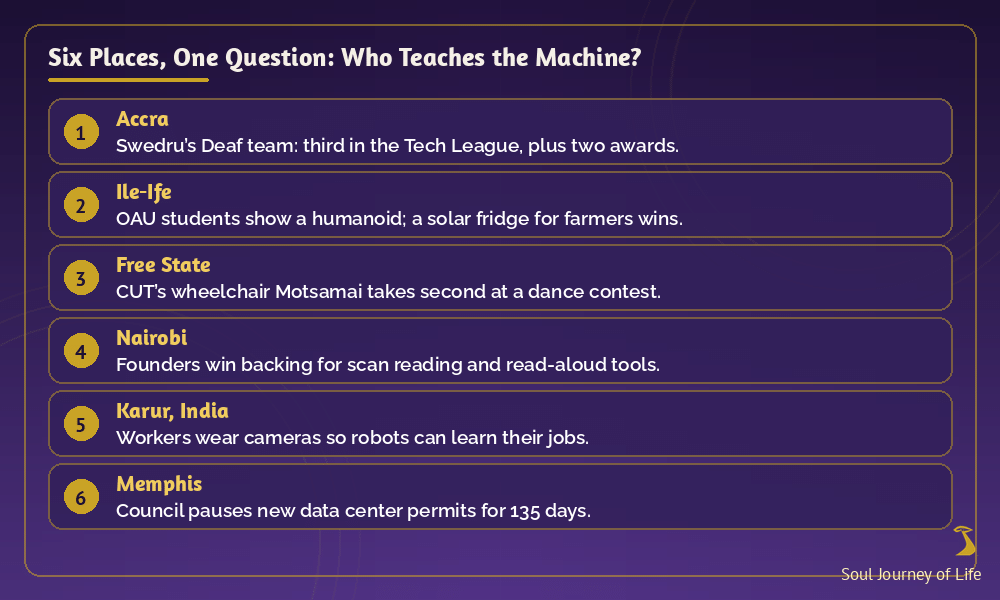
Every robot has teachers. Someone writes its code, someone shows it how to move, and someone lives next door to the buildings full of computers that make it think. This week we follow the hands behind the machines. In Ghana, Deaf schoolchildren programmed their way onto the podium at a national robotics competition. In Ile-Ife, Nigerian engineering students showed a humanoid robot, and judges reminded them that the best invention is the one that meets a real need. In the Free State, a South African team taught a wheelchair to dance. In Nairobi, local founders won backing for tools that read scans and read aloud. In India, factory workers are wearing cameras so robots can learn their jobs. And in Memphis, where an AI supercomputer its owner has called the world’s largest sits near a historically Black neighbourhood, residents asked their city council to slow down new data centers. Different places, one question: who teaches the machine, and who benefits from what it learns?
What is happening on the ground
Accra: Deaf learners take the podium (early October)
The fourth Ghana Robotics Competition was held at the University of Ghana in early October under the theme “AI and Robotics for Sustainable Africa.” It was organised by Firefly IO with the university’s School of Engineering Sciences. Teams guided pre-programmed or hand-controlled robots through missions on competition tables. New this year was an innovation challenge, worth 40 percent of a team’s qualifying score, that asked students to find a problem in their own community and propose a solution. “The innovation challenge allows students to be creative, discover problems or issues that are around their vicinity,” said head judge George Kwasi Klenam.
Bosomtwe Boys STEM Senior High School in the Ashanti Region was named overall champion. Headmaster Kwaku Yeboah Snr said the school also won Best Robot Controller and Overall Best School. “Getting the robot to complete the task and reach the target is a bit challenging, but our boys delivered,” he said when the team presented its trophy to the Ashanti Regional Education Directorate on 13 October.
The team that drew the most attention came from the Swedru Salvation Army School for the Deaf. Competing against mainstream schools, its Deaf learners placed third in the Tech League and won the Best Coach Award and the Controller Conquest Award, according to DisabilityNewsGH. The school thanked its sponsor, Sintex Tank Ghana, and the group DeafCanTalk for technical and logistical support. Advocates quoted in the report want accessible science labs and sign-language-friendly technology lessons in every special school.
Firefly IO founder George Sarfo welcomed the government’s plan to bring robotics into the school curriculum but warned that Ghana does not yet have enough trained teachers or learning materials. “It’s not just about implementing it, but it’s about making sure that it’s going on and it’s very sustainable,” he said.
Ile-Ife: a humanoid on show, a solar fridge takes the prize (Oct 21)
On 21 October, final-year mechanical engineering students at Obafemi Awolowo University (OAU) in Ile-Ife, Nigeria, showed their projects to industry guests and pupils from ten secondary schools. Twelve groups took part. Among the projects were a humanoid robot, a miniature crane and a dialysis membrane designed to cut treatment costs for rural patients, the campus press agency ACJOAU reports.
The humanoid drew interest, but the top prize of ₦500,000 went to EcoRide, a solar-powered 12-volt mobile refrigerator built to keep farm produce fresh on the way from rural areas to market. Second runner-up was a gravity-fed system that cleans oil-polluted water in the Niger Delta without electricity. A judge from Moniepoint Group urged the students to work on cost analysis, explain clear uses for their inventions and avoid relying on technology for its own sake. Head of department Prof. Adam Muritala told industry guests: “Let us invest in their ideas while they are still in the university environment.”
Free State to Pittsburgh: a wheelchair that dances (announced Oct 13)
Motsamai, a smart robotic wheelchair built at the Central University of Technology, Free State (CUT) in South Africa, placed second at the 2026 Volting Cup wheelchair dance competition. The contest ran from 28 to 30 September at IROS, a major international robotics conference held this year in Pittsburgh in the United States. CUT announced the result on 13 October.
The project is led by Prof. Markus Elisha, with Morakane Mohanoe, Matsietsi Mohapi, Kesaoleboga Mabuzweni and Jessica Elisha. According to the university, Motsamai can detect obstacles, map its surroundings and work out where it is. Its name means “to walk,” and the team says it shows that robotics for people living with disabilities can offer more than getting from one place to another. It can also make room for creativity and self-expression.
Nairobi: tools that read scans and read aloud (Oct 18)
Ten Kenyan teams pitched at the first AI Academy Kenya Pitchathon, run by Meta and the Nairobi accelerator This Is Digital. The competition drew more than 426 applications, The Star reports. Two winners each received US$5,000 in equity-free funding. Neural Labs Africa, represented by Tom Kinyanjui, built NeuralSight, which connects hospitals and clinics with remote specialists who help read medical scans, including in places with poor internet. Me-Nasoma, represented by Oscar Karuga, turns documents and web pages into audio so people can listen on their phones, with support for local languages. Other finalists built a solar-powered clinic triage hub, a tool for children with speech and language difficulties, and a WhatsApp assistant that helps small businesses file electronic tax invoices. Both winners are due to pitch again at a Meta regional summit in Istanbul on 24 November.
Karur, India: workers who train their replacements (Oct 14)
For robots to learn human jobs, developers need millions of hours of video recorded from a worker’s point of view. NPR reported from Karur, in southern India, where textile workers pack aprons while wearing GoPro cameras and smart glasses. Shoba Kirubakaran, 40, has worked at the factory for ten years and earns about US$90 a month. She told NPR that no one had explained the camera was recording her movements to train robots. “Nobody told me anything about it,” she said. Astha Kapoor of the Aapti Institute, which studies technology’s impact on people, called it “exploitation of labor.” That is her view, not a ruling by any court or regulator.
Others have been told, and they are paid. Kannagi Periyasaamy, 42, earns about US$2.60 an hour for the recordings. She believes a robot will take her job one day and says she may turn to farming. Meanwhile, she thinks of the robots as her students. “I’m proud I can teach it to do a good job,” she said. Some experts told NPR that robots are unlikely to replace Indian workers at scale soon because they are expensive and need reliable power. “Humans are cheaper to run than robots,” Kapoor said.
Taicang, China: humanoids building humanoid parts (Oct 20)
At the other end of the chain, German manufacturer Schaeffler opened what it calls a “lighthouse factory” for humanoid robotics in Taicang, China, on 20 October. According to the company, six humanoid robots work at five stations on an assembly line. They sort, join, inspect, label and package joint modules and actuators for the next generation of humanoids. Schaeffler also says it trains robots there for tasks such as inspecting parts and moving containers, and that its humanoid robotics orders have reached about €400 million. These are company figures from its own press release.
Memphis: residents ask the city to slow down (Oct 20)
Large AI systems run on data centers, and in Memphis, Tennessee, people living near them have been asking for a say. Elon Musk’s AI company xAI, now owned by SpaceX and rebranded as SpaceXAI, has built several data centers in and around the city since 2024. About two miles from the first one lies Boxtown, a nearly all-Black South Memphis neighbourhood settled by formerly enslaved families, NBC News has reported. Residents have long raised concerns about air pollution from the gas turbines used to power the sites. The NAACP and other groups have sued over turbines at a plant in Southaven, Mississippi, that powers the company’s data centers. On 19 October a federal judge refused a request to dismiss that case. These are allegations still before the court, not findings, and the company did not respond to CBS News’ request for comment.
On 20 October, after a meeting of more than five hours, the Memphis City Council voted down an 18-month pause on new data centers in a 6–6 tie. It then passed a substitute ordinance, by 7–5, that pauses new data center permits for 135 days while Mayor Paul Young’s 90-day review sets rules for where and how they may be built. Existing data centers are not affected. KeShaun Pearson of Memphis Community Against Pollution said the substitute was presented shortly before the vote. “It’s not good enough because it’s not what the people wanted,” he told Action News 5. Council Chairwoman Jana Swearengen-Washington said the measure would still bring “a pause” and “some guardrails.” Supporters of data centers say they bring tax revenue and jobs, though experts quoted by CBS News say many of those jobs are temporary construction work.
Lessons we can carry
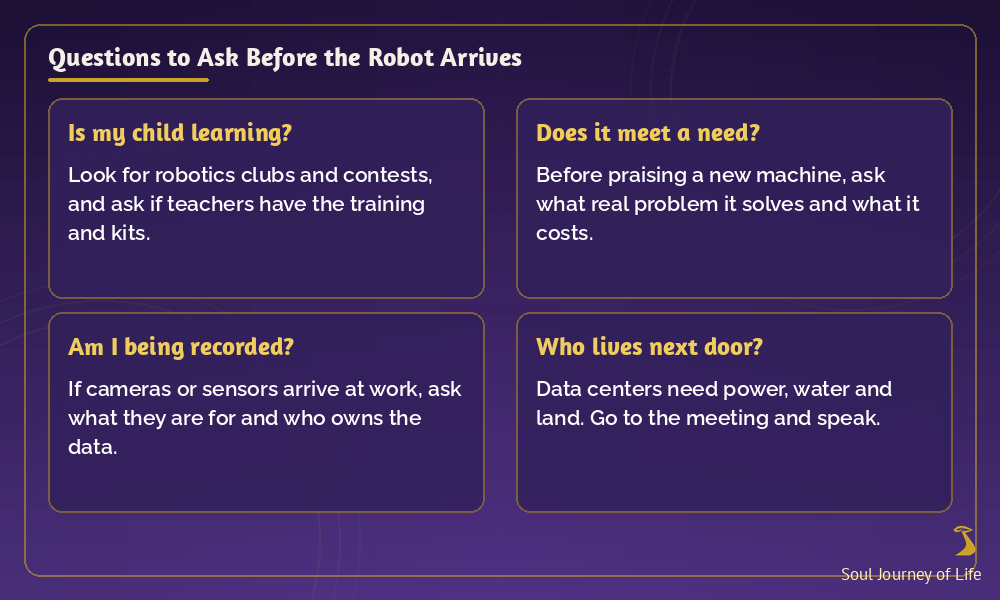
- Teach every child, and teach the teachers. The Swedru team shows that Deaf learners can compete with anyone when they have coaching and equipment. Ghana’s robotics plan will only work if teachers are trained and schools are supplied.
- Build for the need, not the headline. In Ile-Ife, a solar fridge for farmers beat a humanoid robot. A machine is worth building when it solves a problem people actually have.
- Know when you are teaching a machine. Workers who are recorded to train robots deserve to be told, to agree, and to be paid fairly for that knowledge.
- Ask who carries the cost. The computers behind AI need power, water and land. Neighbours deserve a voice before the next one is built.
Encouragement
This week, find a young person who is curious about robots or coding and help them find a club, a competition or a teacher. If your workplace brings in cameras, sensors or new machines, ask plainly what they are for. And if a data center or factory is planned near your home, go to the meeting and speak. The machines will learn from somebody. Let it be people who know their worth and their community’s needs.
Watch: whether Ghana’s robotics curriculum comes with trained teachers and kits for special schools; whether OAU’s student projects find investors; what Memphis decides when the 135-day pause ends; and whether companies collecting work footage in India start telling workers what the recordings are for.
Sources
- The Sikaman Times on the 2026 Ghana Robotics Competition
- Modern Ghana on Bosomtwe Boys STEM SHS
- DisabilityNewsGH on the Swedru Salvation Army School for the Deaf
- ACJOAU on the OAU final-year project exhibition
- Central University of Technology on Motsamai
- IROS 2026 competitions
- The Star on the AI Academy Kenya Pitchathon
- NPR on workers training robots in India
- Schaeffler on its Taicang humanoid factory
- Action News 5 on the Memphis council vote
- CBS News on the Memphis data center pause
- DCD on the Memphis council vote
- NBC News on Boxtown
Soul Journey of Life — Write About It. Conscious. Constructive. United.
Recommend0 recommendationsPublished in Write About It












You must be logged in to post a comment.