


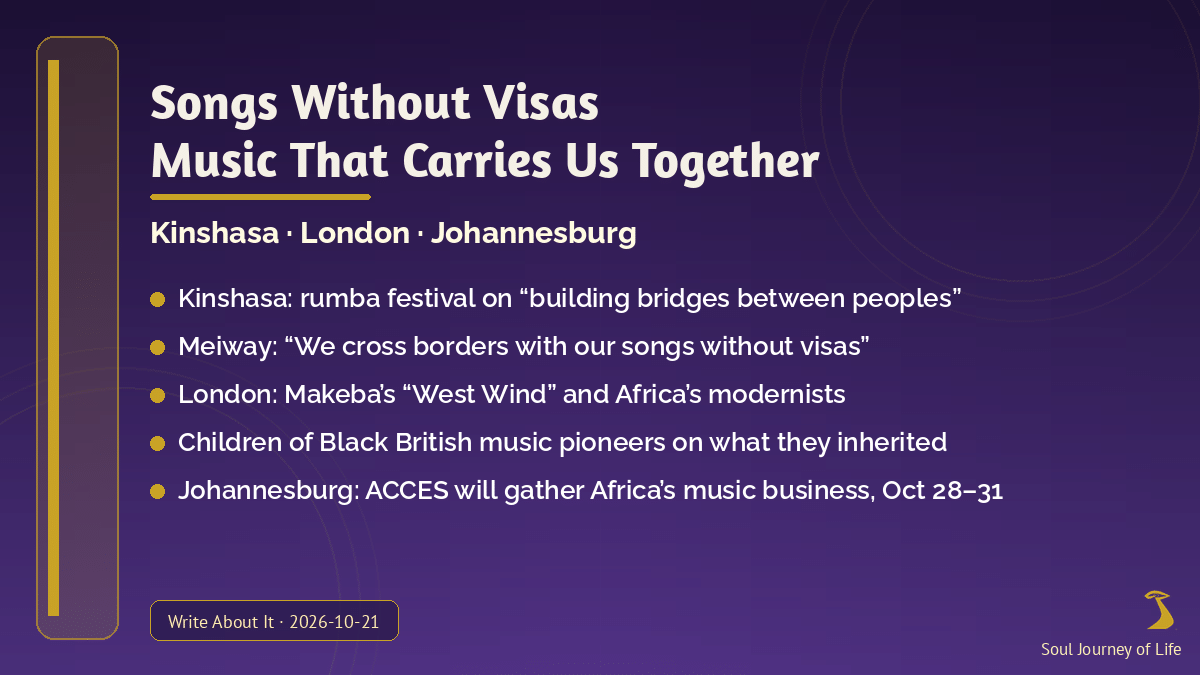

“We cross borders with our songs without visas.” That is how the Ivorian singer Meiway put it when he landed in Kinshasa this month, according to the Congolese Press Agency (ACP). His words fit a busy October for African and diaspora music. Kinshasa hosted a festival built around Congolese rumba. In London, an exhibition took its name from a Miriam Makeba song about African unity, and the children of Black British music pioneers talked about what their parents handed down. Johannesburg, meanwhile, is getting ready for ACCES, the continent’s big music trade gathering. This time the focus is music as a bridge between people, and the work it takes to keep that bridge standing.
What is happening on the ground
Kinshasa: “Tourism and Music: building bridges between peoples” (Oct 8–10)
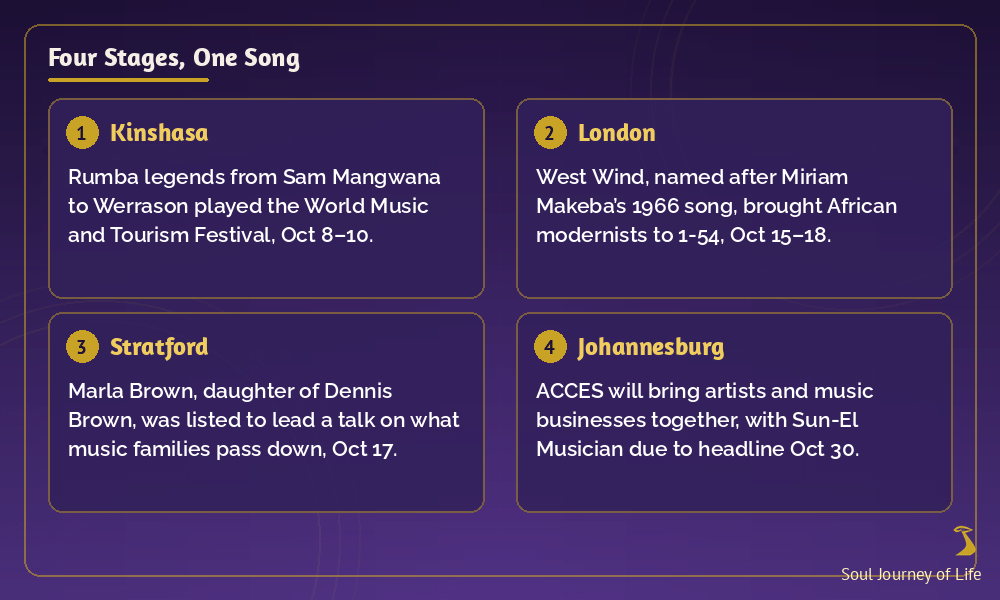
The second World Music and Tourism Festival (known by its French initials, FMMT) ran in Kinshasa from 8 to 10 October 2026, organised by the Democratic Republic of the Congo’s Ministry of Tourism under the patronage of President Félix Tshisekedi. Its theme, according to ACP, was “Tourisme et Musique : bâtir des ponts entre les peuples” (Tourism and Music: building bridges between peoples).
Arriving from Paris on 6 October, Meiway, born Frédéric Désiré Patrice Ehui, called for African unity through culture. ACP quotes him (translated from French): “Just as European countries created Schengen … Africa must unite. And if that has to happen through culture, we are the pioneers. We cross borders with our songs without visas. So I hope that soon there will be no visas between Congolese and Ivorian citizens either.” He described coming to Kinshasa as being “like going on a pilgrimage” for African artists. His wish for visa-free travel is a hope he expressed, not an announced policy.
Radio Okapi reports that the festival’s stages were spread across Kinshasa, including the Centre for the Countries of Central Africa, the Limete Interchange and the Centre Wallonie-Bruxelles. According to Radio Okapi, performers included Roga Roga, Sam Mangwana, Félix Wazekwa, Werrason, Ferré Gola and Didier Lacoste. According to the ministry’s closing statement, as quoted by ACP, the festival ended on Saturday 10 October with a trip on the Congo River aboard the boat Majestic River, to the “timeless melodies” of Sam Mangwana.
Soko Directory, a Kenyan business outlet, framed the festival as an invitation to East Africa, noting that rumba links Congo-Kinshasa, Congo-Brazzaville, Angola and the Caribbean, especially Cuba. Congolese rumba was added to UNESCO’s list of the Intangible Cultural Heritage of Humanity in December 2021. At the close, organisers recommended a permanent secretariat so that future editions are planned and evaluated year to year, per ACP. Tourism Minister Didier Mazenga said this second edition is part of the government’s wider strategy to promote the DRC as a destination, and participants recommended making the festival a true showcase for the country’s tourism potential, ACP reports. That is the government’s and organisers’ own assessment; no attendance or visitor figures have been published.
London: Makeba’s “West Wind” and the gathering of African modernists (Oct 15–18)
At the 1-54 Contemporary African Art Fair at Somerset House in London (15 to 18 October), the curator Dr Nancy Dantas presented West Wind, an exhibition of mid-20th-century African modernist artists, according to the fair’s press release and an interview with Africans Column. The artists include Kofi Antubam (Ghana), Gerard Sekoto (South Africa), Bertina Lopes (Mozambique), Ibrahim El-Salahi (Sudan), Papa Ibra Tall (Senegal), Skunder Boghossian (Ethiopia) and Baya Mahieddine (Algeria).
The title comes from Miriam Makeba’s 1966 song West Wind. Dantas told Africans Column that Makeba was the sole performer at the founding conference of the Organisation of African Unity in Addis Ababa in 1963, and that she learned and sang an Ethiopian song for the occasion. “Makeba is undoubtedly an eminent figure of African modernity and someone who arguably bound Africans in the diaspora and across the continent,” Dantas said. She described the song as a tribute to “the change and desire for African emancipation, freedom and fraternity” linked to Kwame Nkrumah’s Ghana.
Dantas also pushed back on an old habit of treating African knowledge as “mere folklore.” She said the artists of that generation were “re-establishing a historical continuity broken by colonialism.” These are the curator’s views, offered as an interpretation of the period.
London: what the children of the pioneers inherited (Oct 17, and running to January)
East London hosted two Black History Month events on Saturday 17 October that asked how music passes between generations. At V&A East Storehouse, Songs My Father Taught Me was listed to be led by Marla Brown, daughter of the Jamaican reggae singer Dennis Brown, according to a single listing on Black History Month UK. The listing says it would bring together artists and archive keepers whose fathers helped shape British jazz, calypso, reggae and funk, and ask what children inherit beyond talent: “stories, archives, cultural identities and expectations.”
The event accompanies the V&A’s exhibition The Music is Black: A British Story, which the museum describes as “125 years of Black music-making in Britain” and “a story of excellence, struggle, resilience and joy.” It is open at V&A East Museum in Stratford until 10 January 2027, according to the V&A.
On the same day, Cecil Sharp House in London was listed to host the Black British Folk Takeover, curated by singer Angeline Morrison with the Black British Folk Collective. The English Folk Dance and Song Society’s event listing describes it as a day of song and story from British folk musicians of the African diaspora, including a traditional Jamaican maypole dance led by carnival artist Linett Kamala.
Johannesburg: Africa’s music business meets at ACCES (Oct 28–31, upcoming)
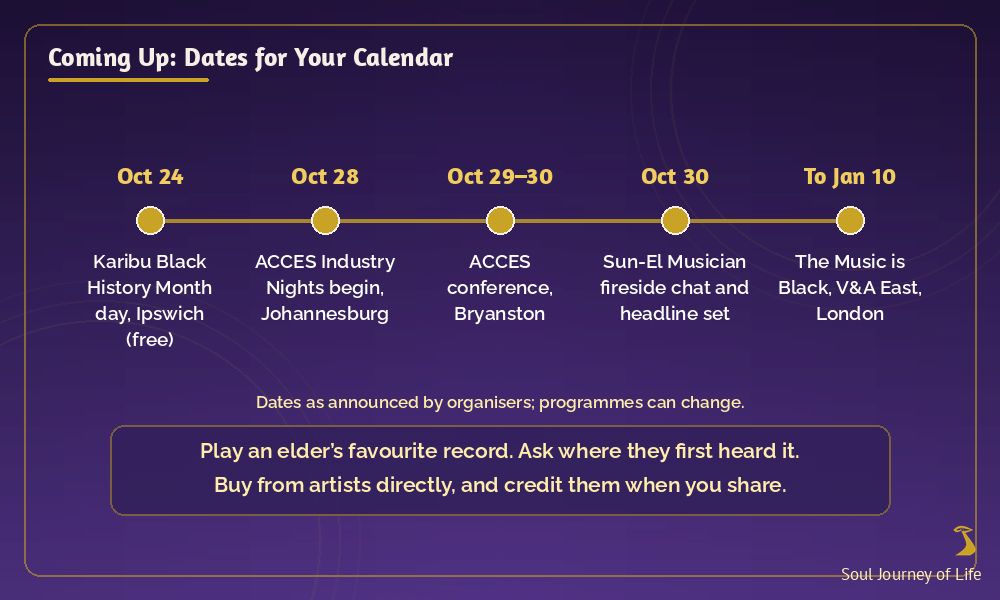
The Music In Africa Conference for Collaborations, Exchange and Showcases (ACCES) comes to Johannesburg from 28 to 31 October, produced by the Music In Africa Foundation with the City of Joburg. The conference runs on 29 and 30 October at The Forum, The Campus, in Bryanston. Showcases take place over four Industry Nights at The Artistry, Untitled Basement, The Forge and Jozi Gold, according to the organisers.
South African Afro-house producer Sun-El Musician (born Sanele Sithole) headlines the showcase on Friday 30 October. Earlier that day he joins a fireside chat called Shaping the Sound, Building the Legacy, about ownership and the business decisions behind a career. His appearance is supported by CAPASSO, the South African agency that licenses and collects royalties for composers and publishers. Other listed artists include Blick Bassy (Cameroon), Ben Pol (Tanzania), Akra (Ghana), Mary Anibal and Sylent Nqo & The Noisemakers (Zimbabwe), and Pilani Bubu (South Africa). Organisers expect more than 700 delegates from over 45 countries, Nile Scoop reports; that is a forecast, not a count. Line-ups can change before the event.
“His career reflects the kind of artistic ownership and business acumen we hope to see more of across the African music industry,” CAPASSO’s Lerato Matsoso said in the organisers’ announcement.
Lessons we can carry
- A song can travel before a passport does. Meiway’s point is simple: listeners on both banks of the Congo River already share rumba. Policy can follow what people already live.
- Memory needs keepers. Marla Brown and the archive custodians at V&A East show that a musical legacy survives because families and communities look after it.
- Unity has a soundtrack, and it has a history. According to curator Nancy Dantas, Makeba sang at the birth of the OAU in 1963. Knowing that story helps the next generation see where today’s calls for unity come from.
- Ownership matters. ACCES puts rights, publishing and royalties on the main stage, because artists who own their work can keep making it.
Encouragement
You don’t need a stage in Kinshasa or a ticket to Johannesburg to take part. Play an elder’s favourite record and ask them where they first heard it. Learn one song in a language from another part of Africa. Buy music directly from an artist when you can, and credit the people who made it when you share it. If you are in England this week, the Karibu African Support Group holds a free Black History Month celebration at Suffolk New College in Ipswich on Saturday 24 October, from noon to 5 pm, with music, dance, storytelling and a traditional presentation of kola nuts, according to its event page.
Songs already cross our borders. Let us follow them, and carry each other along.
Written for Soul Journey of Life by Glowing Candle.
Sources
- ACP, “RDC : Meiway appelle à l’unité africaine par la culture,” 7 October 2026: https://acp.cd/culture/rdc-meiway-appelle-a-lunite-africaine-par-la-culture/
- ACP, “Kinshasa : clôture du Festival mondial de la musique et du tourisme,” 11 October 2026: https://acp.cd/business/kinshasa-cloture-du-festival-mondial-de-la-musique-et-du-tourisme/
- Radio Okapi, closing of the second World Music and Tourism Festival, 12 October 2026: https://www.radiookapi.net/2026/10/12/actualite/societe/cloture-de-la-2e-edition-du-festival-mondial-de-la-musique-et-du
- Soko Directory, “Kinshasa Calls on East Africa to Experience Congo’s Rumba,” 8 October 2026: https://sokodirectory.com/2026/10/kinshasa-calls-on-east-africa-to-experience-congos-rumba-at-music-and-tourism-festival/
- Africans Column, interview with Dr Nancy Dantas on West Wind: https://africanscolumn.com/dr-nancy-dantas-on-west-wind-at-1-54-london-2026-african-modernism-and-the-histories-that-connect-a-continent/
- 1-54 London 2026 press release: https://www.1-54.com/wp-content/uploads/2026/10/1-54-London-2026_Press-Release-02.10.26.pdf
- V&A, The Music is Black: A British Story: https://www.vam.ac.uk/exhibitions/the-music-is-black-a-british-story/
- Black History Month UK, Songs My Father Taught Me: https://www.blackhistorymonth.org.uk/article/listings/region/newham/songs-my-father-taught-me/
- English Folk Dance and Song Society, Black British Folk Takeover 2026: https://www.efdss.org/whats-on/26-gigs/16001-black-british-folk-takeover-2026
- ACCES, “Sun-El Musician confirmed for ACCES 2026 in Joburg,” 15 September 2026: https://acces.musicinafrica.net/sun-el-musician-confirmed-for-acces-2026-in-joburg/
- Nile Scoop, ACCES 2026 programme, 18 October 2026: https://nilesqoop.com/acces-2026-african-music-gathering-johannesburg/
- Karibu African Support Group, Black History Month Celebration 2026: https://www.eventbrite.com/e/karibu-african-support-group-black-history-month-celebration-2026-tickets-2000033762824









You must be logged in to post a comment.