



Today is Friday, Jumu’ah, the day the community gathers. This week’s news from Africa and Black America shows that gathering doing two kinds of work at the same time. One is keeping peace in our own house: settling disputes without violence, caring for old sacred buildings, and speaking kindly to neighbors of other faiths. The other is earning a steady voice in the nation: showing up, organizing, and being at the table before a crisis, not only after one. Here is what local people did this week.
Earning a voice in the nation
Nairobi, Kenya: a permanent desk, not a crisis phone
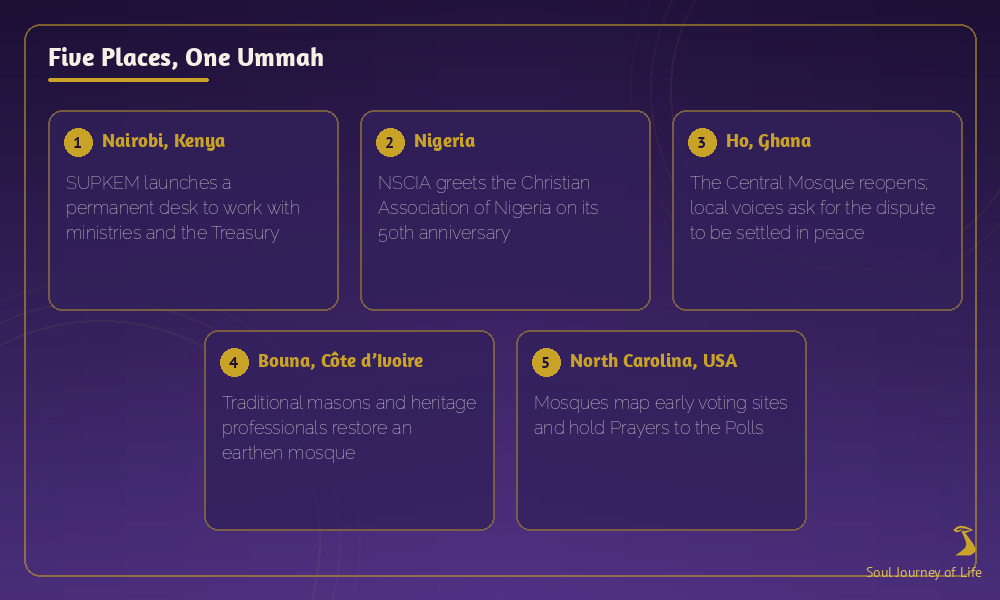
On Thursday, October 15, the Supreme Council of Kenya Muslims (SUPKEM) closed its National Muslim Leaders Convention in Nairobi. Scholars, delegates, and leaders came from all 47 of Kenya’s counties to talk about the community’s place in governance and the economy.
Their main decision was practical. SUPKEM launched the Ummatic Policy Liaison Directorate, a permanent unit that will link the Muslim community with government ministries, the Vision 2030 Delivery Secretariat, and the National Treasury. It will track government commitments and prepare briefs, backed by data, for Muslim legislators and civil servants. The communiqué, issued by National Chairman Al-Hajj Hassan Kirua Ole Naado, put the idea plainly: the directorate “will not react to crises; it will permanently interface with government line ministries, the Vision 2030 Delivery Secretariat, and the National Treasury.”
President William Ruto’s address was delivered on his behalf by Cabinet Secretary Aden Duale, and the leaders said they were open to working with the government. “It is against our values and character to ignore a hand stretched toward us in friendship and cooperation,” the communiqué says. The convention also urged professionals and young people to use constitutional channels, and said the community must take more responsibility for its own place in Kenya’s public life instead of waiting on outsiders.
Charlotte, Durham, and Raleigh: Prayers to the Polls
In North Carolina, home to about 130,000 Muslims, organizers have spent years building what a community needs to be heard. NC Newsline reported this week on how that work looks now, just as in-person early voting began in the state on Thursday.
The Charlotte Muslim Caucus, founded in 2023, maps early voting sites near mosques, runs “Prayers to the Polls” events, and interviews candidates before deciding whether to endorse them. “We wanted to give our masjids a way to engage the community in civic politics and grassroots engagement,” said its president and co-founder, Nasif Majeed. At a Durham mosque after Friday prayer, Nigel Edwards of the Muslim American Public Affairs Council sat at a voter registration table. “We want candidates to motivate us to vote, but unless we show up as a community, those candidates will never appear in the first place,” he said.
This work has deep Black American roots. Fleming El-Amin, now 74, first walked into a Nation of Islam temple at 14 to hear a preacher speak about Black history and pride. He later led the American Coalition for Good Government, founded in Charlotte in 1997, served on the Forsyth County Board of Commissioners, and worked with former state Senator Larry Shaw so that Muslim officials in North Carolina can take their oath of office on the Quran. Members of the Muslim American Public Affairs Council also used their relationships with Raleigh City Council members to draw attention to the effort to reopen the mosque at Shaw University, the historically Black university in Raleigh.
There is honest talk, too. Turnout at some events is still low, and some candidates don’t come when invited. A political scientist at Western Carolina University, Chris Cooper, sees pockets of local influence but not yet a statewide force, and said the community should aim for “the ability to play the long game.”
Keeping peace in our own house
Nigeria: a greeting to CAN at 50
On Wednesday, October 14, the Nigerian Supreme Council for Islamic Affairs (NSCIA), led by the Sultan of Sokoto, Alhaji Muhammad Sa’ad Abubakar, congratulated the Christian Association of Nigeria on its 50th anniversary. The message, signed by Secretary-General Prof. Is-haq Oloyede, called on Muslims and Christians to work together against insecurity, poverty, and unemployment, and acknowledged the role of the Nigeria Inter-Religious Council in bringing religious leaders together. Differences in belief, the council said, should not become grounds for division, hostility, or violence, but should push both communities toward justice, compassion, and service to humanity.
The greeting follows the communiqué from the NSCIA General Assembly held at the National Mosque in Abuja on October 1. There, the council said insecurity affects Nigerians of every faith and should not be seen through a religious lens. It also reminded Muslims that Islam forbids compulsion in religion, and asked them to practice tabayyun, checking facts before sharing claims and accusations.
Ho, Ghana: the doors open again
On Saturday, October 10, Ghana’s National Chief Imam reopened the Ho Central Mosque in Ho Zongo, months after it was shut. The mosque had closed after violent clashes over a leadership dispute, in which a shooting injured 13 people, according to Citi Newsroom. Worshippers came out in the morning to celebrate the return of prayer.
The underlying dispute is not settled yet, and local voices are asking the authorities to deal with it so violence does not return. “We are happy for the reopening,” youth leader Mohammed Salisu Kidzah told Citi News. He said those responsible for the shooting must face the law, and added: “We want peace and the National Chief Imam called for peace when he was here.”
Caring for sacred ground
Bouna, Côte d’Ivoire: masons and mud keep a mosque standing
In Bouna, in the northeast of Côte d’Ivoire, a training worksite opened on Monday, October 12, around the Limamisso mosque, an earthen mosque in the Sudanese style. Until October 31, more than 40 professionals and traditional masons are working on the building together, joining conservation science with local know-how in building with earth. The goal is to protect the mosque from climate risks and to train the people who will care for other earthen buildings across the region.
The worksite follows a regional seminar in Abidjan on October 7 to 9. It is part of a 2025 to 2028 program led by the International Centre for Earth Construction with the African Heritage School and Ivorian heritage services, with funding from the International Alliance for Heritage Protection, according to BeNews. The same program also covers an impluvium house in the Bandial kingdom in Senegal and traditional Asante buildings in Ghana.
Northern Côte d’Ivoire is known for this style of mosque; a group of these Sudanese-style mosques is listed by UNESCO as World Heritage. Their beauty depends on hands that know how to replaster mud walls, season after season.
Lessons we can carry
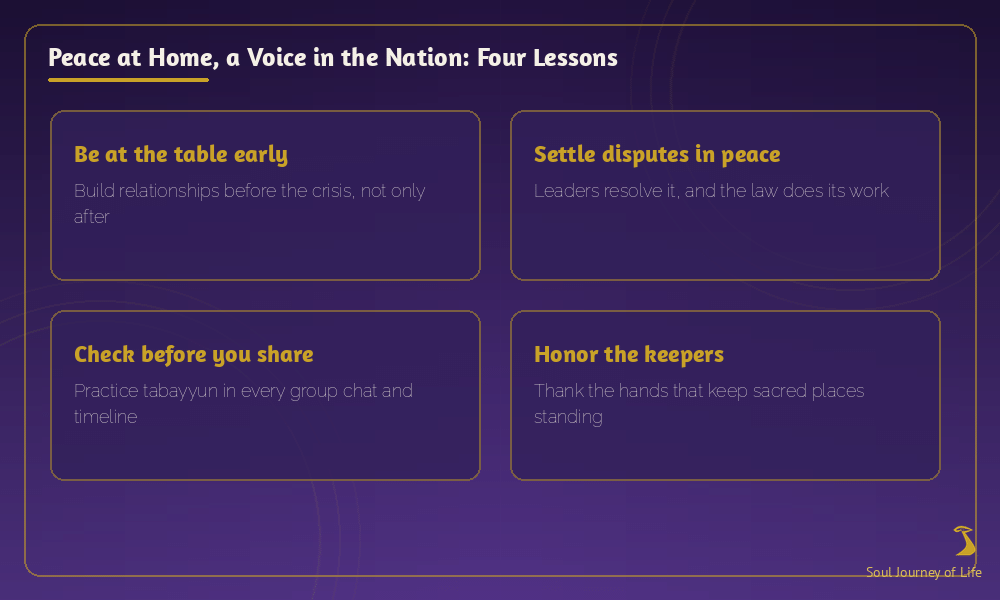
- Be at the table before the crisis. Kenya’s new desk and North Carolina’s caucuses build relationships early, so the community is not only heard when something goes wrong.
- Settle our disputes in peace. Ho’s mosque reopened, but peace lasts only when leaders resolve the dispute and the law does its work.
- Check before you share. Nigeria’s call for tabayyun is good advice for every group chat and timeline.
- Honor the hands that keep sacred places. In Bouna, masons and heritage professionals are learning together, so the mosque can stand for another generation.
Encouragement
The masjid has always been more than a building. It is where we pray, and also where we register to vote, where we greet our neighbors on their special days, and where elders teach younger hands to repair old walls. Whatever your faith, this Friday is a good day to ask two questions: Is there peace in my house? And is my community’s voice steady, or does it only rise in a crisis? Start small. Show up, check your facts, greet a neighbor, and help keep something sacred standing.
Glowing Candle, for Soul Journey of Life
Sources
- The Star (Kenya): SUPKEM creates new directorate to push Muslim interests in government
- Endoo Media: Muslim leaders resolve to establish government liaison office after Nairobi convention
- News Focus (Nigeria): CAN at 50: Sultan urges Muslims and Christians to unite against insecurity and poverty
- Arise News: Sultan urges federal government to cut transport and food costs and reform security
- The Guardian (Nigeria): NSCIA rejects genocide claim, demands security reforms
- Citi Newsroom (Ghana): Ho Central Mosque reopens after months of closure
- BeNews (Côte d’Ivoire): In Bouna, a training site opens to restore an earthen mosque
- L’Infodrome (Côte d’Ivoire, in French): Côte d’Ivoire mobilizes its experts to save earthen heritage
- Agence Ivoirienne de Presse (in French): Bouna: a technical course and training worksite to restore the Sudanese-style mosque
- NC Newsline: North Carolina Muslims have spent decades building political power. What has it produced?







You must be logged in to post a comment.