


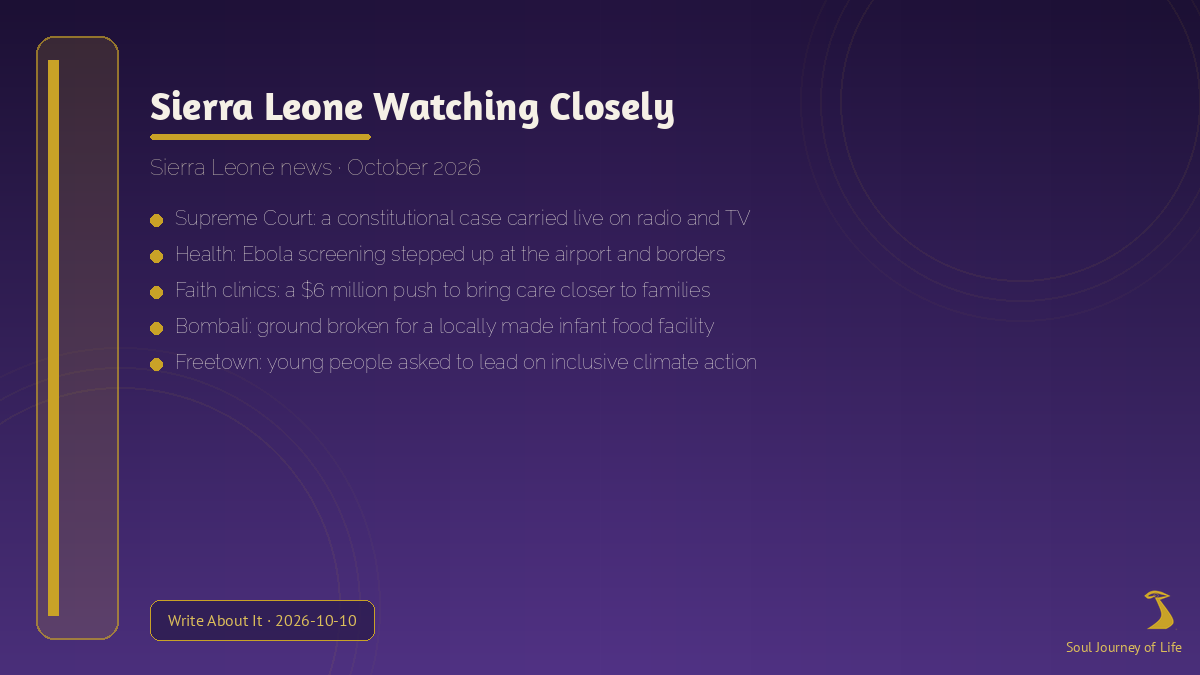

This was a week when Sierra Leone’s news reached ordinary people directly. Their highest court’s work was carried live on radio and television, travelers met health screeners at the borders, and farmers, mothers and young people were asked to help shape their communities’ future. Here is what happened, as local outlets reported it, with each side’s words left in their own hands.
A constitutional case the whole country can hear
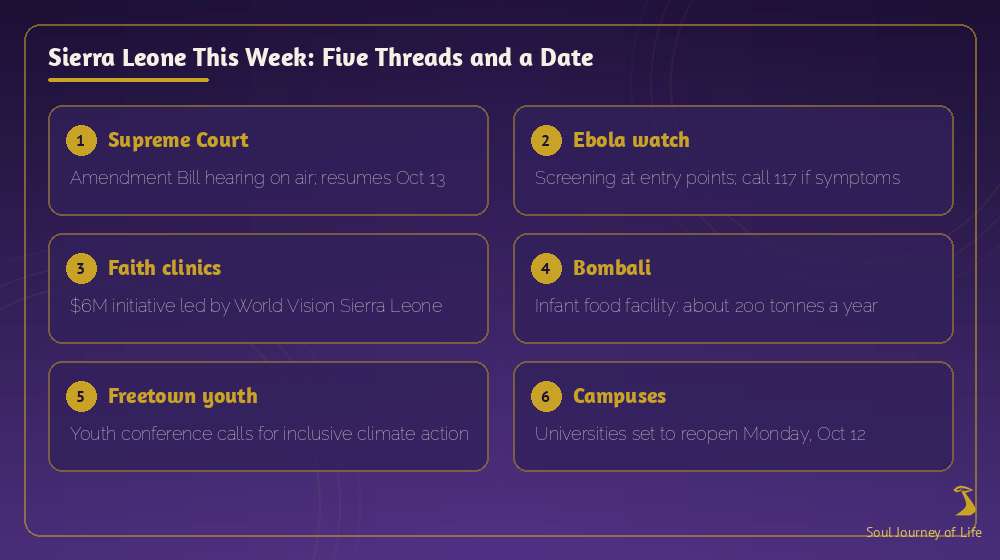
On Wednesday, October 7, the Supreme Court began hearing the consolidated cases on the Constitution of Sierra Leone (Amendment) Bill, 2025. According to the Sierra Leone Monitor, Parliament treated the Bill as passed on August 10, 2026, after Speaker Segepoh Solomon Thomas ruled that it carried with a majority of members present; opposition All People’s Congress (APC) members had walked out before the final vote. The APC, plaintiffs including Hon. Osman Timbo, and civil society organisations argue that the Constitution requires the support of at least two-thirds of all members, which they put at 100 of 149. President Julius Maada Bio did not sign the Bill and referred it to the Supreme Court after a petition from the Institute for Governance Reform.
If it becomes law, the Monitor reports, the Bill would lower the threshold to win a presidential election from 55% to 50% plus one vote, return parliamentary elections to a district block proportional representation system, and require that 30% of leadership positions in political parties go to women.
What made this hearing different for ordinary citizens is how they could follow it. The Judiciary approved a request from the Sierra Leone Association of Journalists (SLAJ) to coordinate live coverage, with 10 media houses accredited inside the courtroom and the Independent Radio Network carrying the hearing on more than 40 radio stations, according to the Monitor. According to the Judiciary’s statement, as relayed by the Monitor, live coverage of public-interest cases has been allowed since 2019, and what is new is SLAJ’s coordinating role. Media may not comment on the merits while the case is before the court. Per the Monitor, SLAJ said live coverage would let citizens follow the case directly and reduce misinformation.
The hearing has also been tense. On the opening day, APC lead counsel Joseph Fitzgerald Kamara said the Attorney-General’s office had not filed its statement of case, and Chief Justice Komba Kamanda reminded counsel that the court is not a political platform, the Monitor reported. On October 8, the Chief Justice found Mr. Kamara’s apology for remarks made the day before inadequate, and he was held in contempt and remanded at the Pademba Road correctional centre, according to Sierraloaded and the Monitor. A bail application later that day did not proceed because the five-judge panel did not sit, and he was returned to Pademba Road, according to the Monitor; Sierraloaded corrected an earlier report that he had been granted bail. As of the latest reports, both outlets said he was expected to remain in custody until the hearing resumes.
Legal bodies have spoken in different voices. The General Legal Council, which regulates the profession, called Mr. Kamara’s conduct “quite discourteous and misrepresentative of the legal profession” while urging the court to reconsider the custodial sentence, Truth Media reported. The Lawyers’ Society asked the court to accept his public apology and release him unconditionally, according to the Monitor. The hearing is scheduled to resume on Tuesday, October 13.
Ebola watch at the borders
After Kenya confirmed its first imported Ebola case on October 6, the National Public Health Agency strengthened screening at Freetown International Airport and official land crossings, A-Z Newspaper reported. Anyone who develops symptoms within 21 days of travel from the Democratic Republic of Congo or Kenya, or after possible contact with an infected person, is asked to call the national emergency line, 117. The agency stressed that bleeding does not occur in every case, so no one should wait for it before seeking care, and asked the public to rely on official updates rather than rumours.
Care closer to home: faith clinics and community health
The United States government is investing a stated $6 million in a new Faith and Community Initiative, to be implemented by World Vision Sierra Leone with the Ministry of Health and Sanitation, the Sierra Leone Monitor reported. The programme aims to link faith-based facilities and community health structures to bring HIV, tuberculosis, malaria, maternal and child health, and nutrition services to hard-to-reach families through churches, mosques and community health workers. According to the Monitor, faith-based providers deliver an estimated 30% of rural health services; U.S. officials said the support is meant to strengthen national systems, not build parallel ones, and the ministry welcomed it.
Bombali breaks ground on food for its babies
In Makarie village, Bombali District, the World Food Programme (WFP), the government and local leaders broke ground on an infant food processing facility, This Day reported. Under a four-year project financed principally by the European Union, with a contribution of €11.5 million, the plant is expected, according to project targets reported by This Day, to process about 200 metric tonnes of fortified food a year for children aged 6 to 23 months and benefit more than 25,000 people, including more than 8,000 farmers. Makeni Mayor Abubakarr Kamara said it would help create jobs, especially for youth. WFP Country Director Andrew Odero said the facility builds on four existing ones: “We are breaking ground not for an idea that has never been tried but rather building on what has already been started.”
Young voices on climate
At the 2026 Local Conference of Youth, held on October 7 and 8 at Freetown City Council Hall, Mayor Yvonne Aki-Sawyerr told young people that “there are solutions, and you as young people can and must be the champions of those solutions,” Truth Media reported. Elaine Gondoe, Country Director of Sightsavers, said, according to the same report, persons with disabilities must be treated as leaders in climate action, not only as recipients of support.
On the calendar
Public universities are scheduled to reopen on Monday, October 12. The Ministry of Technical and Higher Education has called the lecturers’ strike unlawful and asked staff to return, while saying its door remains open to dialogue, Sierraloaded reported. The Union of Academic Staff Associations said in late September that its action would continue until government negotiates with its national leadership, according to earlier reports. No union response to the ministry’s October 9 statement had been reported as of Saturday morning, and the Monitor reported it was not yet clear whether lecturers would return.
What we can carry forward
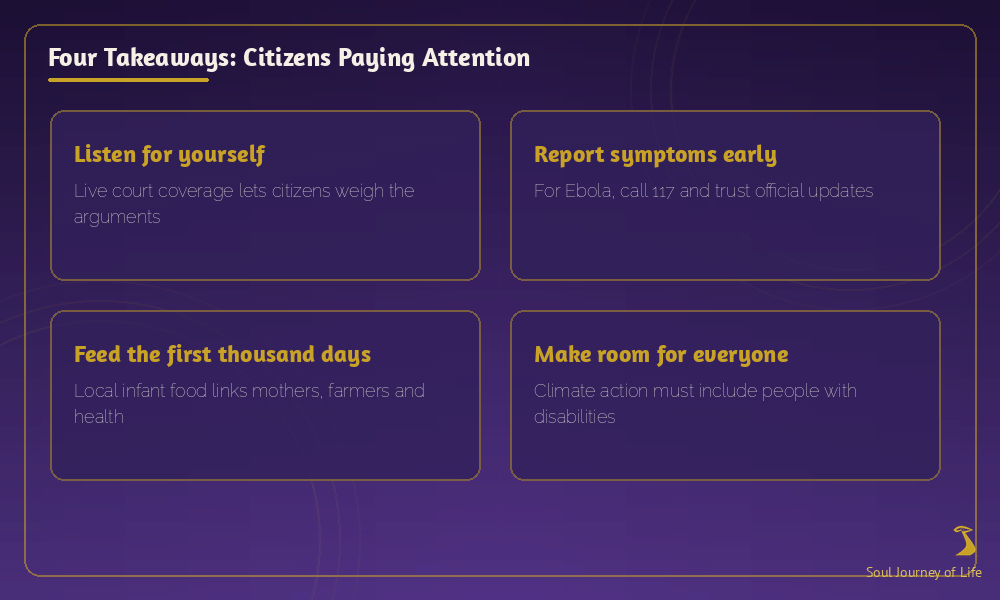
- Listen for yourself. When a court opens its doors to radio, citizens can judge the arguments, not the rumours.
- Keep the focus on the questions. Courts serve citizens best when bench and bar treat each other with respect.
- Report symptoms early. For Ebola, the number is 117, and calm, accurate information saves lives.
- Feed the first thousand days. Locally made infant food links mothers, farmers and children’s health.
- Make room for every young person. Climate action that leaves out people with disabilities leaves the work unfinished.
Sierra Leone’s strength this week was not in any single headline. It was in people paying attention, together.
Soul Journey of Life — Write About It
Sources
- Sierra Leone Monitor: https://www.sierraleonemonitor.com/judiciary-broadcast-court-constitutional-amendment/
- Sierra Leone Monitor: https://www.sierraleonemonitor.com/jfk-chief-justice-constitutional-amendment/
- Sierraloaded: https://sierraloaded.sl/news/jfk-pademba-road-prison-court-appearance/
- Truth Media: https://truthmedia.sl/general-legal-council-criticises-jfks-conduct-urges-supreme-court-to-reconsider-his-custodial-sentence/
- Sierra Leone Monitor: https://www.sierraleonemonitor.com/lawyers-society-demands-release-jfk/
- A-Z Newspaper: https://a-zsl.com/sierra-leone-tightens-ebola-surveillance/
- Sierra Leone Monitor: https://www.sierraleonemonitor.com/u-s-invests-million-sierra-leone/
- This Day: https://thisdaysl.com/wfp-and-government-break-ground-on-infant-food-factory-in-makeni/
- Truth Media: https://truthmedia.sl/mayor-aki-sawyerr-urges-youth-to-champion-inclusive-climate-action/
- Sierraloaded: https://sierraloaded.sl/news/government-lecturers-strike-unlawful-return/










You must be logged in to post a comment.